


Association between pubic hair grooming and prevalent sexually transmitted infection among female university students
- PMID: 31483828
- PMCID: PMC6726136
- DOI: 10.1371/journal.pone.0221303
Association between pubic hair grooming and prevalent sexually transmitted infection among female university students
Abstract
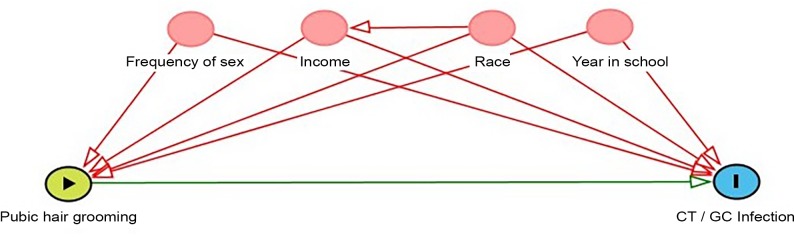
Recent findings have suggested an association between pubic hair grooming and self-reported history of sexually transmitted infection (STI), specifically gonococcal infection (GC), chlamydial infection (CT), or human immunodeficiency virus (HIV). We evaluated the association between self-reported extreme grooming and laboratory-confirmed prevalence of GC/CT. Between April 2017 and April 2018, we enrolled English-speaking, adult, female students at a large, Midwestern university who presented on-campus for STI testing. Participants completed a questionnaire on demographics and sexual and grooming behaviors, which was linked to their GC/CT test results based on nucleic acid amplification testing. We defined extreme grooming as removal of all pubic hair either at least weekly in the past 12 months or ≥6 times in the past 30 days. We used two separate logistic regression models to determine whether odds of GC/CT varied by extreme groomer status for either time interval. In the study sample of 214 women, prevalence of GC/CT was 9.8%. Nearly all participants (98.1%) reported ever grooming; 53.6% were extreme groomers in the past year and 18% in the past month. Extreme grooming was not associated with prevalent GC/CT in the past year (odds ratio [OR] = 0.8; 95% confidence interval [CI]: 0.3-1.9; adjusted OR = 0.7; 95% CI: 0.3-2.0) or in the past month (OR = 0.5; 95% CI: 0.1-2.0; aOR = 0.4; 95% CI: 0.1-1.9). Pubic hair grooming was common among female university students attending for STI testing. Findings do not support pubic hair grooming as an STI risk factor in this population.
Conflict of interest statement
The authors have declared that no competing interests exist.
Figures
References
-
- Barton J, Braxton J, Davis DW, de Voux A, Flagg EW, Grier L, et al. Sexually transmitted disease surveillance 2015. Atlanta: National Center for HIV/AIDS VH, STD, and TB Prevention, Division of STD Prevention; 2016.
-
- Centers for Disease Control and Prevention. Sexually Transmitted Disease Surveillance 2017. Atlanta: U.S. Department of Health and Human Services; 2018.
Publication types
MeSH terms
Grants and funding
LinkOut - more resources
Full Text Sources
Medical
Miscellaneous
