Review
. 2019 Sep 4;12(1):90.
doi: 10.1186/s13045-019-0776-8.

CircRNAs in cancer metabolism: a review

Affiliations
Review

CircRNAs in cancer metabolism: a review

Tao Yu et al. J Hematol Oncol. .

Abstract

Altered energy metabolism is a hallmark of tumors aiming at supplying necessary nutrients for tumorigenesis and development. These redirected metabolic pathways associated with carbohydrate, lipid and amino acid are orchestrated not only by carcinogenic proteins but by non-coding RNAs. Among them, circular RNA (circRNA), as a kind of novel identified non-coding RNAs, has become the focus of attention. Through binding with corresponding microRNAs or directly contacting proteins, circRNA plays a primarily important role in regulating cellular metabolism. Herein, we analyze the emerging findings and select circRNAs contributing to mutant glycolysis, lipogenesis and lipolysis, glutam inolysis, and oxidative respiration to deepen the understanding about the cancer metabolic regulatory network. In addition, we also discuss the possibility of circRNAs exerting their functions via exosomes and cancer stem cells. Owing to their unique structures and wide impacts, circRNAs may help reap huge fruits in developing clinical treatments targeting cancer metabolism.

Keywords: Cancer metabolism; CircRNAs; Glutamine; Lipid metabolism; ROS; Warburg effect.


Conflict of interest statement

The authors declare that they have no competing interests.

Figures
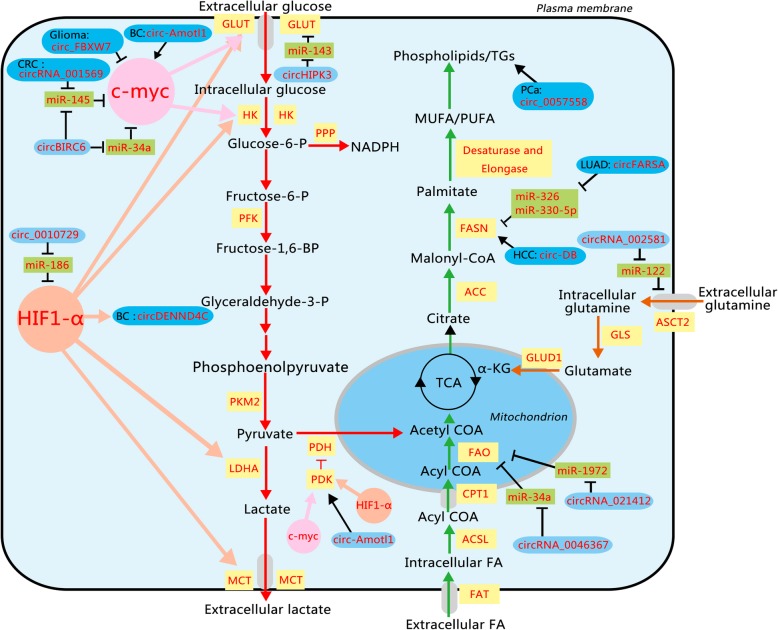
Fig. 1.
Fig. 1.
Schematic representation of altered metabolic pathways and associated circRNAs in cancer. The characteristic features include two aspects. First, it illustrates deregulated uptake of glucose and amino acids, overactive fatty acid synthesis and oxidation, and NADPH overproduction. Second, it shows how circRNAs interact with these metabolic pathways by enzymes and TFs. HIF1-α and c-myc can adjust the Warburg effect-relevant enzymes and transporters. The majority of circRNAs can antagonize miRNAs to indirectly produce effects. In addition, circ-Amotl1 and circ_FBXW7 can directly affect TFs. The circRNAs in the dark blue rounded rectangle are considered to function in cancer cells, while the circRNAs in the light blue rounded rectangle are just proved to function in normal cells. miRNAs are in the green rectangle; the components affecting metabolism are in faint yellow rectangle. The positive relationships are shown by arrows, and the negative relationships are shown by short dashes. ACC, acetyl-COA carboxylase; ACSL, acyl-CoA synthetases; ASCT2, neutral amino acid transporter2; BC, breast cancer; CPT1, carnitine palmitoyltransferase 1; CRC, colorectal cancer; FAO, fatty acids β-oxidation; FASN, fatty acid synthase; FAT, fatty acid translocase; GLS, glutaminase; GLUD1, glutamate dehydrogenase; GLUT, glutamate dehydrogenase; HCC, hepatocellular carcinoma; HK, hexokinase; LDHA, lactate dehydrogenase A; LUAD, lung adenocarcinoma; MCT. monocarboxylate transporter; PCa, prostate cancer; PDH, pyruvate dehydrogenase; PDK, pyruvate dehydrogenase kinase; PFK, 6-phosphfructa-1-kinase; PKM2, Pyruvate kinase isozymes M2; PPP, pentose phosphate pathway; α-KG, α-ketoglutarate. (Red lines, catabolic pathways; orange lines, glutamine pathways; green lines, lipid pathways)
Fig. 2
Fig. 2
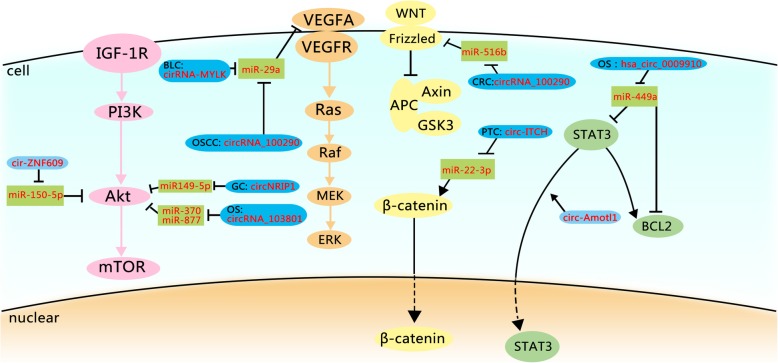
circRNAs and the Warburg effect associated signaling pathways. This figure indicates the effects of circRNAs on the Warburg effect-associated signaling pathways. The PI3K/Akt pathway promotes GLUT1, HK2, and PFK2. The alteration of RAS pathway upregulates GLUT1 and glycolytic enzymes. The STAT3 pathway gives rise to HK2. And the Wnt/β-catenin pathway upregulates the transcription of MCT1 and PDK1. In these four pathways, most circRNAs work as ceRNAs to affect the Warburg effect. The circRNAs in the dark blue rounded rectangle are considered to function in cancer cells, while the circRNAs in the light blue rounded rectangle are just proved to function in normal cells. miRNAs are in the green rectangle; the components of the PI3K/Akt pathway are in the pink circle; the components of the RAS pathway are in the orange circle; the components of the STAT3 pathway are in the green circle; the components of the Wnt/β-catenin pathway are in the yellow circle. The positive relationships are shown by arrows, and the negative relationships are shown by short dashes. BLC, bladder cancer; CRC, colorectal cancer; GC, gastric cancer; OS, osteosarcoma; OSCC, oral squamous cell carcinoma ; PTC, papillary thyroid cancer

References

    1. Hanahan D, Weinberg RA. Hallmarks of cancer: the next generation. Cell. 2011;144(5):646–674. doi: 10.1016/j.cell.2011.02.013. - DOI - PubMed
    1. Pavlova NN, Thompson CB. The emerging hallmarks of cancer metabolism. Cell Metab. 2016;23(1):27–47. doi: 10.1016/j.cmet.2015.12.006. - DOI - PMC - PubMed
    1. Chan Brian, Manley Jacob, Lee Jae, Singh Shree Ram. The emerging roles of microRNAs in cancer metabolism. Cancer Letters. 2015;356(2):301–308. doi: 10.1016/j.canlet.2014.10.011. - DOI - PubMed
    1. Xiao ZD, Zhuang L, Gan B. Long non-coding RNAs in cancer metabolism. Bioessays. 2016;38(10):991–996. doi: 10.1002/bies.201600110. - DOI - PMC - PubMed
    1. Jeck WR, Sharpless NE. Detecting and characterizing circular RNAs. Nat Biotechnol. 2014;32(5):453–461. doi: 10.1038/nbt.2890. - DOI - PMC - PubMed

Publication types

LinkOut - more resources