


Onset of clinical and MRI efficacy of ocrelizumab in relapsing multiple sclerosis
- PMID: 31484710
- PMCID: PMC6946481
- DOI: 10.1212/WNL.0000000000008189
Onset of clinical and MRI efficacy of ocrelizumab in relapsing multiple sclerosis
Abstract
Objective: To assess the onset of ocrelizumab efficacy on brain MRI measures of disease activity in the phase II study in relapsing-remitting multiple sclerosis (RRMS), and relapse rate in the pooled phase III studies in relapsing multiple sclerosis (RMS).
Methods: Brain MRI activity was determined in the phase II trial at monthly intervals in patients with RRMS receiving placebo, ocrelizumab (600 mg), or intramuscular interferon (IFN) β-1a (30 μg). Annualized relapse rate (ARR; over various epochs) and time to first relapse were analyzed in the pooled population of the phase III OPERA (A Study of Ocrelizumab in Comparison With Interferon Beta-1a [Rebif] in Participants With Relapsing Multiple Sclerosis) I and OPERA II trials in patients with RMS receiving ocrelizumab (600 mg) or subcutaneous IFN-β-1a (44 μg).
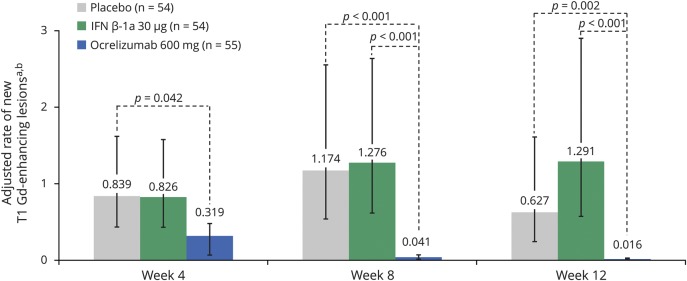
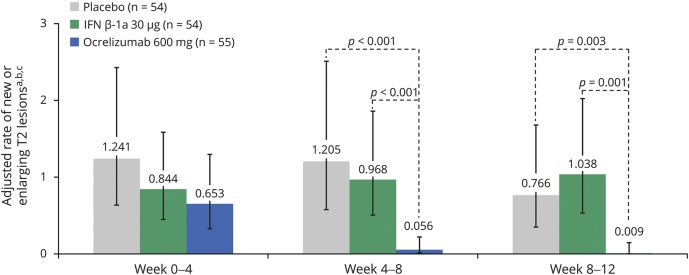
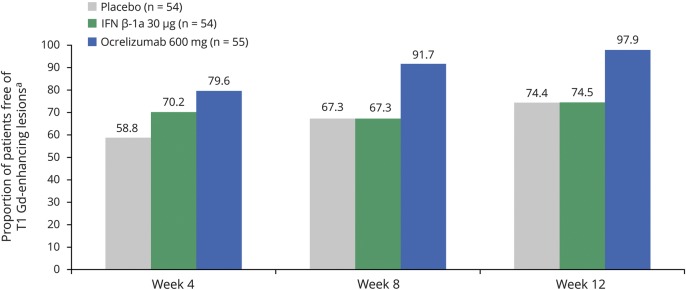
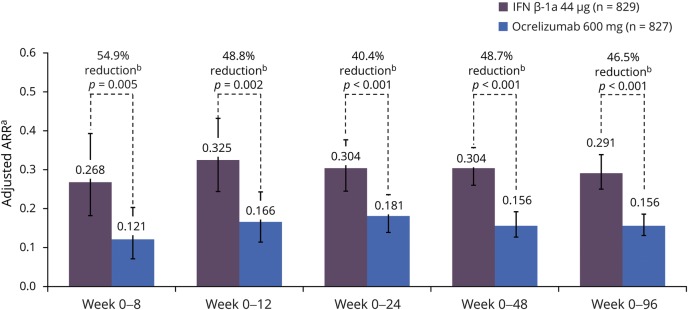
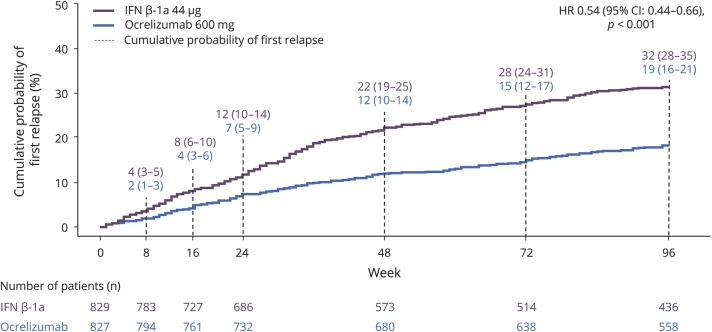
Results: In patients with RRMS, ocrelizumab reduced the number of new T1 gadolinium-enhancing lesions by week 4 vs placebo (p = 0.042) and by week 8 vs intramuscular IFN-β-1a (p < 0.001). Ocrelizumab also reduced the number of new or enlarging T2 lesions appearing between weeks 4 and 8 vs both placebo and IFN-β-1a (both p < 0.001). In patients with RMS, ocrelizumab significantly reduced ARR (p = 0.005) and the probability of time to first protocol-defined relapse (p = 0.014) vs subcutaneous IFN-β-1a within the first 8 weeks.
Conclusion: Epoch analysis of MRI-measured lesion activity in the phase II study and relapse rate in the phase III studies consistently revealed a rapid suppression of acute MRI and clinical disease activity following treatment initiation with ocrelizumab in patients with RRMS and RMS, respectively.
Classification of evidence: This study provides Class II evidence that for patients with RRMS and RMS, ocrelizumab suppressed MRI activity within 4 weeks and clinical disease activity within 8 weeks.
Copyright © 2019 The Author(s). Published by Wolters Kluwer Health, Inc. on behalf of the American Academy of Neurology.
Figures
References
-
- Calabresi PA, Kieseier BC, Arnold DL, et al. . Pegylated interferon beta-1a for relapsing-remitting multiple sclerosis (ADVANCE): a randomised, phase 3, double-blind study. Lancet Neurol 2014;13:657–665. - PubMed
-
- Kappos L, Wiendl H, Selmaj K, et al. . Daclizumab HYP versus interferon beta-1a in relapsing multiple sclerosis. N Engl J Med 2015;373:1418–1428. - PubMed
Publication types
MeSH terms
Substances
LinkOut - more resources
Full Text Sources
Other Literature Sources
Research Materials
