


Reference Intervals of Serum Non-Cholesterol Sterols by Gender in Healthy Japanese Individuals
- PMID: 31484845
- PMCID: PMC7242229
- DOI: 10.5551/jat.50187
Reference Intervals of Serum Non-Cholesterol Sterols by Gender in Healthy Japanese Individuals
Abstract
Aims: The present study was conducted to establish a practical method for measuring non-cholesterol sterols and reference intervals of serum levels.
Methods: Healthy subjects (109 men and 151 women), four patients with sitosterolemia, and 10 heterozygous mutation carriers of ABCG5/ABCG8 genes were investigated. Then, three non-cholesterol sterols (sitosterol, campesterol, and lathosterol) of fasting serum samples were measured via a practical and highly sensitive gas chromatography (GC) method with 0.2 µg/mL as the lower limit of quantification. The coefficient of variation (CV) values for within-run reproducibility were 3.06%, 1.89%, and 1.77% for lathosterol, campesterol, and sitosterol, respectively. The CV values for between-run reproducibility were 2.81%, 2.06%, and 2.10% for lathosterol, campesterol, and sitosterol, respectively.
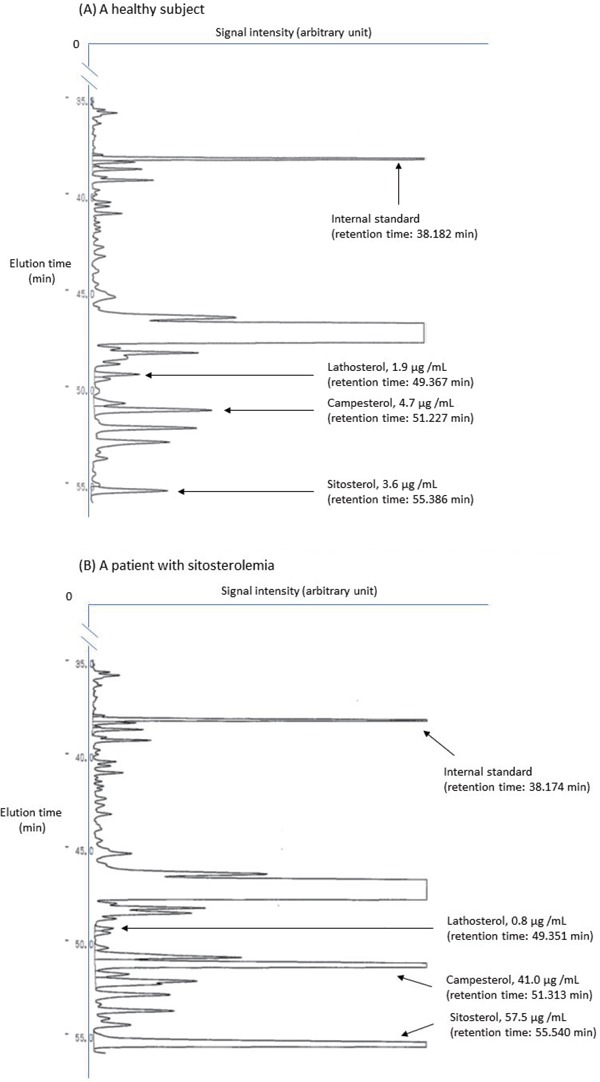
Results: The serum levels of sitosterol and campesterol were significantly higher in women than in men, whereas the serum levels of lathosterol were significantly higher in men than in women. Because of these gender difference, the determination of reference intervals of the three sterol values was performed by considering gender. The reference intervals of sitosterol, campesterol, and lathosterol were 0.99-3.88, 2.14-7.43, and 0.77-3.60 µg/mL in men and 1.03-4.45, 2.19-8.34, and 0.64-2.78 µg/mL in women, respectively. The serum levels of sitosterol and campesterol were higher in patients with sitosterolemia (94.3±47.3 and 66.3±36.6 µg/mL, respectively) than in healthy subjects.
Conclusion: These results demonstrate a practical and highly sensitive GC method to measure non-cholesterol sterol levels and gender-segregated reference intervals of sitosterol, campesterol, and lathosterol in Japanese healthy subjects.
Keywords: Gas chromatography; Non-cholesterol sterol; Reference interval; Sitosterolemia.
Conflict of interest statement
None had conflict of interest to be disclosed in terms of the present study.
Figures
References
-
- Berge KE, Tian H, Graf GA, Yu L, Grishin NV, Schultz J, Kwiterovich P, Shan B, Barnes R, Hobbs HH. Accumulation of dietary cholesterol in sitosterolemia caused by mutations in adjacent ABC transporters. Science, 2000; 290: 1771-1775 - PubMed
-
- Lek M, Karczewski KJ, Minikel EV, Samocha KE, Banks E, Fennell T, O'Donnell-Luria AH, Ware JS, Hill AJ, Cummings BB, Tukiainen T, Birnbaum DP, Kosmicki JA, Duncan LE, Estrada K, Zhao F, Zou J, Pierce-Hoffman E, Berghout J, Cooper DN, Deflaux N, DePristo M, Do R, Flannick J, Fromer M, Gauthier L, Goldstein J, Gupta N, Howrigan D, Kiezun A, Kurki MI, Moonshine AL, Natarajan P, Orozco L, Peloso GM, Poplin R, Rivas MA, Ruano-Rubio V, Rose SA, Ruderfer DM, Shakir K, Stenson PD, Stevens C, Thomas BP, Tiao G, Tusie-Luna MT, Weisburd B, Won HH, Yu D, Altshuler DM, Ardissino D, Boehnke M, Danesh J, Donnelly S, Elosua R, Florez JC, Gabriel SB, Getz G, Glatt SJ, Hultman CM, Kathiresan S, Laakso M, McCarroll S, McCarthy MI, McGovern D, McPherson R, Neale BM, Palotie A, Purcell SM, Saleheen D, Scharf JM, Sklar P, Sullivan PF, Tuomilehto J, Tsuang MT, Watkins HC, Wilson JG, Daly MJ, MacArthur DG;, Exome Aggregation Consortium Analysis of protein-coding genetic variation in 60,706 humans. Nature, 2016; 536 (7616): 285-291 - PMC - PubMed
