. 2019 Aug 14:2019:8918914.
doi: 10.1155/2019/8918914. eCollection 2019.

Sargassum fusiforme Fucoidan SP2 Extends the Lifespan of Drosophila melanogaster by Upregulating the Nrf2-Mediated Antioxidant Signaling Pathway

Affiliations

Sargassum fusiforme Fucoidan SP2 Extends the Lifespan of Drosophila melanogaster by Upregulating the Nrf2-Mediated Antioxidant Signaling Pathway

Ya Zhang et al. Oxid Med Cell Longev. .

Abstract

Damage accumulated in the genome and macromolecules is largely attributed to increased oxidative damage and a lack of damage repair in a cell, and this can eventually trigger the process of aging. Alleviating the extent of oxidative damage is therefore considered as a potential way to promote longevity. SFPS, a heteropolysaccharide extracted from the brown alga Sargassum fusiforme, has previously been shown to alleviate oxidative damage during the aging process in mice, but whether SFPS could extend the lifespan of an organism was not demonstrated. Furthermore, the precise component within SFPS that is responsible for the antioxidant activity and the underlying mechanism of such activity was also not resolved. In this study, SP2, a fucoidan derived from SFPS, was shown to exhibit strong antioxidant activity as measured by in vitro radical-scavenging assays. SP2 also improved the survival rate of D. melanogaster subjected to oxidative stress. The flies that were fed with a diet containing SP2 from the time of eclosion displayed significant enhancement in lifespan and reduced accumulation of triglyceride at the old-age stage. In addition, SP2 markedly improved the activities of the antioxidant enzymes, superoxide dismutase (SOD), catalase (CAT), and glutathione peroxidase (GSH-Px) and reduced the contents of the malondialdehyde (MDA) and oxidized glutathione (GSSG) in old flies. Furthermore, SP2 also upregulated the expression levels of the nuclear factor-erythroid-2-like 2 (nfe2l2 or nrf2) and its downstream target genes, accompanied by a dramatic reduction in the expression of kelch-like ECH-associated protein 1 (keap1, a canonical inhibitor of the Nrf2) in old flies. Additional support linking the crucial role of the Nrf2/ARE pathway to the antioxidant effect of SP2 was the relatively high survival rate under heat stress for D. melanogaster individuals receiving SP2 supplement, an effect that was abolished by the inclusion of inhibitors specific for the Nrf2/ARE pathway. Collectively, the results indicated that SP2, a S. fusiforme fucoidan, could promote longevity in D. melanogaster by enhancing the Nrf2-mediated antioxidant signaling pathway during the aging process.


Conflict of interest statement

The authors declare that there are no conflicts of interest regarding the publication of this paper.

Figures
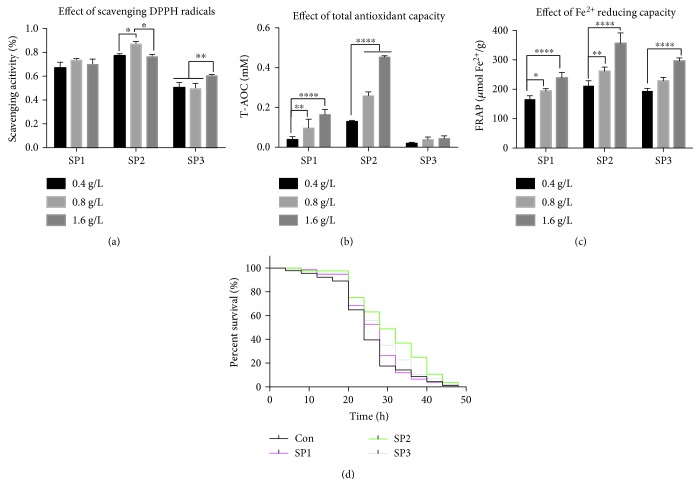
Figure 1
Figure 1
Antioxidant capacity of the different polysaccharides fractionated from SFPS. Antioxidant activity of the polysaccharides was assayed in three different cell-free systems. (a) DPPH-scavenging activity, (b) ABTS-scavenging activity, and (c) radical-scavenging activities and Fe2+ reducing. Data are shown as mean ± SD from three determinations. “,” “∗∗,” and “∗∗∗∗” indicate a significant difference at the P < 0.05, P < 0.01, and P < 0.0001 levels, respectively. (d) Fruit flies were randomly collected (100 flies/group) and reared on basal medium without (control group) or with 1.6 g/L of SP1, SP2, or SP3 for 10 days. Subsequently, the in vivo oxidative resistant capacity was evaluated by determining the survival rate of the flies following exposure to oxidative stress induced by 5 mmol/L paraquat, given as a diet.
Figure 2
Figure 2
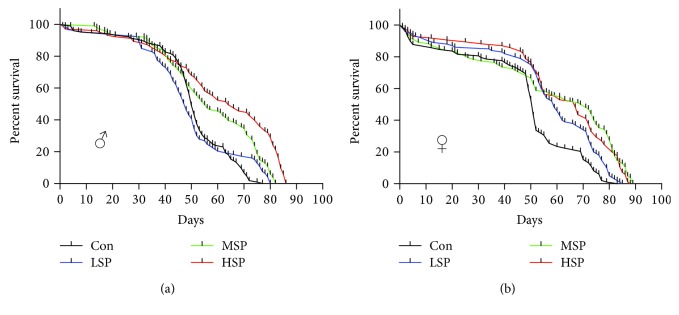
SP2 extends the lifespan of D. melanogaster. Male (a) and female (b) fruit flies were reared on medium containing no SP2 (Con) or different concentrations of SP2 (0.4 g/L (LSP), 0.8 g/L (MSP), and 1.6 g/L (HSP)); the number of dead flies from each group was counted daily; n > 250 flies.
Figure 3
Figure 3
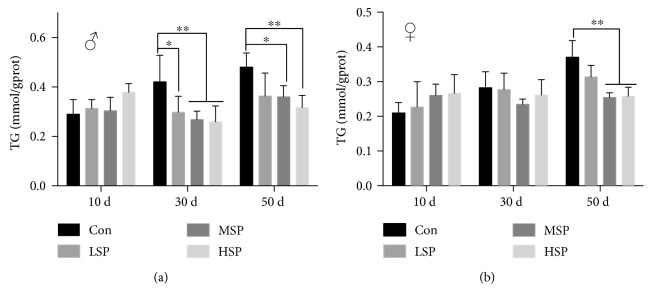
SP2 decreases the accumulation of triglyceride (TG) in D. melanogaster during the aging process. The flies were supplemented with varied concentrations of SP2 (0 (Con), 0.4 g/L (LSP), 0.8 g/L (MSP), and 1.6 g/L (HSP), and the contents of soluble TG in the male (a) and female (b) flies of different ages were then measured. Data are shown as the mean ± SD from three determinations, each used the extract obtained from 25 flies. “” and “∗∗” indicate a significant difference at the P < 0.05 and P < 0.01 levels, respectively.
Figure 4
Figure 4
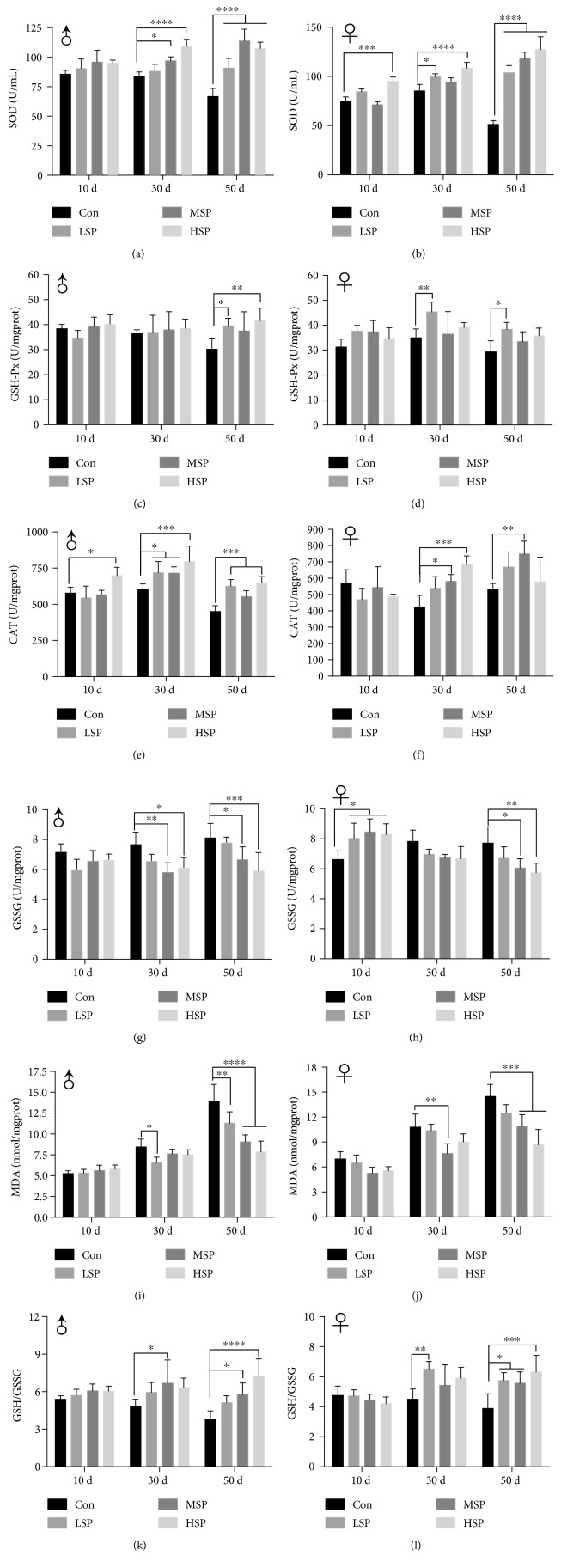
SP2-supplemented diet slows down the decline in the antioxidant capacity of D. melanogaster during the aging process. The fruit flies were reared on a medium containing no SP2 (Con) or different concentrations of SP2 (0.4 g/L (LSP), 0.8 g/L (MSP), and 1.6 g/L (HSP)), and their antioxidant capacity was analyzed at different ages. SOD activity (a, b); GSH-Px level (c, d); CAT activity (e, f); CSSG content (g, h); MDA content (i, j), and GSH/GSSG (k, l). The antioxidant capacity was determined for both male flies (a, d, e, g, i, and k) and female flies (b, d, f, h, j, and l). Data are shown as mean ± SD from three determinations, each used the extract obtained from 25 flies. “,” “∗∗,” and “∗∗∗” indicate a significant difference at the P < 0.05, P < 0.01, and P < 0.001 levels, respectively.
Figure 5
Figure 5
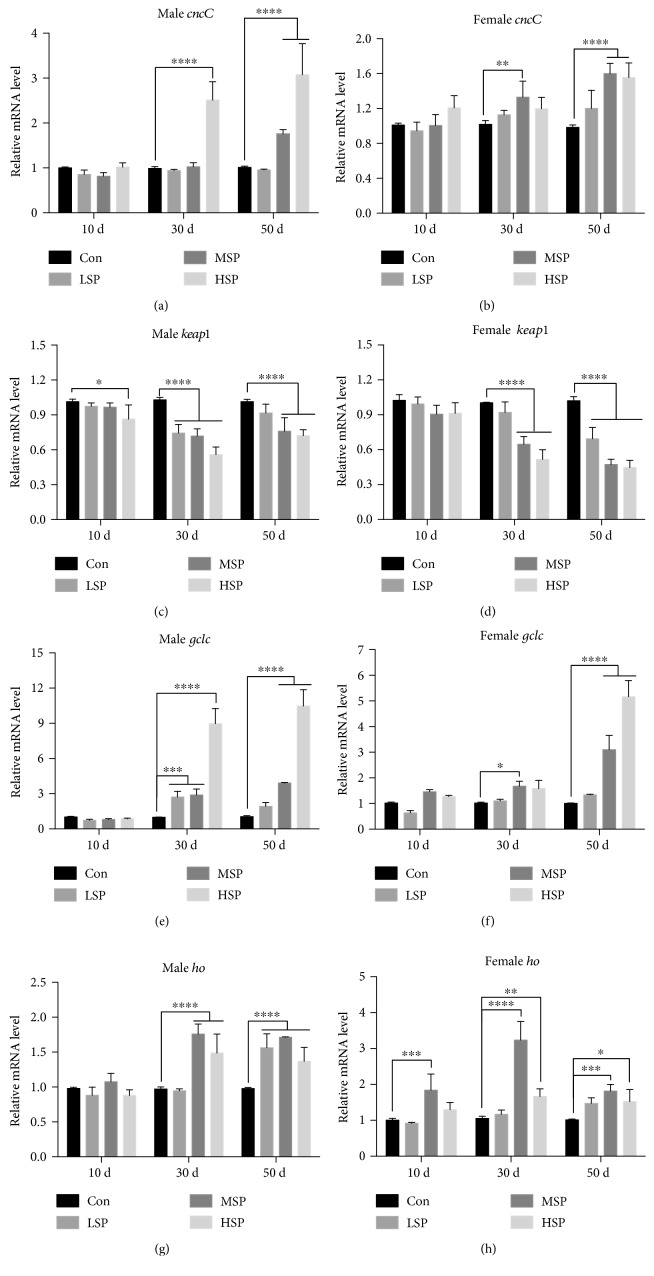
SP2 supplement upregulates the Keap1/CncC/ARE signaling pathway in aging flies. Fruit flies were reared on basal medium containing no SP2 (Con) or different concentrations of SP2 (0.4 g/L (LSP), 0.8 g/L (MSP), and 1.6 g/L (HSP)) over 50 days. The flies were taken at different time intervals, and the mRNA levels of the representative genes (cncC, keap1, gclc, and ho) of the Keap1/CncC/ARE signaling pathway were measured by qRT-PCR using the rp49 gene as the reference gene. (a, b) cncC, (c, d) keap1, (e, f) gclc, and (g, h) ho. The expression levels of the genes were evaluated by the ΔΔCt method and normalized to those of the corresponding control. Data are shown as mean ± SD from three determinations, each used the RNA extracted from 15 flies. “,” “∗∗,” and “∗∗∗” indicate a significant difference at the P < 0.05, P < 0.01, and P < 0.001 levels, respectively.
Figure 6
Figure 6
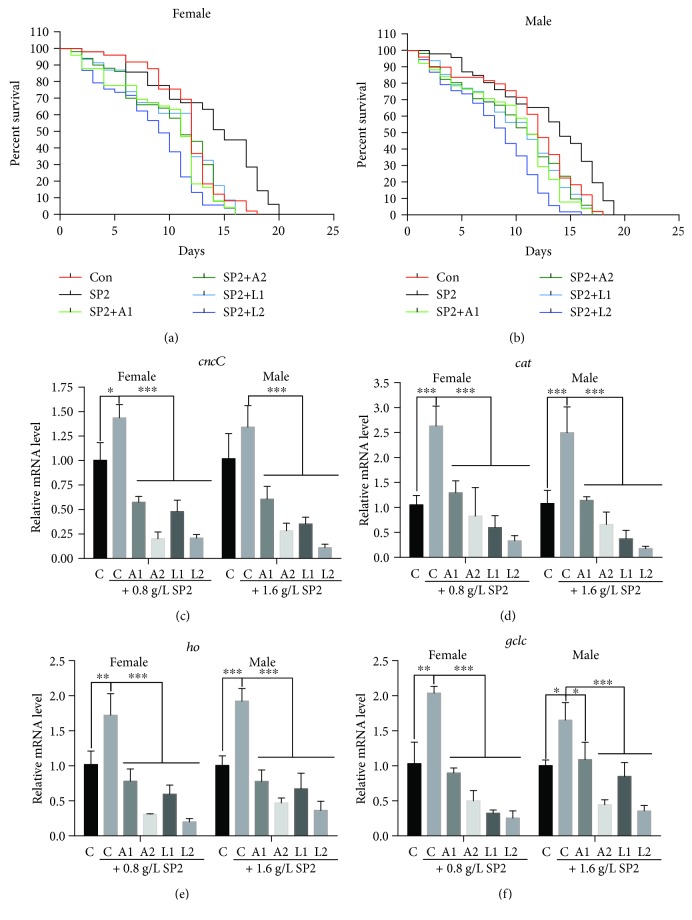
SP2-mediated stress-resistant effect in fruit flies is dependent on the CncC/Nrf2/ARE signaling. Fruit flies were reared on medium containing no SP2 (Con) or different concentrations of SP2 (0.4 g/L (LSP), 0.8 g/L (MSP), and 1.6 g/L (HSP)) without and with all-trans-retinoic-acid (A1, 0.125 g/L; A2, 0.25 g/L) or luteolin (L1, 15 μmol/L; L2, 30 μmol/L), and the survival rates of the flies were determined. (a) Survival rate of male flies; (b) survival rate of female flies. In addition, samples of the flies were also taken after 10 days of treatment, and the transcript levels of cncC (c), cat (d), ho (e), and gclc (f) were then measured by qRT-PCR using the rp49 gene as a reference gene. The expression levels of the genes were evaluated by the ΔΔCt method, and then normalized to those of the corresponding control. Data are shown as mean ± SD from three determinations, each used the RNA extracted from 15 flies. “,” “∗∗,” and “∗∗∗” indicate a significant difference at the P < 0.05, P < 0.01, and P < 0.001 levels, respectively.
Figure 7
Figure 7
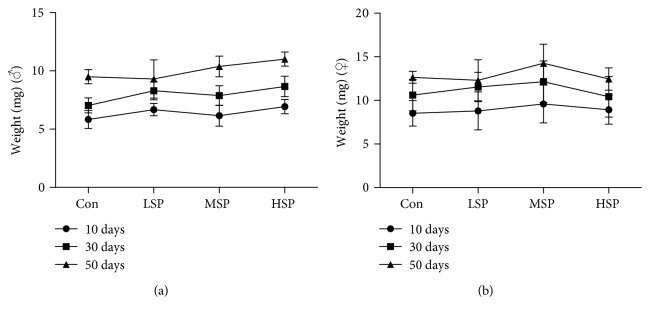
Effect of SP2 on D. melanogaster body weight. Body weights of male (a) and female (b) flies at different ages and reared on medium without (Con) or with different concentrations of SP2: LSP (0.4 g/L), MSP (0.8 g/L), and HSP (1.6 g/L). Data are shown as mean ± SD from three determinations, each based on 10 flies.

References

    1. Sohal R. S., Orr W. C. The redox stress hypothesis of aging. Free Radical Biology & Medicine. 2012;52(3):539–555. doi: 10.1016/j.freeradbiomed.2011.10.445. - DOI - PMC - PubMed
    1. Hernandez-Segura A., Nehme J., Demaria M. Hallmarks of cellular senescence. Trends in Cell Biology. 2018;28(6):436–453. doi: 10.1016/j.tcb.2018.02.001. - DOI - PubMed
    1. López-Otín C., Blasco M. A., Partridge L., Serrano M., Kroemer G. The hallmarks of aging. Cell. 2013;153(6):1194–1217. doi: 10.1016/j.cell.2013.05.039. - DOI - PMC - PubMed
    1. Finkel T., Holbrook N. J. Oxidants, oxidative stress and the biology of ageing. Nature. 2000;408(6809):239–247. doi: 10.1038/35041687. - DOI - PubMed
    1. Harman D. Free radical theory of aging: an update: increasing the functional life span. Annals of the New York Academy of Sciences. 2006;1067(1):10–21. doi: 10.1196/annals.1354.003. - DOI - PubMed

LinkOut - more resources