


A Practical Guideline for Hepatocellular Carcinoma Screening in Patients at Risk
- PMID: 31485568
- PMCID: PMC6713857
- DOI: 10.1016/j.mayocpiqo.2019.04.005
A Practical Guideline for Hepatocellular Carcinoma Screening in Patients at Risk
Abstract
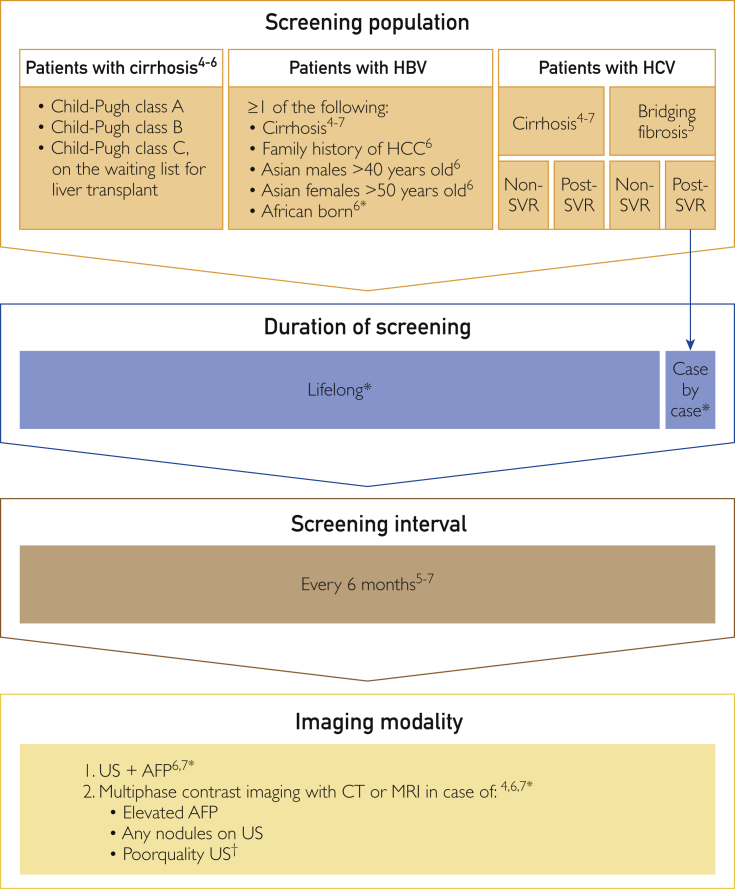
Hepatocellular carcinoma (HCC) arises in the context of cirrhosis and chronic hepatitis B virus (HBV) infections, and the diagnosis is often made at advanced stages. Because early-stage diagnosis improves survival, guidelines recommend screening patients at risk for HCC, such as patients with cirrhosis. However, adherence to screening programs is suboptimal. In this review, we discuss the value of HCC screening and provide practical guidance on patient selection and screening methods. International guidelines concordantly recommend HCC screening in patients with cirrhosis, including patients with HBV infections, hepatitis C virus infections with or without sustained virologic response, and nonalcoholic fatty liver disease. There is no consensus on screening patients without cirrhosis, although patients with advanced fibrosis, HBV infections, or nonalcoholic fatty liver disease without cirrhosis have an increased risk for development of HCC. Screening for HCC improves early tumor detection, receipt of curative treatment, and overall survival in at-risk patients. However, potential harms of HCC screening have not been well quantified. Semiannual abdominal ultrasonography is the screening modality of choice. Using ultrasonography in combination with biomarkers, such as α-fetoprotein, may increase accuracy for early HCC detection. The use of magnetic resonance imaging and computed tomography is limited by cost-effectiveness and practical considerations. Increased awareness of HCC screening will allow for earlier diagnosis and potentially curative treatment. We propose a comprehensive screening algorithm for patients at risk for development of HCC, recommending lifelong, semiannual ultrasonography combined with α-fetoprotein testing in patients with cirrhosis and selected patients without cirrhosis.
Keywords: AFP, α-fetoprotein; CT, computed tomography; HBV, hepatitis B virus; HCC, hepatocellular carcinoma; HCV, hepatitis C virus; MRI, magnetic resonance imaging; NAFLD, nonalcoholic fatty liver disease; NASH, nonalcoholic steatohepatitis; RCT, randomized controlled trial; SVR, sustained viral response.
Figures
References
-
- Ervik M., Lam F., Ferlay J., et al. 2016. Cancer Today. Lyon, France: International Agency for Research on Cancer. International Agency for Research on Cancer website. http://gco.iarc.fr/today Published 2016. Accessed February 23, 2018.
-
- Chang M.H., You S.L., Chen C.J., et al. Taiwan Hepatoma Study Group Decreased incidence of hepatocellular carcinoma in hepatitis B vaccinees: a 20-year follow-up study. J Natl Cancer Inst. 2009;101(19):1348–1355. - PubMed
-
- Heimbach J.K., Kulik L.M., Finn R., et al. AASLD guidelines for the treatment of hepatocellular carcinoma. Hepatology. 2018;67(1):358–380. - PubMed
-
- European Association for the Study of the Liver EASL clinical practice guidelines: management of hepatocellular carcinoma [published correction appears in J Hepatol. 2019;70(4):817] J Hepatol. 2018;69(1):182–236. - PubMed
LinkOut - more resources
Full Text Sources
Other Literature Sources
