


The Buffalo Concussion Bike Test for Concussion Assessment in Adolescents
- PMID: 31486715
- PMCID: PMC6822206
- DOI: 10.1177/1941738119870189
The Buffalo Concussion Bike Test for Concussion Assessment in Adolescents
Abstract
Background: The Buffalo Concussion Treadmill Test (BCTT) is a graded exertion test for assessing exercise tolerance after concussion, but its utility is limited for certain populations.
Hypothesis: We developed the Buffalo Concussion Bike Test (BCBT) and tested its comparability with the BCTT. We hypothesize that heart rate (HR) at symptom exacerbation on the BCBT will be equivalent to the BCTT.
Study design: Case-control study.
Level of evidence: Level 3.
Methods: Adolescents with acute concussion (AC) (n = 20; mean age, 15.9 ± 1.1 years; 60% male) presenting to a concussion clinic within 10 days of injury and age- and sex-matched healthy controls (n = 20; mean age, 15.9 ± 1.1 years; 60% male) performed the BCTT at first visit and returned within 3 days to perform the BCBT. Test duration, HR, symptom severity (measured using a visual analog scale), and exertion (measured using the Borg Rating of Perceived Exertion) were collected during each test.
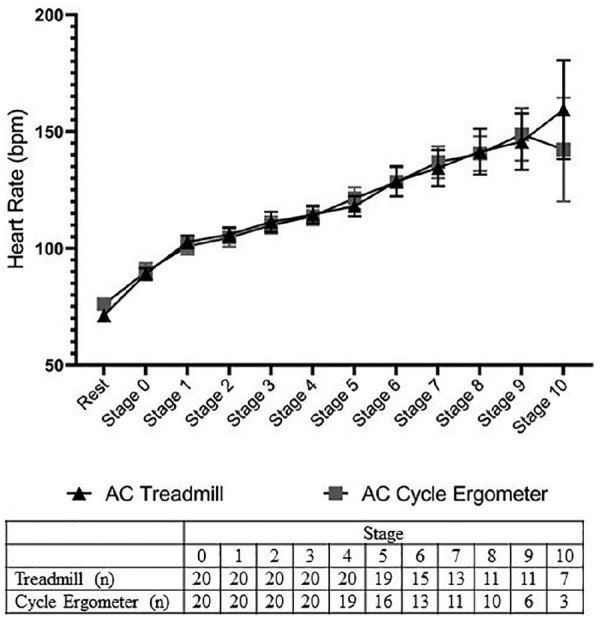
Results: Adolescents with AC who were exercise intolerant on the BCTT were also intolerant on the BCBT, with symptom exacerbation occurring at a mean 8.1 ± 2.8 minutes on the BCTT versus 14.6 ± 6.0 minutes on the BCBT (P < 0.01). Two 1-sided t tests showed that the HR at symptom exacerbation in AC patients (137 ± 28 bpm on BCTT vs 135 ± 25 bpm on BCBT; 95% CI, <0.01-0.03) and at voluntary exhaustion for controls (175 ± 13 bpm on BCTT vs 175 ± 13 bpm on BCBT; 95% CI, 0.03-0.03) on each test were statistically equivalent.
Conclusion: The HR at symptom exacerbation on BCBT is equivalent to the BCTT for the assessment of exercise tolerance after concussion in adolescents.
Clinical relevance: The BCBT can be used in patients with limited mobility or for research interventions that require limited participant motion.
Keywords: BCBT; BCTT; Buffalo Concussion Bike Test; Buffalo Concussion Treadmill Test; exercise test; sport-related concussion.
Conflict of interest statement
The authors declared the following potential conflicts of interest: The University at Buffalo received support for this study from the National Institute of Neurological Disorders and Stroke of the National Institutes of Health under award number 1R01NS094444 and from the National Center for Advancing Translational Sciences of the National Institutes of Health under award number UL1TR001412.
Figures


References
-
- Blake TA, McKay CD, Meeuwisse WH, Emery CA. The impact of concussion on cardiac autonomic function: a systematic review. Brain Inj. 2016;30:132-145. - PubMed
-
- Borg G. Borg’s Perceived Exertion and Pain Scales. Champaign, IL: Human Kinetics; 1998.
-
- Chrisman SP, Quitiquit C, Rivara FP. Qualitative study of barriers to concussive symptom reporting in high school athletics. J Adolesc Health. 2013;52:330-335.e3. - PubMed
-
- Clausen M, Pendergast DR, Willer B, Leddy J. Cerebral blood flow during treadmill exercise is a marker of physiological postconcussion syndrome in female athletes. J Head Trauma Rehabil. 2016;31:215-224. - PubMed
MeSH terms
Grants and funding
LinkOut - more resources
Full Text Sources
Medical
Research Materials
