


The potential of 1H-MRS in CNS drug development
- PMID: 31486875
- PMCID: PMC8062504
- DOI: 10.1007/s00213-019-05344-7
The potential of 1H-MRS in CNS drug development
Abstract
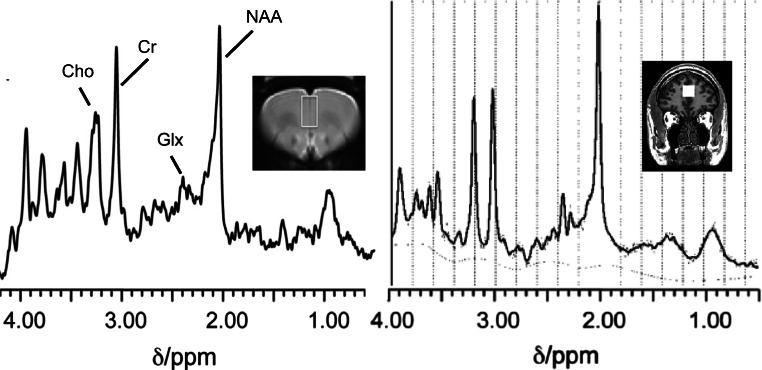
Rationale: Proton magnetic resonance spectroscopy (1H-MRS) is a cross-species neuroimaging technique that can measure concentrations of several brain metabolites, including glutamate and GABA. This non-invasive method has promise in developing centrally acting drugs, as it can be performed repeatedly within-subjects and be used to translate findings from the preclinical to clinical laboratory using the same imaging biomarker.
Objectives: This review focuses on the utility of single-voxel 1H-MRS in developing novel glutamatergic or GABAergic drugs for the treatment of psychiatric disorders and includes research performed in rodent models, healthy volunteers and patient cohorts.
Results: Overall, these studies indicate that 1H-MRS is able to detect the predicted pharmacological effects of glutamatergic or GABAergic drugs on voxel glutamate or GABA concentrations, although there is a shortage of studies examining dose-related effects. Clinical studies have applied 1H-MRS to better understand drug therapeutic mechanisms, including the glutamatergic effects of ketamine in depression and of acamprosate in alcohol dependence. There is an emerging interest in identifying patient subgroups with 'high' or 'low' brain regional 1H-MRS glutamate levels for more targeted drug development, which may require ancillary biomarkers to improve the accuracy of subgroup discrimination.
Conclusions: Considerations for future research include the sensitivity of single-voxel 1H-MRS in detecting drug effects, inter-site measurement reliability and the interpretation of drug-induced changes in 1H-MRS metabolites relative to the known pharmacological molecular mechanisms. On-going technological development, in single-voxel 1H-MRS and in related complementary techniques, will further support applications within CNS drug discovery.
Keywords: Biomarkers; Drug development; GABA; Glutamate; Magnetic resonance spectroscopy; Psychiatry.
Conflict of interest statement
The author declares that they have no conflict of interest.
Figures
References
-
- Abdallah CG, De Feyter HM, Averill LA, Jiang L, Averill CL, Chowdhury GMI, Purohit P, de Graaf RA, Esterlis I, Juchem C, Pittman BP, Krystal JH, Rothman DL, Sanacora G, Mason GF. The effects of ketamine on prefrontal glutamate neurotransmission in healthy and depressed subjects. Neuropsychopharmacology. 2018;43:2154–2160. - PMC - PubMed
-
- Ajram LA, Horder J, Mendez MA, Galanopoulos A, Brennan LP, Wichers RH, Robertson DM, Murphy CM, Zinkstok J, Ivin G, Heasman M, Meek D, Tricklebank MD, Barker GJ, Lythgoe DJ, Edden RAE, Williams SC, Murphy DGM, McAlonan GM. Shifting brain inhibitory balance and connectivity of the prefrontal cortex of adults with autism spectrum disorder. Transl Psychiatry. 2017;7:e1137. - PMC - PubMed
-
- Apsvalka D, Gadie A, Clemence M, Mullins PG. Event-related dynamics of glutamate and BOLD effects measured using functional magnetic resonance spectroscopy (fMRS) at 3T in a repetition suppression paradigm. Neuroimage. 2015;118:292–300. - PubMed
-
- Ariyannur PS, Arun P, Barry ES, Andrews-Shigaki B, Bosomtwi A, Tang H, Selwyn R, Grunberg NE, Moffett JR, Namboodiri AM. Do reductions in brain N-acetylaspartate levels contribute to the etiology of some neuropsychiatric disorders? J Neurosci Res. 2013;91:934–942. - PubMed
Publication types
MeSH terms
Substances
Grants and funding
LinkOut - more resources
Full Text Sources
