


Constituents of Household Air Pollution and Risk of Lung Cancer among Never-Smoking Women in Xuanwei and Fuyuan, China
- PMID: 31487206
- PMCID: PMC6792381
- DOI: 10.1289/EHP4913
Constituents of Household Air Pollution and Risk of Lung Cancer among Never-Smoking Women in Xuanwei and Fuyuan, China
Abstract
Background: Lung cancer rates among never-smoking women in Xuanwei and Fuyuan in China are among the highest in the world and have been attributed to the domestic use of smoky (bituminous) coal for heating and cooking. However, the key components of coal that drive lung cancer risk have not been identified.
Objectives: We aimed to investigate the relationship between lifelong exposure to the constituents of smoky coal (and other fuel types) and lung cancer.
Methods: Using a population-based case-control study of lung cancer among 1,015 never-smoking female cases and 485 controls, we examined the association between exposure to 43 household air pollutants and lung cancer. Pollutant predictions were derived from a comprehensive exposure assessment study, which included methylated polycyclic aromatic hydrocarbons (PAHs), which have never been directly evaluated in an epidemiological study of any cancer. Hierarchical clustering and penalized regression were applied in order to address high colinearity in exposure variables.
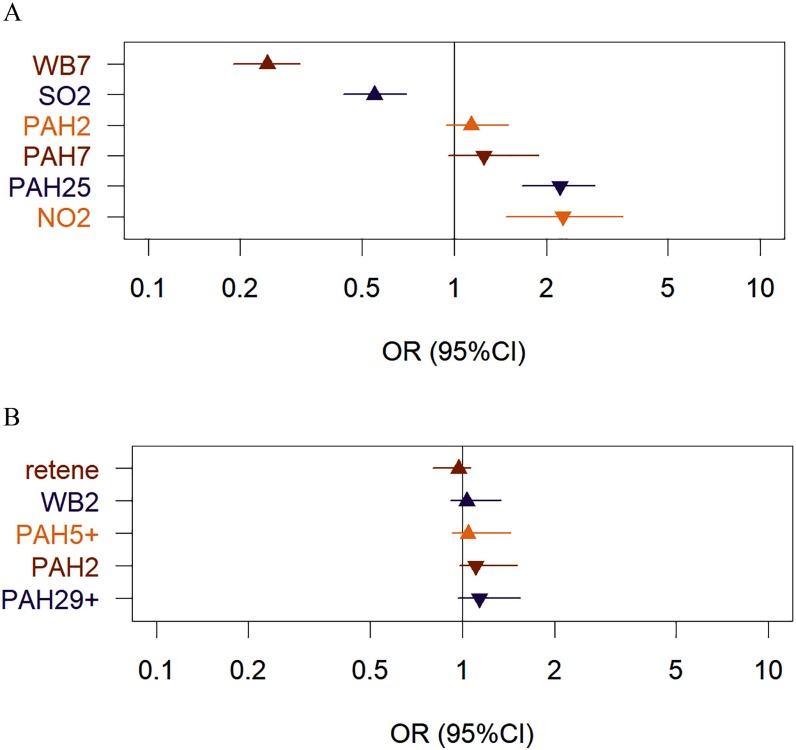
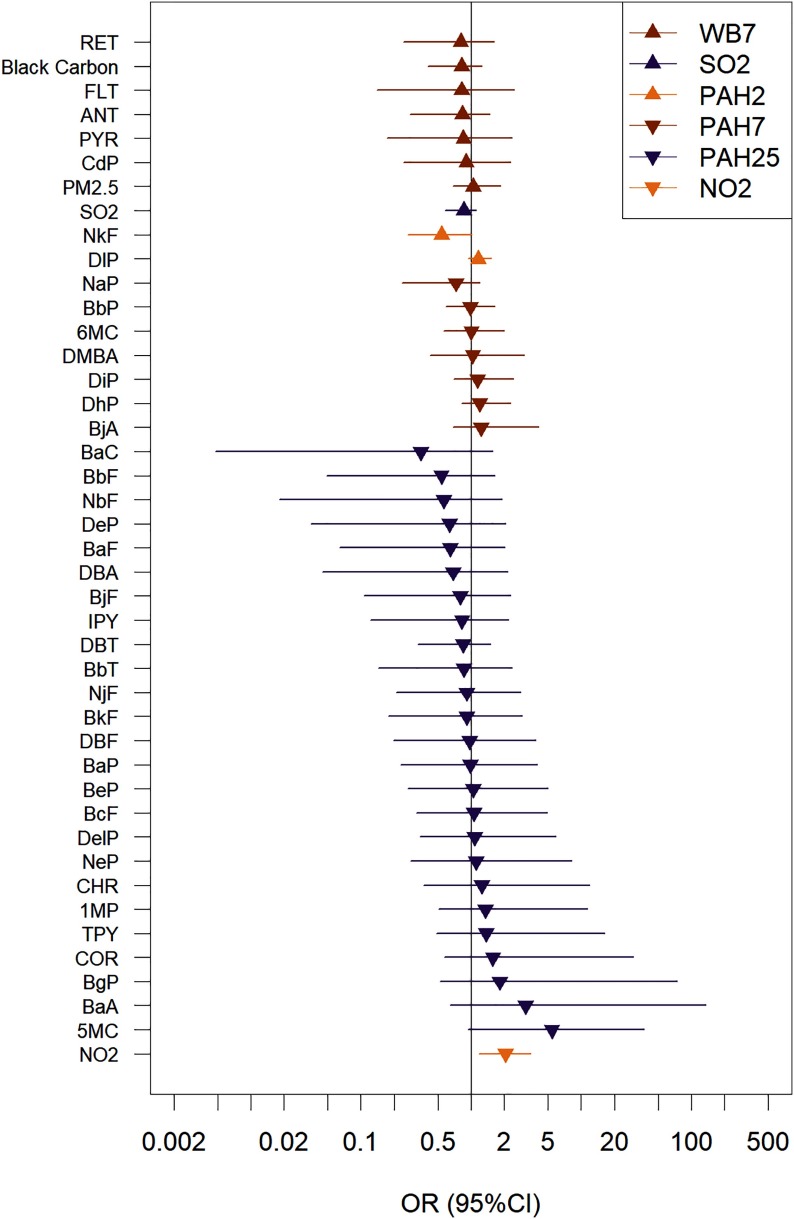
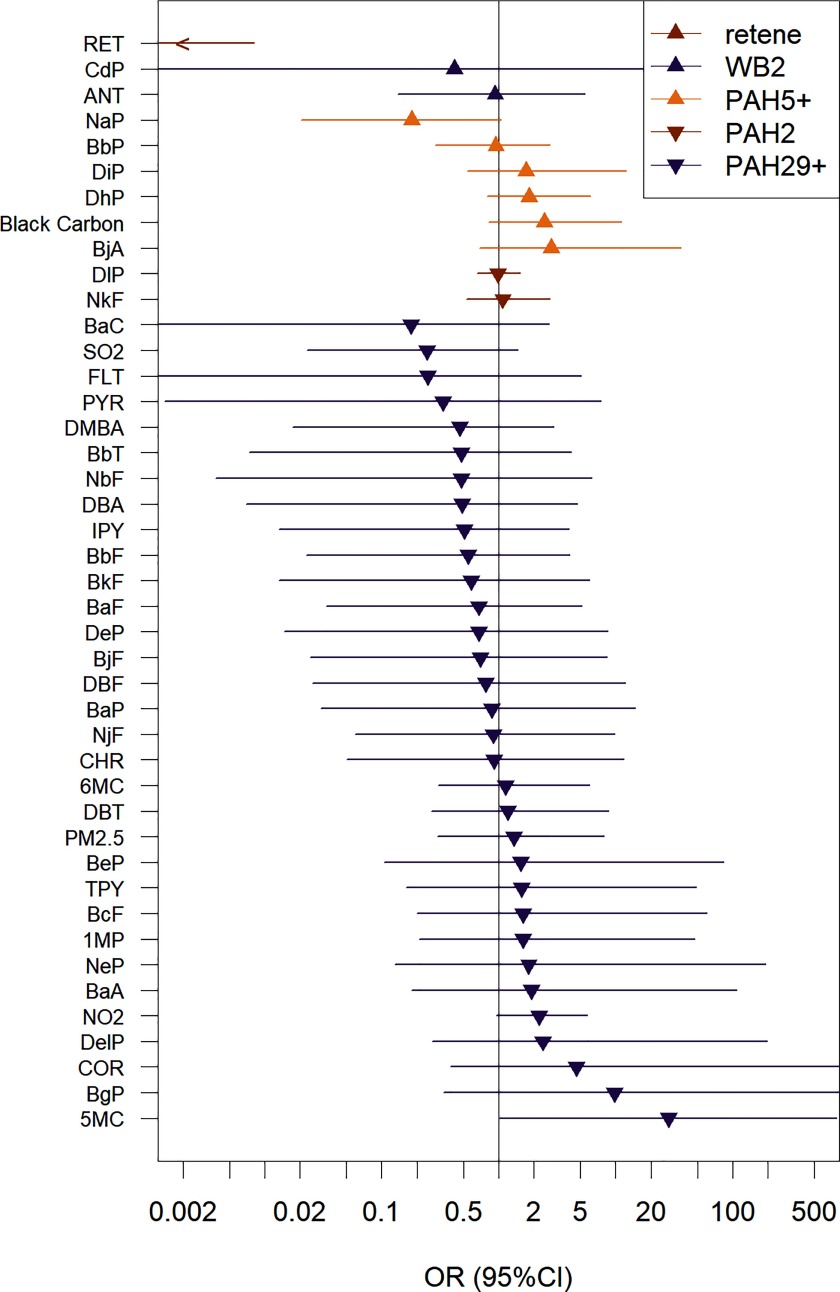
Results: The strongest association with lung cancer was for a cluster of 25 PAHs [odds ratio (OR): 2.21; 95% confidence interval (CI): 1.67, 2.87 per 1 standard deviation (SD) change], within which 5-methylchrysene (5-MC), a mutagenic and carcinogenic PAH, had the highest individual observed OR (5.42; 95% CI: 0.94, 27.5). A positive association with nitrogen dioxide ([Formula: see text]) was also observed (OR: 2.06; 95% CI: 1.19, 3.49). By contrast, neither benzo(a)pyrene (BaP) nor fine particulate matter with aerodynamic diameter [Formula: see text] ([Formula: see text]) were associated with lung cancer in the multipollutant models.
Conclusions: To our knowledge, this is the first study to comprehensively evaluate the association between lung cancer and household air pollution (HAP) constituents estimated over the entire life course. Given the global ubiquity of coal use domestically for indoor cooking and heating and commercially for electric power generation, our study suggests that more extensive monitoring of coal combustion products, including methylated PAHs, may be warranted to more accurately assess health risks and develop prevention strategies from this exposure. https://doi.org/10.1289/EHP4913.
Figures
Comment in
-
Expanded View of PAHs: Identifying Especially Harmful Constituents of Bituminous Coal Smoke.Environ Health Perspect. 2020 Apr;128(4):44001. doi: 10.1289/EHP6343. Epub 2020 Apr 16. Environ Health Perspect. 2020. PMID: 32298151 Free PMC article.
References
-
- Agier L, Portengen L, Chadeau-Hyam M, Basagaña X, Giorgis-Allemand L, Siroux V, et al. . 2016. A systematic comparison of linear regression-based statistical methods to assess exposome-health associations. Environ Health Perspect 124(12):1848–1856, PMID: 27219331, 10.1289/EHP172. - DOI - PMC - PubMed
-
- Betancourt M. 2018. A Conceptual Introduction to Hamiltonian Monte Carlo. https://arxiv.org/pdf/1701.02434.pdf, [accessed 15 December 2018].
-
- Box GEP, Cox DR. 1964. An analysis of transformations. J Roy Stat Soc B 26:211–243, 10.1111/j.2517-6161.1964.tb00553.x. - DOI
-
- Brooks SP, Gelman A. 1998. General methods for monitoring convergence of iterative simulations. J Comput Graph Stat 7(4):434–455, 10.2307/1390675. - DOI
Publication types
MeSH terms
Substances
Grants and funding
LinkOut - more resources
Full Text Sources
Medical