


Community Health Workers Improve Linkage to Hypertension Care in Western Kenya
- PMID: 31487546
- PMCID: PMC6788970
- DOI: 10.1016/j.jacc.2019.08.003
Community Health Workers Improve Linkage to Hypertension Care in Western Kenya
Abstract
Background: Elevated blood pressure (BP) is the leading global risk factor for mortality. Delay in seeking hypertension care is associated with increased mortality.
Objectives: This study investigated whether community health workers, equipped with behavioral communication strategies and smartphone technology, can increase linkage of individuals with elevated BP to a hypertension care program in western Kenya and significantly reduce BP.
Methods: The study was a cluster randomized trial with 3 arms: 1) usual care (standard training); 2) "paper-based" (tailored behavioral communication, using paper-based tools); and 3) "smartphone" (tailored behavioral communication, using smartphone technology). The co-primary outcomes were: 1) linkage to care; and 2) change in systolic BP (SBP). A covariate-adjusted mixed-effects model was used, adjusting for differential time to follow-up. Bootstrap and multiple imputation were used to handle missing data.
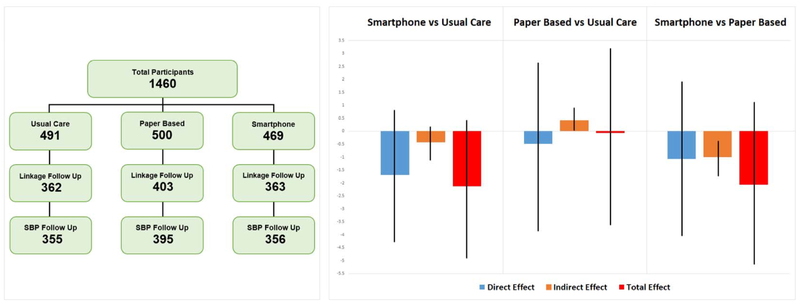
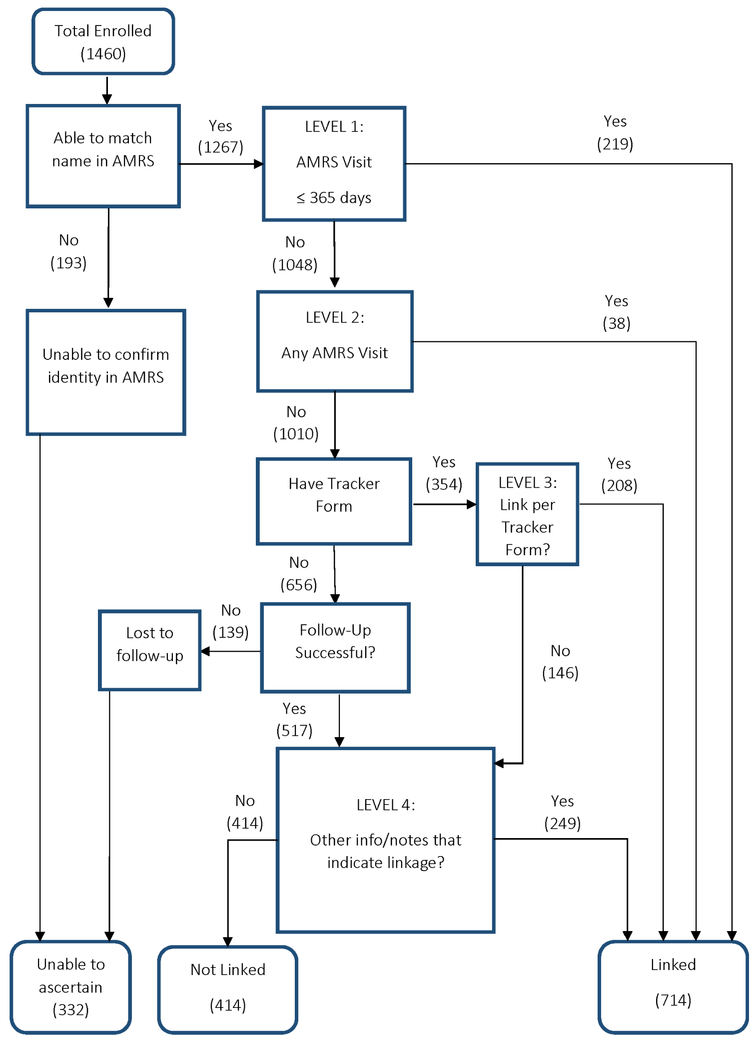
Results: A total of 1,460 individuals (58% women) were enrolled (491 usual care, 500 paper-based, 469 smartphone). Average baseline SBP was 159.4 mm Hg. Follow-up measures of linkage were available for 1,128 (77%) and BP for 1,106 (76%). Linkage to care was 49% overall, with significantly greater linkage in the usual care and smartphone arms of the trial. Average overall follow-up SBP was 149.9 mm Hg. Participants in the smartphone arm experienced a modestly greater reduction in SBP versus usual care (-13.1 mm Hg vs. -9.7 mm Hg), but this difference was not statistically significant. Mediation analysis revealed that linkage to care contributed to SBP change.
Conclusions: A strategy combining tailored behavioral communication and mobile health (mHealth) for community health workers led to improved linkage to care, but not statistically significant improvement in SBP reduction. Further innovations to improve hypertension control are needed. (Optimizing Linkage and Retention to Hypertension Care in Rural Kenya [LARK]; NCT01844596).
Keywords: Kenya; community health workers; hypertension; linkage to care; smartphone technology; tailored behavioral communication.
Copyright © 2019 American College of Cardiology Foundation. Published by Elsevier Inc. All rights reserved.
Figures
Comment in
-
Finding Hay in the Haystack.J Am Coll Cardiol. 2019 Oct 15;74(15):1907-1909. doi: 10.1016/j.jacc.2019.08.1001. J Am Coll Cardiol. 2019. PMID: 31601370 No abstract available.
References
-
- Lewington S, Clarke R, Qizilbash N, Peto R, Collins R. Age-specific relevance of usual blood pressure to vascular mortality: a meta-analysis of individual data for one million adults in 61 prospective studies. Lancet 2002;360:1903–13. - PubMed
-
- Stanaway JD, Afshin A, Gakidou E et al. Global, regional, and national comparative risk assessment of 84 behavioural, environmental and occupational, and metabolic risks or clusters of risks for 195 countries and territories, 1990-2017: a systematic analysis for the Global Burden of Disease Study 2017. The Lancet 2018;392:1923–1994. - PMC - PubMed
-
- Chow CK, Teo KK, Rangarajan S et al. Prevalence, Awareness, Treatment, and Control of Hypertension in Rural and Urban Communities in High-, Middle-, and Low-Income Countries Global Prevalence and Control of Hypertension Global Prevalence and Control of Hypertension. JAMA 2013;310:959–968. - PubMed
Publication types
MeSH terms
Substances
Associated data
Grants and funding
LinkOut - more resources
Full Text Sources
Medical
