


Food Addiction: Implications for the Diagnosis and Treatment of Overeating
- PMID: 31487791
- PMCID: PMC6770567
- DOI: 10.3390/nu11092086
Food Addiction: Implications for the Diagnosis and Treatment of Overeating
Abstract
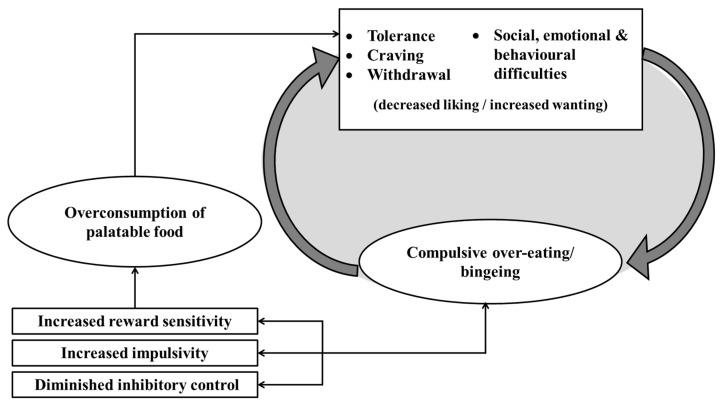
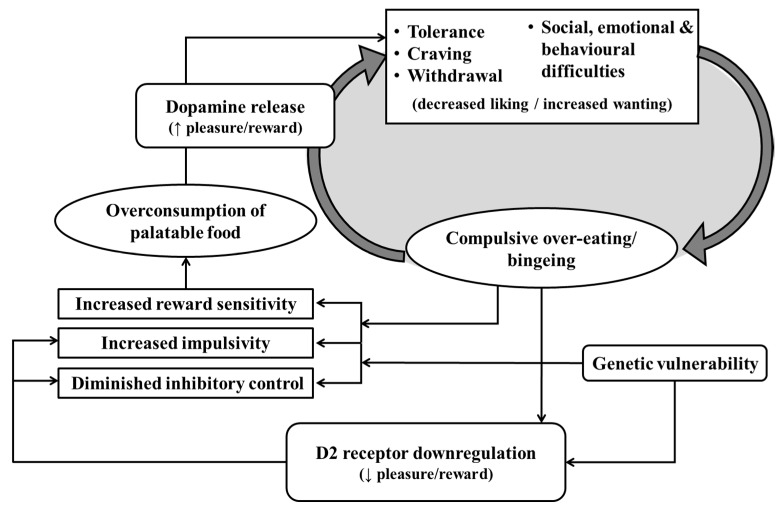
With the obesity epidemic being largely attributed to overeating, much research has been aimed at understanding the psychological causes of overeating and using this knowledge to develop targeted interventions. Here, we review this literature under a model of food addiction and present evidence according to the fifth edition of the Diagnostic and Statistical Manual (DSM-5) criteria for substance use disorders. We review several innovative treatments related to a food addiction model ranging from cognitive intervention tasks to neuromodulation techniques. We conclude that there is evidence to suggest that, for some individuals, food can induce addictive-type behaviours similar to those seen with other addictive substances. However, with several DSM-5 criteria having limited application to overeating, the term 'food addiction' is likely to apply only in a minority of cases. Nevertheless, research investigating the underlying psychological causes of overeating within the context of food addiction has led to some novel and potentially effective interventions. Understanding the similarities and differences between the addictive characteristics of food and illicit substances should prove fruitful in further developing these interventions.
Keywords: cognitive training; food addiction; impulsivity; neuromodulation; obesity; overeating; reward sensitivity.
Conflict of interest statement
The authors declare no competing interests.
Figures
References
-
- WHO . Obesity and Overweight. World Health Organization; Geneva, Switzerland: 2003.
-
- Global Burden of Disease Collaborative Network . Global Burden of Disease Study. Obesity Prevalence 1990–2013. Institute for Health Metrics and Evaluation (IHME); Seattle, WA, USA: 2014.
-
- Ng M., Fleming T., Robinson M., Thomson B., Graetz N., Margono C., Mullany E.C., Biryukov S., Abbafati C., Abera S.F., et al. Global, regional, and national prevalence of overweight and obesity in children and adults during 1980–2013: A systematic analysis for the Global burden of disease study 2013. Lancet. 2014;384:766–781. doi: 10.1016/S0140-6736(14)60460-8. - DOI - PMC - PubMed
-
- WHO . Obesity and Overweight. World Health Organization; Geneva, Switzerland: 2018.
-
- Butland B., Jebb S., Kopelman P., McPherson K., Thomas S., Mardell J., Parry V. Tackling Obesities: Future Choices—Project Report. 2nd ed. Foresight Programme of the Government Office for Science; London, UK: 2007. [(accessed on 28 September 2018)]. Available online: www.bis.gov.uk/assets/bispartners/foresight/docs/obesity/17.pdf.
Publication types
MeSH terms
Grants and funding
LinkOut - more resources
Full Text Sources
Medical
