


Understanding Enterovirus D68-Induced Neurologic Disease: A Basic Science Review
- PMID: 31487952
- PMCID: PMC6783995
- DOI: 10.3390/v11090821
Understanding Enterovirus D68-Induced Neurologic Disease: A Basic Science Review
Abstract
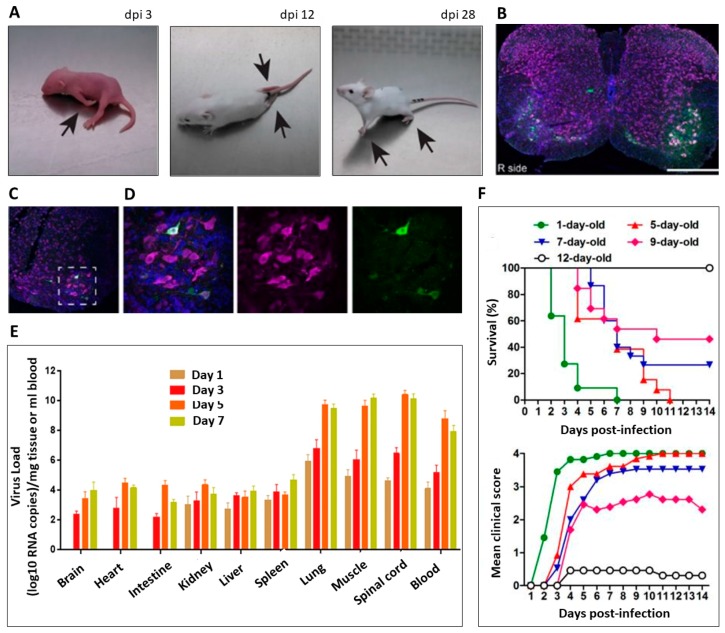
In 2014, the United States (US) experienced an unprecedented epidemic of enterovirus D68 (EV-D68)-induced respiratory disease that was temporally associated with the emergence of acute flaccid myelitis (AFM), a paralytic disease occurring predominantly in children, that has a striking resemblance to poliomyelitis. Although a definitive causal link between EV-D68 infection and AFM has not been unequivocally established, rapidly accumulating clinical, immunological, and epidemiological evidence points to EV-D68 as the major causative agent of recent seasonal childhood AFM outbreaks in the US. This review summarizes evidence, gained from in vivo and in vitro models of EV-D68-induced disease, which demonstrates that contemporary EV-D68 strains isolated during and since the 2014 outbreak differ from historical EV-D68 in several factors influencing neurovirulence, including their genomic sequence, their receptor utilization, their ability to infect neurons, and their neuropathogenicity in mice. These findings provide biological plausibility that EV-D68 is a causal agent of AFM and provide important experimental models for studies of pathogenesis and treatment that are likely to be difficult or impossible in humans.
Keywords: acute flaccid myelitis; enterovirus D68; experimental models; mouse models; neuropathogenesis; paralysis.
Conflict of interest statement
The authors report no conflicts of interest. The funders had no role in the interpretation of data; in the writing of the manuscript, or in the decision to publish the review.
Figures
References
-
- Oberste M.S., Maher K., Schnurr D., Flemister M.R., Lovchik J.C., Peters H., Sessions W., Kirk C., Chatterjee N., Fuller S., et al. Enterovirus 68 is associated with respiratory illness and shares biological features with both the enteroviruses and the rhinoviruses. J. Gen. Virol. 2004;85:2577–2584. doi: 10.1099/vir.0.79925-0. - DOI - PubMed
-
- Khetsuriani N., LaMonte-Fowlkes A., Oberst S., Pallansch M.A. Centers for Disease Control and Prevention. Enterovirus surveillance—United States, 1970–2005. MMWR Surveill. Summ. 2006;55:1–20. - PubMed
Publication types
MeSH terms
Supplementary concepts
Grants and funding
LinkOut - more resources
Full Text Sources
Medical
Miscellaneous
