


Long-term adherence to antiretroviral therapy in a South African adult patient cohort: a retrospective study
- PMID: 31488063
- PMCID: PMC6727323
- DOI: 10.1186/s12879-019-4410-8
Long-term adherence to antiretroviral therapy in a South African adult patient cohort: a retrospective study
Abstract
Background: South Africa has the highest HIV prevalence and supports the largest antiretroviral therapy (ART) programme globally. With the introduction of a test and treat policy, ensuring long term optimal adherence to ART (≥95%) is essential for successful patient and public health outcomes. The aim of this study was to assess long-term ART adherence to inform best practices for chronic HIV care.
Method: Long-term ART adherence was retrospectively analysed over a median duration of 5 years (interquartile range [IQR]: 5.3-6.5) in patients initially enrolled in a randomised controlled trial assessing tuberculosis and HIV treatment integration and subsequently followed post-trial in an observational cohort study in Durban, South Africa. The association between baseline patient characteristics and adherence over time was estimated using generalized estimating equations (GEE). Adherence was assessed using pharmacy pill counts conducted at each study visit and compared to 6 monthly viral load measurements. A Kaplan Meier survival analysis was used to estimate time to treatment failure. The McNemar test (with exact p-values) was used to determine the effect of pill burden and concurrent ART and tuberculosis treatment on adherence.
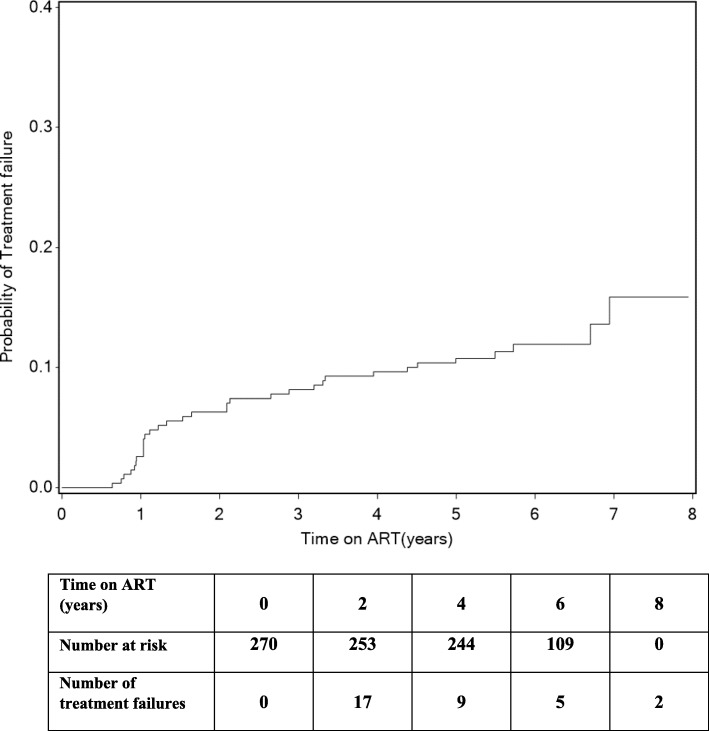
Results: Of the 270 patients included in the analysis; 54.8% were female, median age was 34 years (IQR:29-40) and median time on ART was 70 months (IQR = 64-78). Mean adherence was ≥95% for each year on ART. Stable patients provided with an extended 3-month ART supply maintained adherence > 99%. At study end, 96 and 94% of patients were optimally adherent and virologically suppressed, respectively. Time since ART initiation, female gender and primary breadwinner status were significantly associated with ≥95% adherence to ART. The cumulative probability of treatment failure was 10.7% at 5 years after ART initiation. Concurrent ART and tuberculosis treatment, or switching to a second line ART regimen with higher pill burden, did not impair ART adherence.
Conclusion: Optimal long-term adherence with successful treatment outcomes are possible within a structured ART programme with close adherence monitoring. This adherence support approach is relevant to a resource limited setting adopting a test and treat strategy.
Keywords: Adherence; Antiretroviral therapy; HIV; Pill count; South Africa.
Conflict of interest statement
The authors declare that they have no competing interests.
Figures


References
-
- World Health Organization, Global Health Observatory (GHO) data, HIV/AIDS. http://apps.who.int/gho/data/node.home. Accessed 16 Oct 2018.
-
- Shisana O, Rehle T, Simbayi L, Zuma K, Jooste S, Zungu N et al. South African national HIV prevalence, incidence and behaviour survey, 2012 Cape Town, HSRC Press 2014 http://www.hsrc.ac.za/uploads/pageContent/4565/SABSSM%20IV%20LEO%20final.... Accessed 27 Jun 2017.
-
- Statistics South Africa, statistical release mid-year population estimates 2018. www.statssa.gov.za/publications/P0302/P03022017.pdf. Accessed 29 Aug 2018.
-
- Implementation of the universal test and treat strategy for HIV positive patients and differentiated care for stable patients. Department of Health Circular, Republic of South Africa dated 26 Aug 2016 http://www.sahivsoc.org/Files/22%208%2016%20Circular%20UTT%20%20%20Decon.... Accessed 24 Jul 2018.
-
- UNAIDS, Country factsheets South Africa. 2017. http://www.unaids.org/en/regionscountries/countries/southafrica. Accessed 30 Sep 2018.
MeSH terms
Substances
LinkOut - more resources
Full Text Sources
Medical
