


Screening of 31 genes involved in monogenic forms of obesity in 23 Pakistani probands with early-onset childhood obesity: a case report
- PMID: 31488071
- PMCID: PMC6727494
- DOI: 10.1186/s12881-019-0886-8
Screening of 31 genes involved in monogenic forms of obesity in 23 Pakistani probands with early-onset childhood obesity: a case report
Abstract
Background: Consanguine families display a high degree of homozygosity which increases the risk of family members suffering from autosomal recessive disorders. Thus, homozygous mutations in monogenic obesity genes may be a more frequent cause of childhood obesity in a consanguineous population.
Methods: We identified 23 probands from 23 Pakistani families displaying autosomal recessive obesity. We have previously excluded mutations in MC4R, LEP and LEPR in all probands. Using a chip-based, target-region capture array, 31 genes involved in monogenic forms of obesity, were screened in all probands.
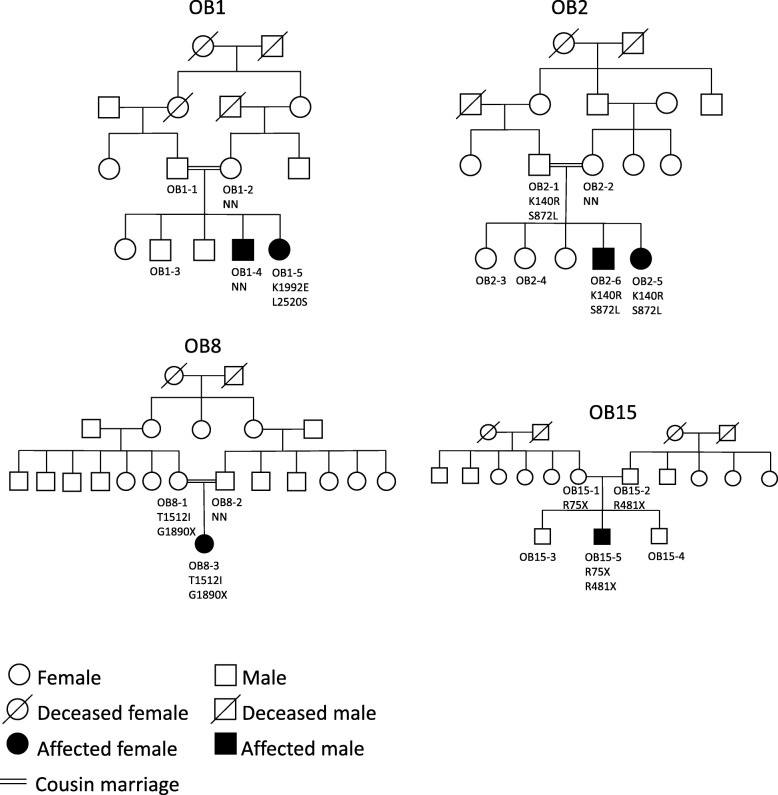
Results: We identified 31 rare non-synonymous possibly pathogenic variants (28 missense and three nonsense) within the 31 selected genes. All variants were heterozygous, thus no homozygous pathogenic variants were found. Two of the rare heterozygous nonsense variants identified (p.R75X and p.R481X) were found in BBS9 within one proband, suggesting that obesity is caused by compound heterozygosity. Sequencing of the parents supported the compound heterozygous nature of obesity as each parent was carrying one of the variants. Subsequent clinical investigation strongly indicated that the proband had Bardet-Biedl syndrome.
Conclusions: Mutation screening in 31 genes among probands with severe early-onset obesity from Pakistani families did not reveal the presence of homozygous obesity causing variants. However, a compound heterozygote carrier of BBS9 mutations was identified, indicating that compound heterozygosity must not be overlooked when investigating the genetic etiology of severe childhood obesity in populations with a high degree of consanguinity.
Keywords: Autosomal recessive; Bardet-Biedl syndrome 9; Compound heterozygous; Consanguinity; Early-onset obesity; Monogenic obesity; Pakistani families.
Conflict of interest statement
The authors declare that no conflicts interests.
Figures
References
-
- World Health Organization. http://www.who.int/mediacentre/news/releases/2017/increase-childhood-obe.... Accesed on 20.10.17.
-
- Nguyen NT, Magno CP, Lane KT, Hinojosa MW, Lane JS. Association of hypertension, diabetes, dyslipidemia, and metabolic syndrome with obesity: findings from the national health and nutrition examination survey, 1999 to 2004. J Am Coll Surg. 2008;207(6):928–934. doi: 10.1016/j.jamcollsurg.2008.08.022. - DOI - PubMed
-
- Winter Y, Sankowski R, Back T: Chapter two - genetic determinants of obesity and related vascular diseases. In: Vitamins & Hormones. Edited by Litwack G, vol. 91: Academic Press; 2013. 29–48. - PubMed
Publication types
MeSH terms
Substances
LinkOut - more resources
Full Text Sources
Medical
Molecular Biology Databases
Miscellaneous
