


Dynamic Interactive Social Cognition Training in Virtual Reality (DiSCoVR) for social cognition and social functioning in people with a psychotic disorder: study protocol for a multicenter randomized controlled trial
- PMID: 31488103
- PMCID: PMC6727396
- DOI: 10.1186/s12888-019-2250-0
Dynamic Interactive Social Cognition Training in Virtual Reality (DiSCoVR) for social cognition and social functioning in people with a psychotic disorder: study protocol for a multicenter randomized controlled trial
Abstract
Background: Problems in social functioning (e.g., unemployment, social isolation), are common in people with a psychotic disorder. Social cognition is a treatment target to improve social functioning, as it is a proximal predictor of social functioning. Social Cognition Training (SCT) improves social cognition, but may not generalize (enduringly) to social functioning, perhaps due to insufficient opportunity to practice in daily-life social situations. Using virtual reality (VR) for SCT could address this problem, as VR is customizable, accessible, and interactive. We will test the effect of a VR SCT, 'DiSCoVR', on social cognition and social functioning in a randomized controlled trial (RCT).
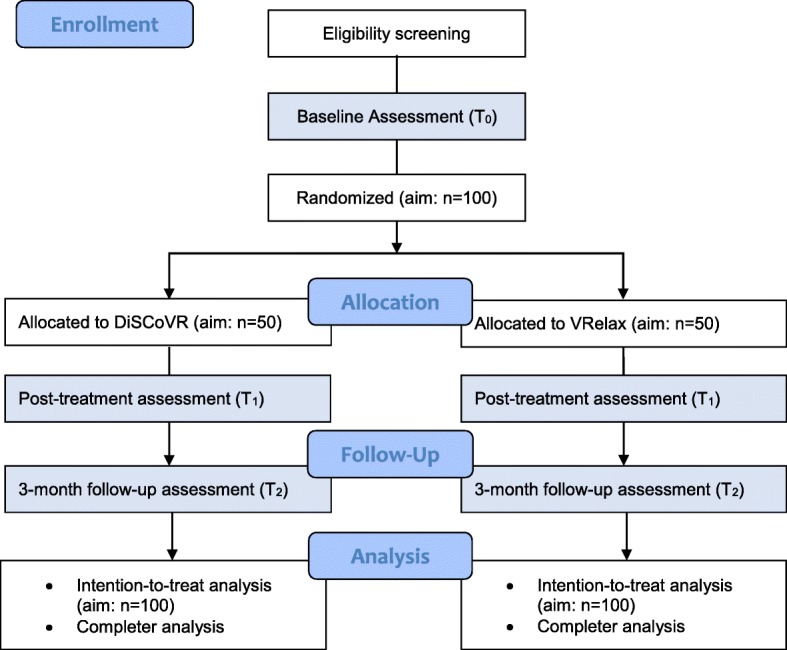
Methods: In total 100 people with a psychotic disorder and deficits in social cognition will be recruited for this multicenter randomized controlled trial (RCT). Participants will be randomized to VR SCT (DiSCoVR) or VR relaxation training (VRelax; active control). DiSCoVR is a 16-session individual SCT, consisting of three modules: 1) emotion perception (recognizing facial emotions in a virtual shopping street); 2) social perception and theory of mind (observing social interactions between virtual characters and assessing their behavior, emotions and thoughts); and 3) application of higher-order social cognition in social interaction (role-playing personalized situations in VR). People receiving VRelax complete sixteen individual sessions, in which they receive psycho-education about stress, identify personal stressors, learn relaxation techniques, and explore relaxing immersive virtual environments. Assessments will be performed at baseline, post-treatment, and 3-month follow-up. Primary outcomes are emotion perception (Ekman 60 Faces), social perception and theory of mind (The Awareness of Social Inference Test). Secondary outcomes include social functioning (Personal and Social Performance Scale), experiences and social interactions in daily life (experience sampling of emotions, social participation and subjective experience of social situations), psychiatric symptoms (e.g., depression, perceived stress, anxiety, positive and negative symptoms) and self-esteem.
Discussion: To our knowledge, this will be the first RCT testing the efficacy of VR SCT. It will also investigate generalization to daily life social situations, the durability of treatment effects, and moderators and mediators of treatment success.
Trial registration: On December 5, 2017, this trial was registered prospectively in the Dutch Trial Register as NTR6863 .
Keywords: Emotion perception; Psychotic disorder; Social cognition training; Social functioning; Theory of mind; Virtual reality.
Conflict of interest statement
The authors declare that they have no competing interests.
Figures


References
Publication types
MeSH terms
Associated data
LinkOut - more resources
Full Text Sources
Medical
