. 2019 Sep 5;10(1):4006.
doi: 10.1038/s41467-019-11999-9.

Translational coupling via termination-reinitiation in archaea and bacteria

Affiliations

Translational coupling via termination-reinitiation in archaea and bacteria

Madeleine Huber et al. Nat Commun. .

Abstract

The genomes of many prokaryotes contain substantial fractions of gene pairs with overlapping stop and start codons (ATGA or TGATG). A potential benefit of overlapping gene pairs is translational coupling. In 720 genomes of archaea and bacteria representing all major phyla, we identify substantial, albeit highly variable, fractions of co-directed overlapping gene pairs. Various patterns are observed for the utilization of the SD motif for de novo initiation at upstream genes versus reinitiation at overlapping gene pairs. We experimentally test the predicted coupling in 9 gene pairs from the archaeon Haloferax volcanii and 5 gene pairs from the bacterium Escherichia coli. In 13 of 14 cases, translation of both genes is strictly coupled. Mutational analysis of SD motifs located upstream of the downstream genes indicate that the contribution of the SD to translational coupling widely varies from gene to gene. The nearly universal, abundant occurrence of overlapping gene pairs suggests that tight translational coupling is widespread in archaea and bacteria.


Conflict of interest statement

The authors declare no competing interests.

Figures
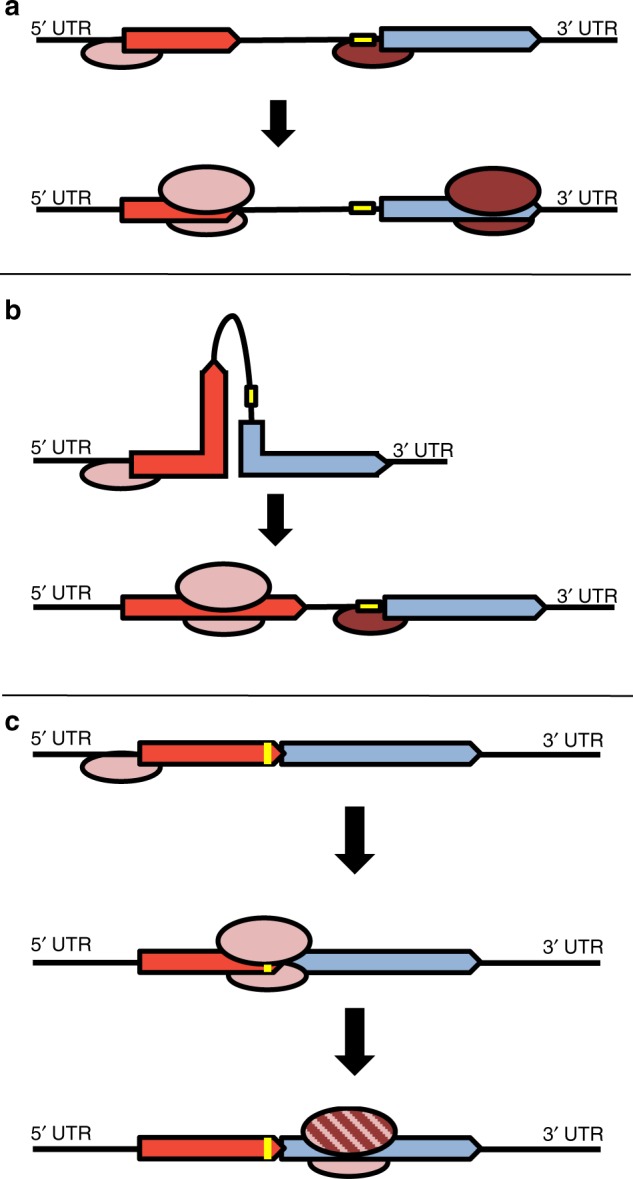
Fig. 1
Fig. 1
Three mechanisms of translation initiation at polycistronic mRNAs. a No translational coupling. Genes with intergenic regions, independent translation initiation at all genes. b Translational coupling (UTNI mechanism). Genes with intergenic regions. Translation of the downstream gene is inhibited due to long-range interactions. Translation of the upstream gene destroys these structures and enables do novo initiation at the downstream gene. c Translational coupling (TeRe mechanism). Genes with overlaps of stop and start codons. The same ribosome that terminates translation of the upstream gene (or the same 30S subunit) restarts translation at the downstream gene
Fig. 2
Fig. 2
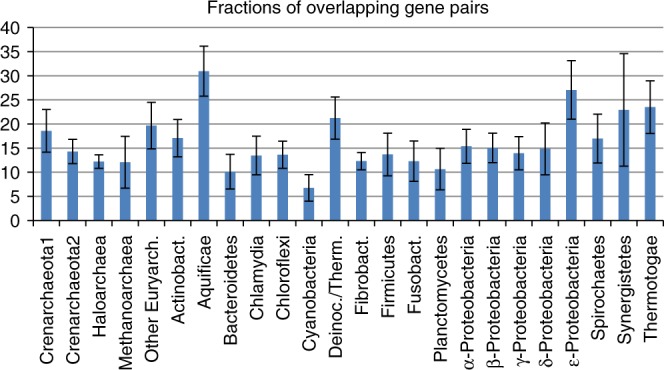
Overlapping gene pairs in 720 genomes of 24 groups of prokaryotes. Fractions of overlapping gene pairs (%). Mean values and standard deviations are shown
Fig. 3
Fig. 3
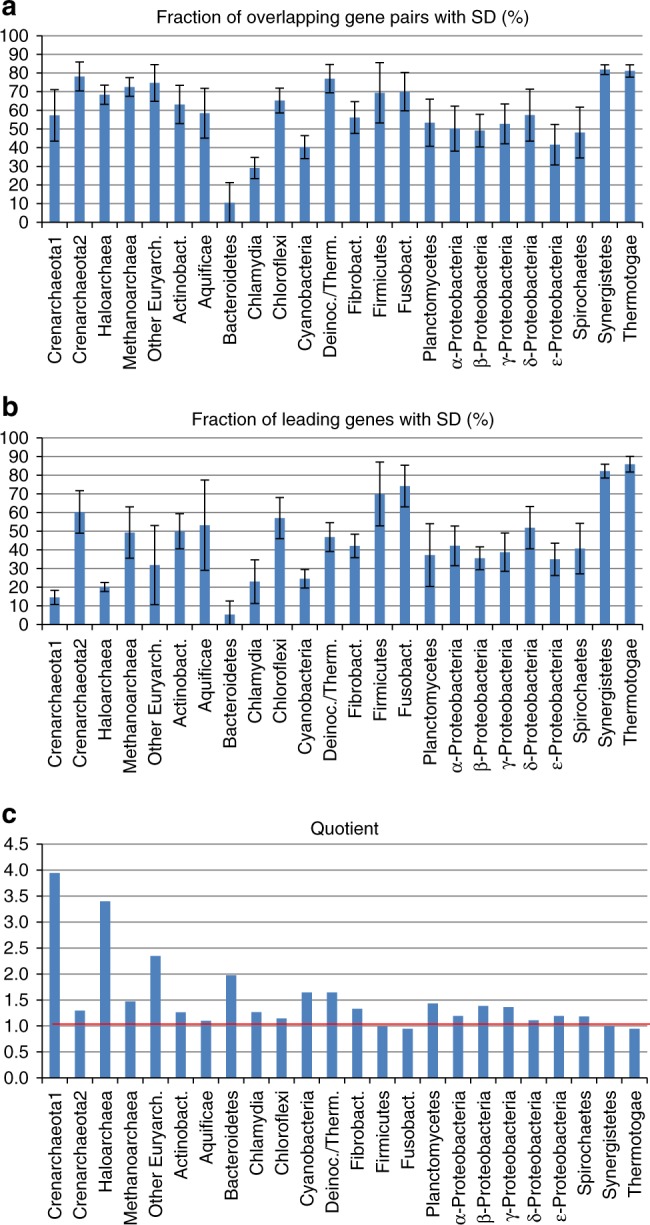
SD sequences in 720 genomes of 24 groups of prokaryotes. a Fractions of overlapping gene pairs that contain a SD motif upstream of the downstream gene, in the 3′-region of the upstream gene. Mean values and standard deviations are shown. b Fractions of leading genes that are preceded by a SD motif. Mean values and standard deviations are shown. c The quotient of the values shown in a and b, which represents the relative importance of the SD motif at downstream genes of overlapping gene pairs versus leading genes
Fig. 4
Fig. 4
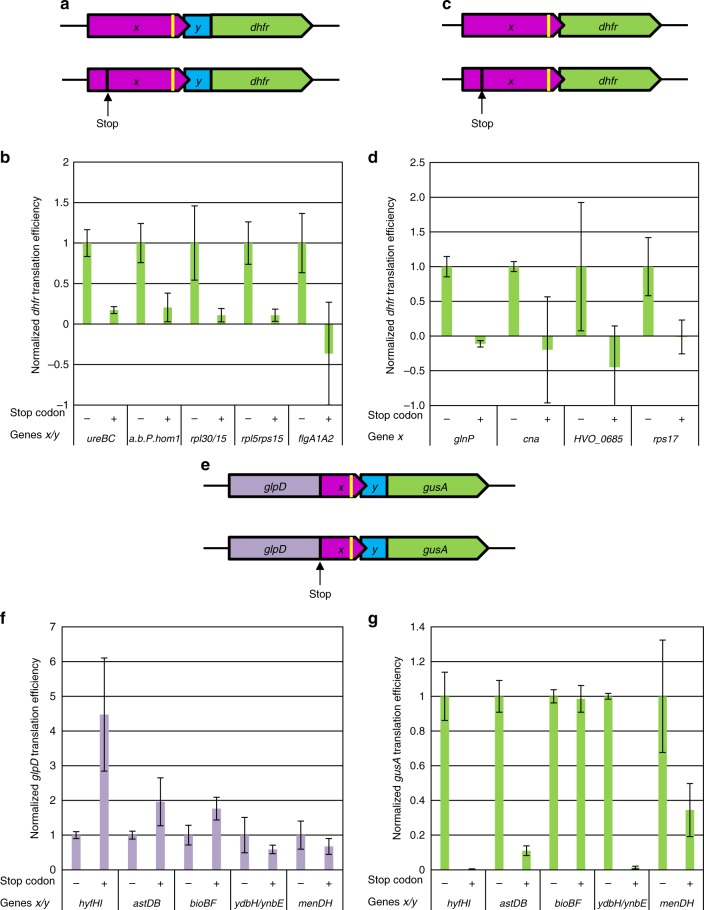
Translational coupling via the TeRe mechanism in H. volcanii and E. coli. a Schematic overview of the constructs for H. volcanii. The native overlapping gene pairs are shown in magenta and blue, the dhfr reporter gene is shown in green. The intragenic SD motif is indicated by a yellow bar. The designed premature stop codon is indicated. b. Normalized translational efficiencies of the native gene pairs lacking a premature stop codon (-) and the stop codon variants (+). The names of the gene pairs are shown at the bottom. Average results of three biological replicates and their standard deviations are shown. Source data are provided as Source Data file. c Schematic over view of the constructs for H. volcanii. The native upstream gene is shown in magenta, the dhfr reporter gene is shown in green. The intragenic SD motif is indicated by a yellow bar. The designed premature stop codon is indicated. d Normalized translational efficiencies of the native genes lacking a premature stop codon (−) and the stop codon variants (+). The names of the genes are shown at the bottom. Average results of three biological replicates and their standard deviations are shown. Source data are provided as Source Data file. e Schematic overview of the constructs for E. coli. The native overlapping gene pairs are shown in magenta and blue, the glpD reporter gene is shown in purple, the dhfr reporter gene is shown in green. The intragenic SD motif is indicated by a yellow bar. The presence of a stop codon is indicated. f Normalized glpD translational efficiencies of the native gene pairs lacking a stop codon (−) and the stop codon variants (+). The names of the gene pairs are shown at the bottom. Average results of three biological replicates and their standard deviations are shown. Source data are provided as Source Data file. g Normalized gusA translational efficiencies of the native gene pairs lacking a stop codon (−) and the stop codon variants (+). The names of the gene pairs are shown at the bottom. Average results of three biological replicates and their standard deviations are shown. Source data are provided as Source Data file
Fig. 5
Fig. 5
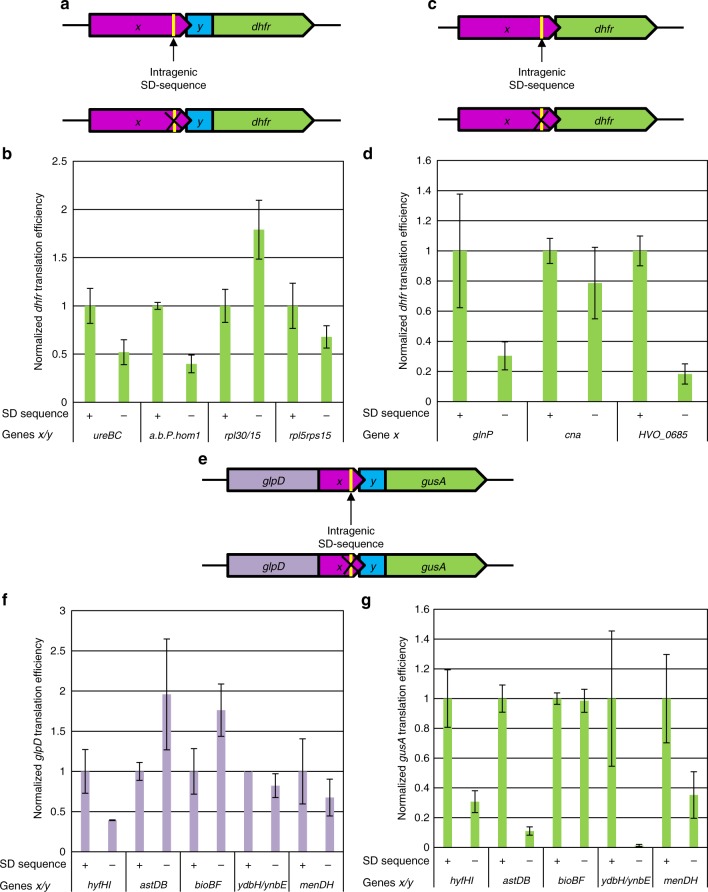
The importance of the SD motif for termination-reinitiation. a Schematic overview of the constructs for H. volcanii. The native overlapping gene pairs are shown in magenta and blue, the dhfr reporter gene is shown in green. The intragenic SD motif is indicated by a yellow bar, which is crossed in the SD mutants. b Normalized translational efficiencies of the native gene pairs containing (+) or lacking (−) a SD motif. The names of the gene pairs are shown at the bottom. Average results of three biological replicates and their standard deviations are shown. Source data are provided as Source Data file. c Schematic overview of the constructs for H. volcanii. The native upstream gene is shown in magenta, the dhfr reporter gene is shown in green. The intragenic SD motif is indicated by a yellow bar, which is crossed in the SD mutants. d Normalized translational efficiencies of the containing (+) or lacking (−) a SD motif. The names of the genes are shown at the bottom. Average results of three biological replicates and their standard deviations are shown. Source data are provided as Source Data file. e Schematic overview of the constructs for E. coli. The native overlapping gene pairs are shown in magenta and blue, the glpD reporter gene is shown in purple, the dhfr reporter gene is shown in green. The intragenic SD motif is indicated by a yellow bar, which is crossed in the SD mutants. f Normalized glpD translational efficiencies of the native gene pairs with (+) or without (−) a SD motif. The names of the gene pairs are shown at the bottom. Average results of three biological replicates and their standard deviations are shown. Source data are provided as Source Data file. g Normalized gusA translational efficiencies of the native gene pairs with (+) or without (−) a SD motif. The names of the gene pairs are shown at the bottom. Average results of three biological replicates and their standard deviations are shown. Source data are provided as Source Data file

References

    1. Normark S, et al. Overlapping genes. Annu. Rev. Genet. 1983;17:499–525. doi: 10.1146/annurev.ge.17.120183.002435. - DOI - PubMed
    1. Lawrence JG, Roth JR. Selfish operons: horizontal transfer may drive the evolution of gene clusters. Genetics. 1996;143:1843–1860. - PMC - PubMed
    1. Krakauer DC. Stability and evolution of overlapping genes. Evolution. 2000;54:731–739. doi: 10.1111/j.0014-3820.2000.tb00075.x. - DOI - PubMed
    1. Sakharkar KR, Chow VTK. Strategies for genome reduction in microbial genomes. Genome Inf. 2005;16:69–75. - PubMed
    1. Huvet, M. & Stumpf, M. P. H. Overlapping genes: a window on gene evolvability. BMC Genomics15, 721 (2014). - PMC - PubMed

Publication types