


Autism and toe-walking: are they related? Trends and treatment patterns between 2005 and 2016
- PMID: 31489038
- PMCID: PMC6701446
- DOI: 10.1302/1863-2548.13.180160
Autism and toe-walking: are they related? Trends and treatment patterns between 2005 and 2016
Abstract
Purpose: This study quantified toe-walking trends and treatment decisions in patients with autism spectrum disorder (ASD) in the United States between 2005 and 2016 using a large national private-payer database.
Methods: A retrospective database review was performed on paediatric patients with ASD, and for International Classification of Diseases-9/10 diagnosis codes for toe-walking. Patients were filtered based on treatment type by Current Procedural Terminology (CPT) code. Continued toe-walking rates were assessed for each patient population and treatment group. A Pearson's chi-squared test was used to evaluate differences in group characteristics.
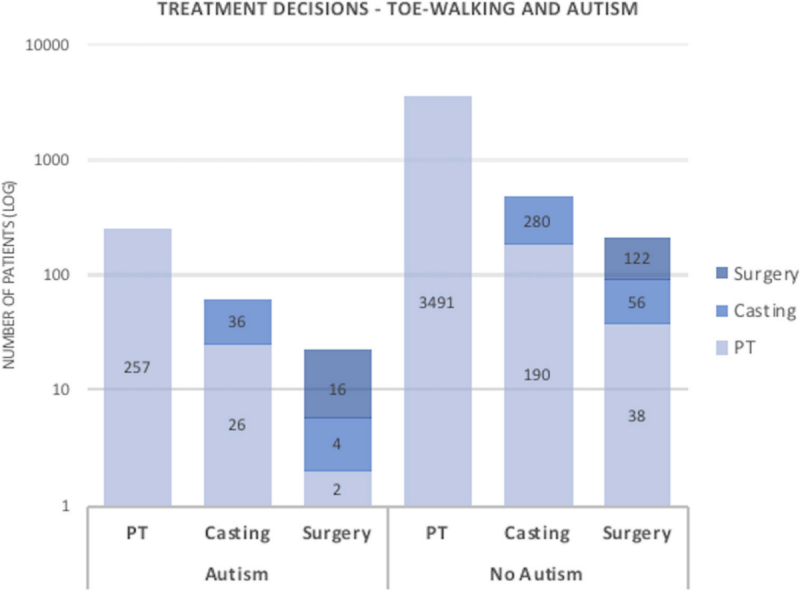
Results: Of 2 221 009 paediatric patients in the database, 5739 patients had a diagnosis of ASD, and 8.4% of patients with ASD also had a diagnosis of toe-walking (n = 484). For typically developing children in the database, 0.47% of patients had a diagnosis of persistent toe-walking. In all, 59.3% of ASD patients underwent physical therapy, 7.4% serial casting and 3.3% surgical correction, compared with 38.1%, 3.6% and 1.2% of normally developing children, respectively (chi-square 6.4031; p < 0.040699). Without intervention, 63.6% of patients with ASD continued to toe-walk within ten years of their diagnosis, with 19.3% of patients without ASD (chi-square 82.9762; p < 0.0001).
Conclusion: This study supports the association between a greater prevalence of toe-walking in children with ASD. We showed that patients with ASD and toe-walking receive surgical correction at nearly triple the rate of children without ASD who toe-walk. The continued rate of toe-walking is comparable between treatment groups as well as between ASD and typically developing children. Typically developing children have higher rates of toe-walking resolution without intervention than children with ASD.
Level of evidence: Level II.
Keywords: autism; toe-walking; treatment trends.
Figures
References
-
- Ruzbarsky JJ, Scher D, Dodwell E. Toe walking: causes, epidemiology, assessment, and treatment. Curr Opin Pediatr 2016;28:40-46. - PubMed
-
- Davies K, Black A, Hunt M, Holsti L. Long-term gait outcomes following conservative management of idiopathic toe walking. Gait Posture 2018;62:214-219. - PubMed
-
- Barrow WJ, Jaworski M, Accardo PJ. Persistent toe walking in autism. J Child Neurol 2011;26:619-621. - PubMed
-
- Engström P, Tedroff K. Idiopathic toe-walking: prevalence and natural history from birth to ten years of age. J Bone Joint Surg [Am] 2018;100:640-647. - PubMed
LinkOut - more resources
Full Text Sources
Medical
Research Materials
