


Radiological outcome after treatment of juvenile flatfeet with subtalar arthroereisis: a matched pair analysis of 38 cases comparing neurogenic and non-neurogenic patients
- PMID: 31489039
- PMCID: PMC6701442
- DOI: 10.1302/1863-2548.13.190046
Radiological outcome after treatment of juvenile flatfeet with subtalar arthroereisis: a matched pair analysis of 38 cases comparing neurogenic and non-neurogenic patients
Abstract
Purpose: Therapy of juvenile neurogenic flatfoot (JNF) with subtalar arthroereisis (SA) is currently under critical clinical investigation. In this retrospective matched pair analysis, the radiological outcome after arthroereisis in paediatric patients with infantile cerebral palsy and JNF was compared with children with juvenile flatfeet (JF) without neurological diseases.
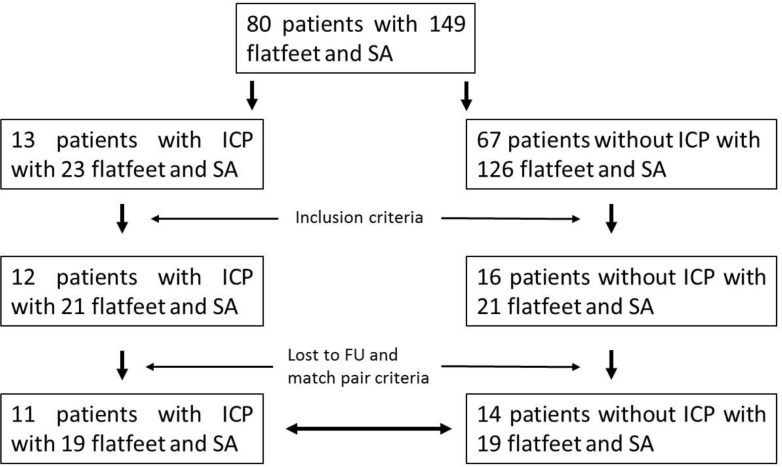
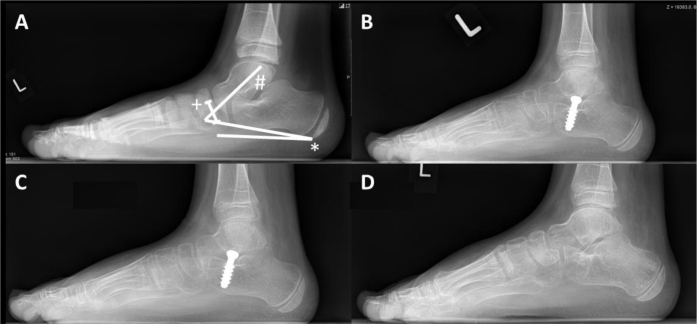
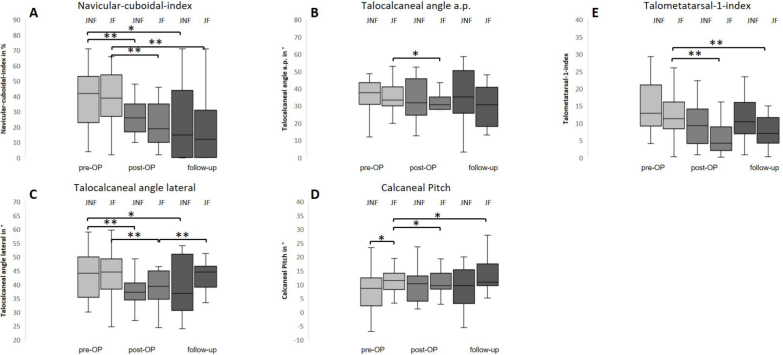
Methods: From October 2007 to April 2018 80 patients with 149 flatfeet underwent surgery with SA. Inclusion criteria were: 1) JNF or JF with age at surgery ≤ 13 years; 2) treatment with SA; 3) presence of three sets of biplane radiographs (preoperative, postoperative and follow-up (FU)). The radiographs were analyzed for: 1) navicular-cuboidal-index (NCI); 2) talocalcaneal angle anteroposterior; 3) talocalcaneal angle lateral; 4) calcaneal-pitch (CP); and 5) talometatarsal-index (TMTI). Following this, 25 patients with 38 flatfeet could be included.
Results: The mean age at SA of the JNF group was 9.2 years (JF group: 9.3 years) and the mean time of FU was 35.2 months (JF group: 39.4 months). In comparison with preoperatively, a significant decrease of the NCI was seen in both groups (p = ≤ 0.05 and p = ≤ 0.001) in the FU radiographs. The analysis of CP and TMTI in the JF group also resulted in a significant improvement (p = ≤ 0.001 and p = ≤ 0.05). Overall, the comparison between the JNF and JF group showed no significant differences in regard to the analyzed postoperative parameters.
Conclusion: Based on this data, treatment of flatfeet by SA in patient with neurological disorders shows an improvement of radiological parameters comparable with neurologically unimpaired patients and might be considered as additional treatment option.
Level of evidence: IV.
Keywords: cerebral palsy; flatfoot; pes planus; subtalar arthroereisis.
Figures
References
-
- Molayem I, Persiani P, Marcovici LL, Rosi S, Calistri A, Villani C. Complications following correction of the planovalgus foot in cerebral palsy by arthroereisis. Acta Orthop Belg 2009;75:374-379. - PubMed
-
- Mosca VS. Calcaneal lengthening for valgus deformity of the hindfoot. Results in children who had severe, symptomatic flatfoot and skewfoot. J Bone Joint Surg [Am] 1995;77-A:500-512. - PubMed
-
- Chang J-H, Wang S-H, Kuo C-L, et al. . Prevalence of flexible flatfoot in Taiwanese school-aged children in relation to obesity, gender, and age. Eur J Pediatr 2010;169:447-452. - PubMed
-
- Pfeiffer M, Kotz R, Ledl T, Hauser G, Sluga M. Prevalence of flat foot in preschool-aged children. Pediatrics 2006;118:634-639. - PubMed
-
- Panichawit C, Bovonsunthonchai S, Vachalathiti R, Limpasutirachata K. Effects of foot muscles training on plantar pressure distribution during gait, foot muscle strength, and foot function in persons with flexible flatfoot. J Med Assoc Thai 2015;98(suppl 5):S12-S17. - PubMed
LinkOut - more resources
Full Text Sources
Research Materials
Miscellaneous
