Combinatorial morphogenetic and mechanical cues to mimic bone development for defect repair
- PMID: 31489377
- PMCID: PMC6713501
- DOI: 10.1126/sciadv.aax2476
Combinatorial morphogenetic and mechanical cues to mimic bone development for defect repair
Abstract
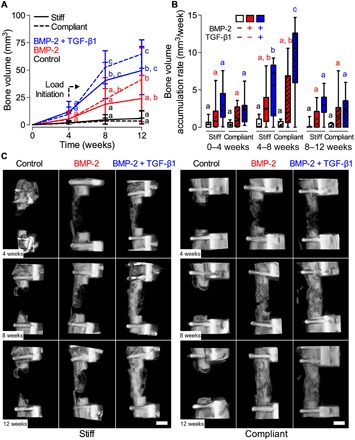
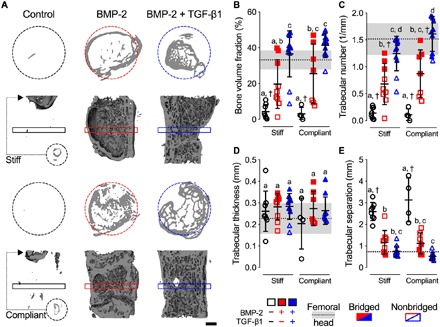
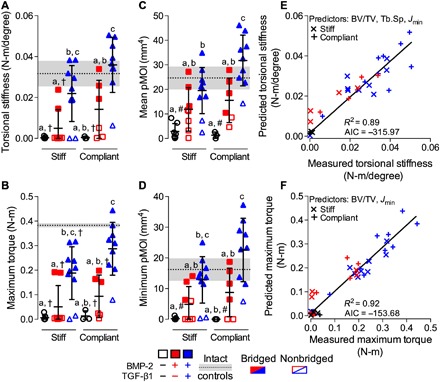
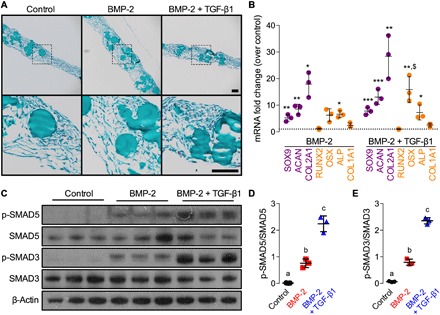
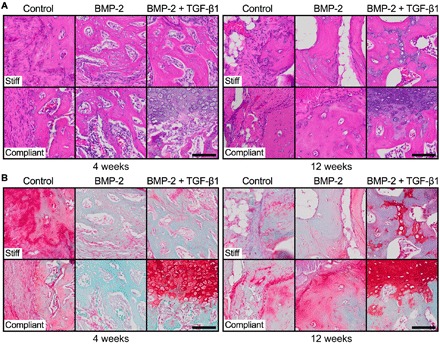
Endochondral ossification during long bone development and natural fracture healing initiates by mesenchymal cell condensation, directed by local morphogen signals and mechanical cues. Here, we aimed to mimic development for regeneration of large bone defects. We hypothesized that engineered human mesenchymal condensations presenting transforming growth factor-β1 (TGF-β1) and/or bone morphogenetic protein-2 (BMP-2) from encapsulated microparticles promotes endochondral defect regeneration contingent on in vivo mechanical cues. Mesenchymal condensations induced bone formation dependent on morphogen presentation, with BMP-2 + TGF-β1 fully restoring mechanical function. Delayed in vivo ambulatory loading significantly enhanced the bone formation rate in the dual morphogen group. In vitro, BMP-2 or BMP-2 + TGF-β1 initiated robust endochondral lineage commitment. In vivo, however, extensive cartilage formation was evident predominantly in the BMP-2 + TGF-β1 group, enhanced by mechanical loading. Together, this study demonstrates a biomimetic template for recapitulating developmental morphogenic and mechanical cues in vivo for tissue engineering.
Figures
References
-
- Gerber H. P., Vu T. H., Ryan A. M., Kowalski J., Werb Z., Ferrara N., VEGF couples hypertrophic cartilage remodeling, ossification and angiogenesis during endochondral bone formation. Nat. Med. 5, 623–628 (1999). - PubMed
-
- Carter D. R., Van Der Meulen M. C., Beaupré G. S., Mechanical factors in bone growth and development. Bone 18, 5S–10S (1996). - PubMed
Publication types
MeSH terms
Substances
Grants and funding
- R01 EB023907/EB/NIBIB NIH HHS/United States
- R01 AR074948/AR/NIAMS NIH HHS/United States
- R01 AR063194/AR/NIAMS NIH HHS/United States
- TL1 TR000441/TR/NCATS NIH HHS/United States
- UL1 TR001108/TR/NCATS NIH HHS/United States
- R01 AR069564/AR/NIAMS NIH HHS/United States
- F32 DE024712/DE/NIDCR NIH HHS/United States
- T32 GM007250/GM/NIGMS NIH HHS/United States
- R01 AR066193/AR/NIAMS NIH HHS/United States
- TL1 TR002549/TR/NCATS NIH HHS/United States
- T32 HL007829/HL/NHLBI NIH HHS/United States
- T32 AR007505/AR/NIAMS NIH HHS/United States
- T32 HL134622/HL/NHLBI NIH HHS/United States
LinkOut - more resources
Full Text Sources