Review
. 2019 Oct;81(7):2288-2303.
doi: 10.3758/s13414-019-01846-w.

No one knows what attention is

Affiliations
Review

No one knows what attention is

Bernhard Hommel et al. Atten Percept Psychophys. 2019 Oct.

Abstract

In this article, we challenge the usefulness of "attention" as a unitary construct and/or neural system. We point out that the concept has too many meanings to justify a single term, and that "attention" is used to refer to both the explanandum (the set of phenomena in need of explanation) and the explanans (the set of processes doing the explaining). To illustrate these points, we focus our discussion on visual selective attention. It is argued that selectivity in processing has emerged through evolution as a design feature of a complex multi-channel sensorimotor system, which generates selective phenomena of "attention" as one of many by-products. Instead of the traditional analytic approach to attention, we suggest a synthetic approach that starts with well-understood mechanisms that do not need to be dedicated to attention, and yet account for the selectivity phenomena under investigation. We conclude that what would serve scientific progress best would be to drop the term "attention" as a label for a specific functional or neural system and instead focus on behaviorally relevant selection processes and the many systems that implement them.

Keywords: Attention; Decision making; Evolution; Intention; Motor control; Parietal cortex; Phylogenetic; Selection; Sensorimotor; Superior colliculus.


Figures
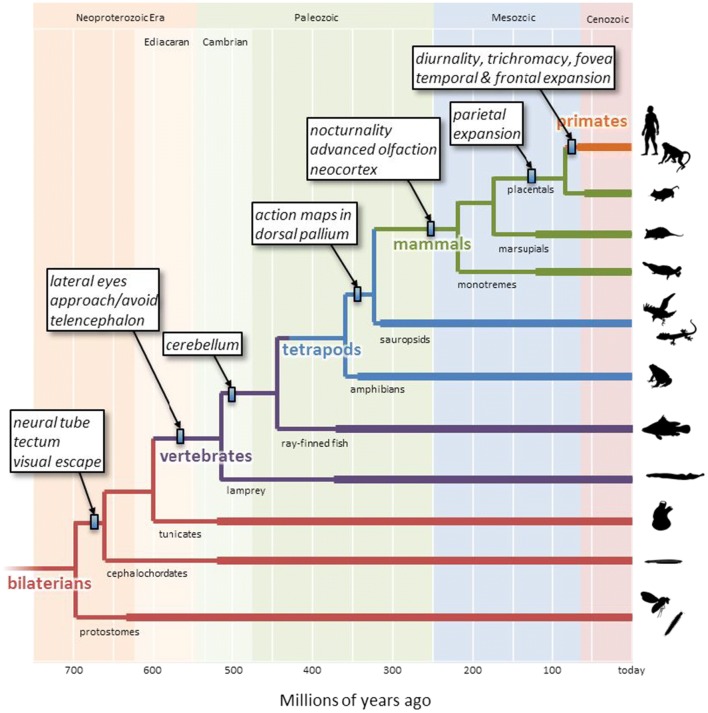
Fig. 1
Fig. 1
A reduced phylogenetic tree of bilaterally symmetric animals, exclusively emphasizing the lineage that leads to humans. Branch points represent some of the divergences between different lineages, with timing estimated on the basis of molecular clock analyses (Erwin et al., 2011). Thick lines indicate the presence of relevant fossil data (paleobiodb.org). Small rectangles indicate the estimated latest timing of innovations described in the boxes. Note that many branch points and lineages are omitted for clarity. Silhouettes along the right are from phylopic.org
Fig. 2
Fig. 2
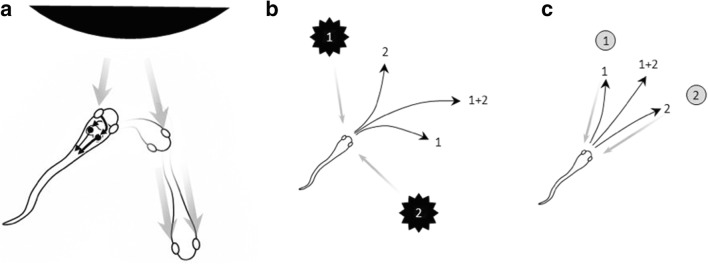
Circuits for avoidance and approach in a hypothetical early vertebrate. (a) In the avoidance circuit, visual information from the lateral eyes arrives in the contralateral tectum, which projects ipsilaterally to the midbrain locomotor regions. Thus, if a stimulus falls on the left eye, the locomotion will tend to turn to the right until stimulation is balanced and the body is oriented away from the stimulus. (b) Spatial averaging of escape directions (numbered arrows) away from two threatening stimuli (black stars) is an effective response. (c) For approach actions, spatial averaging is maladaptive, making winner-take-all dynamics necessary. B and C reused with permission from Cisek (2019)
Fig. 3
Fig. 3
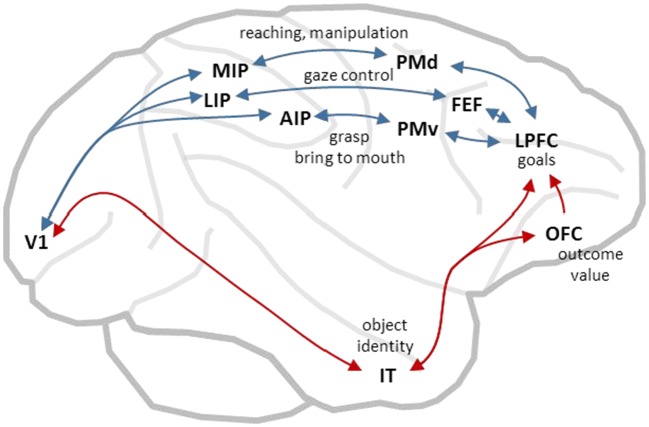
The primate cerebral cortex contains a set of parallel sensorimotor streams in the dorsomedial regions (blue arrows), each involved in a specific type of action using specific representations of space. All of these use information on object identity and outcome value, computed in the ventrolateral regions (red arrows), to select the actions most relevant given the current behavioral context. AIP anterior intraparietal area, FEF frontal eye fields, IT inferotemporal cortex, LIP lateral intraparietal area, LPFC lateral prefrontal cortex, MIP medial intraparietal area, OFC orbitofrontal cortex, PMd dorsal premotor cortex, PMv ventral premotor cortex, V1 primary visual cortex

References

    1. Aboitiz F, Montiel JF. Olfaction, navigation, and the origin of isocortex. Frontiers in Neuroscience. 2015;9:402. - PMC - PubMed
    1. Allport A. Attention and control: Have we been asking the wrong questions? A critical review of twenty-five years. In: Meyer DE, Kornblum S, editors. Attention and performance XIV. Cambridge, MA: MIT Press; 1993. pp. 183–218.
    1. Allport DA. Selection for action: Some behavioral and neurophysiological considerations of attention and action. In: Heuer H, Sanders HF, editors. Perspectives on perception and action. Hillsdale: Lawerence Erlbaum; 1987. pp. 395–419.
    1. Andersen RA, Snyder LH, Bradley DC, Xing J. Multimodal representation of space in the posterior parietal cortex and its use in planning movements. Annual Review of Neuroscience. 1997;20:303–330. - PubMed
    1. Anderson B. There is no such thing as attention. Frontiers in Psychology. 2011;2:1–8. doi: 10.3389/fpsyg.2011.00246. - DOI - PMC - PubMed

LinkOut - more resources