


Literature on Wearable Technology for Connected Health: Scoping Review of Research Trends, Advances, and Barriers
- PMID: 31489843
- PMCID: PMC6818529
- DOI: 10.2196/14017
Literature on Wearable Technology for Connected Health: Scoping Review of Research Trends, Advances, and Barriers
Abstract
Background: Wearable sensing and information and communication technologies are key enablers driving the transformation of health care delivery toward a new model of connected health (CH) care. The advances in wearable technologies in the last decade are evidenced in a plethora of original articles, patent documentation, and focused systematic reviews. Although technological innovations continuously respond to emerging challenges and technology availability further supports the evolution of CH solutions, the widespread adoption of wearables remains hindered.
Objective: This study aimed to scope the scientific literature in the field of pervasive wearable health monitoring in the time interval from January 2010 to February 2019 with respect to four important pillars: technology, safety and security, prescriptive insight, and user-related concerns. The purpose of this study was multifold: identification of (1) trends and milestones that have driven research in wearable technology in the last decade, (2) concerns and barriers from technology and user perspective, and (3) trends in the research literature addressing these issues.
Methods: This study followed the scoping review methodology to identify and process the available literature. As the scope surpasses the possibilities of manual search, we relied on the natural language processing tool kit to ensure an efficient and exhaustive search of the literature corpus in three large digital libraries: Institute of Electrical and Electronics Engineers, PubMed, and Springer. The search was based on the keywords and properties to be found in articles using the search engines of the digital libraries.
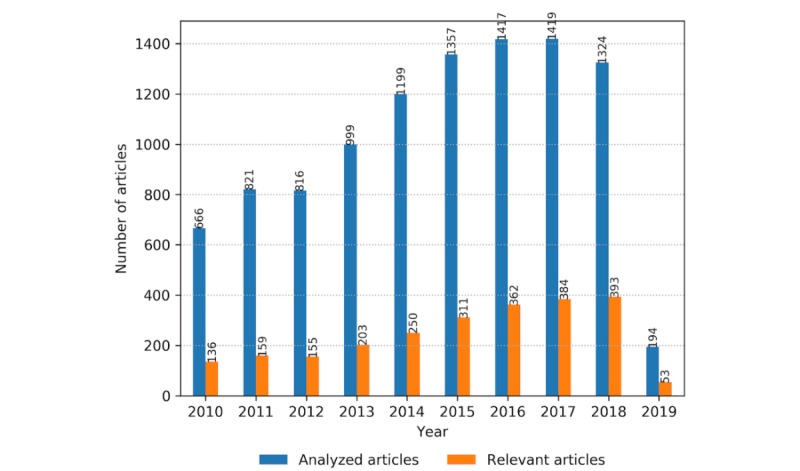
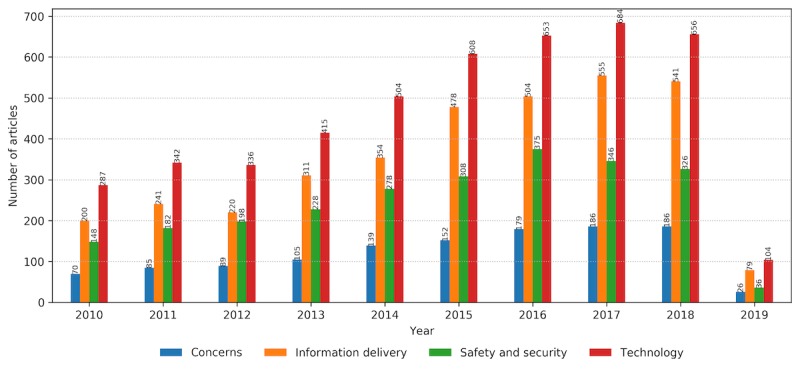
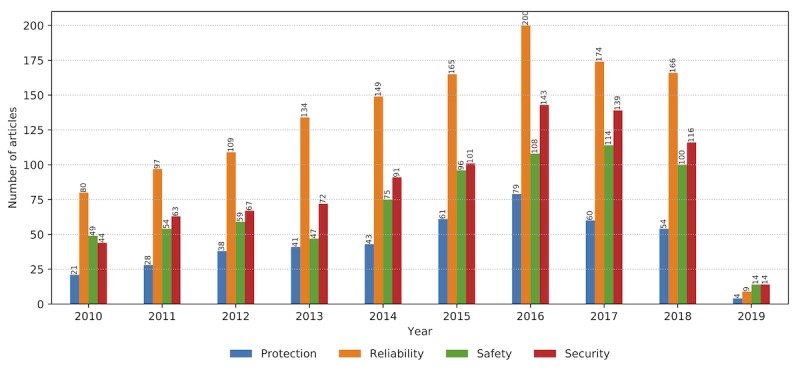
Results: The annual number of publications in all segments of research on wearable technology shows an increasing trend from 2010 to February 2019. The technology-related topics dominated in the number of contributions, followed by research on information delivery, safety, and security, whereas user-related concerns were the topic least addressed. The literature corpus evidences milestones in sensor technology (miniaturization and placement), communication architectures and fifth generation (5G) cellular network technology, data analytics, and evolution of cloud and edge computing architectures. The research lag in battery technology makes energy efficiency a relevant consideration in the design of both sensors and network architectures with computational offloading. The most addressed user-related concerns were (technology) acceptance and privacy, whereas research gaps indicate that more efforts should be invested into formalizing clear use cases with timely and valuable feedback and prescriptive recommendations.
Conclusions: This study confirms that applications of wearable technology in the CH domain are becoming mature and established as a scientific domain. The current research should bring progress to sustainable delivery of valuable recommendations, enforcement of privacy by design, energy-efficient pervasive sensing, seamless monitoring, and low-latency 5G communications. To complement technology achievements, future work involving all stakeholders providing research evidence on improved care pathways and cost-effectiveness of the CH model is needed.
Keywords: assisted living facilities; review; telemedicine; wearable technology.
©Tatjana Loncar-Turukalo, Eftim Zdravevski, José Machado da Silva, Ioanna Chouvarda, Vladimir Trajkovik. Originally published in the Journal of Medical Internet Research (http://www.jmir.org), 05.09.2019.
Conflict of interest statement
Conflicts of Interest: None declared.
Figures
References
-
- Framingham M. IDC. 2019. [2019-03-13]. IDC Reports Strong Growth in the Worldwide Wearables Market, Led by Holiday Shipments of Smartwatches, Wrist Bands, and Ear-Worn Devices https://www.idc.com/getdoc.jsp?containerId=prUS44901819 .
-
- Hunke N, Yusuf Z, Rüßmann M, Schmieg F, Bhatia A, Kalra N. The Boston Consulting Group. 2017. [2019-03-13]. Winning in IoT: It’s All About the Business Processes https://www.bcg.com/publications/2017/hardware-software-energy-environme... .
Publication types
MeSH terms
LinkOut - more resources
Full Text Sources
Medical
Research Materials
