. 2020 Feb;61(2):235-245.
doi: 10.1002/em.22331. Epub 2019 Sep 30.

Role of Human N-Acetyltransferase 2 Genetic Polymorphism on Aromatic Amine Carcinogen-Induced DNA Damage and Mutagenicity in a Chinese Hamster Ovary Cell Mutation Assay

Affiliations

Role of Human N-Acetyltransferase 2 Genetic Polymorphism on Aromatic Amine Carcinogen-Induced DNA Damage and Mutagenicity in a Chinese Hamster Ovary Cell Mutation Assay

Kristin J Baldauf et al. Environ Mol Mutagen. 2020 Feb.

Abstract

Carcinogenic aromatic amines such as 4-aminobiphenyl (ABP) and 2-aminofluorene (AF) require metabolic activation to form electrophilic intermediates that mutate DNA leading to carcinogenesis. Bioactivation of these carcinogens includes N-hydroxylation catalyzed by CYP1A2 followed by O-acetylation catalyzed by arylamine N-acetyltransferase 2 (NAT2). To better understand the role of NAT2 genetic polymorphism in ABP- and AF-induced mutagenesis and DNA damage, nucleotide excision repair-deficient (UV5) Chinese hamster ovary (CHO) cells were stably transfected with human CYP1A2 and either NAT2*4 (rapid acetylator) or NAT2*5B (slow acetylator) alleles. ABP and AF both caused significantly (P < 0.001) greater mutagenesis measured at the hypoxanthine phosphoribosyl transferase (hprt) locus in the UV5/CYP1A2/NAT2*4 acetylator cell line compared to the UV5, UV5/CYP1A2, and UV5/CYP1A2/NAT2*5B cell lines. ABP- and AF-induced hprt mutant cDNAs were sequenced and over 80% of the single-base substitutions were at G:C base pairs. DNA damage also was quantified by γH2AX in-cell western assays and by identification and quantification of the two predominant DNA adducts, N-(deoxyguanosin-8-yl)-4-aminobiphenyl (dG-C8-ABP) and N-(deoxyguanosin-8-yl)-2-aminofluorene (dG-C8-AF) by liquid chromatography-mass spectrometry. DNA damage and adduct levels were dose-dependent, correlated highly with levels of hprt mutants, and were significantly (P < 0.0001) greater in the UV5/CYP1A2/NAT2*4 rapid acetylator cell line following treatment with ABP or AF as compared to all other cell lines. Our findings provide further clarity on the importance of O-acetylation in CHO mutagenesis assays for aromatic amines. They provide evidence that NAT2 genetic polymorphism modifies aromatic amine-induced DNA damage and mutagenesis that should be considered in human risk assessments following aromatic amine exposures. Environ. Mol. Mutagen. 61:235-245, 2020. © 2019 Wiley Periodicals, Inc.

Keywords: 2-aminofluorene; 4-aminobiphenyl; N-acetyltransferase 2; genetic polymorphism.


Figures

Figure 1.
Figure 1.
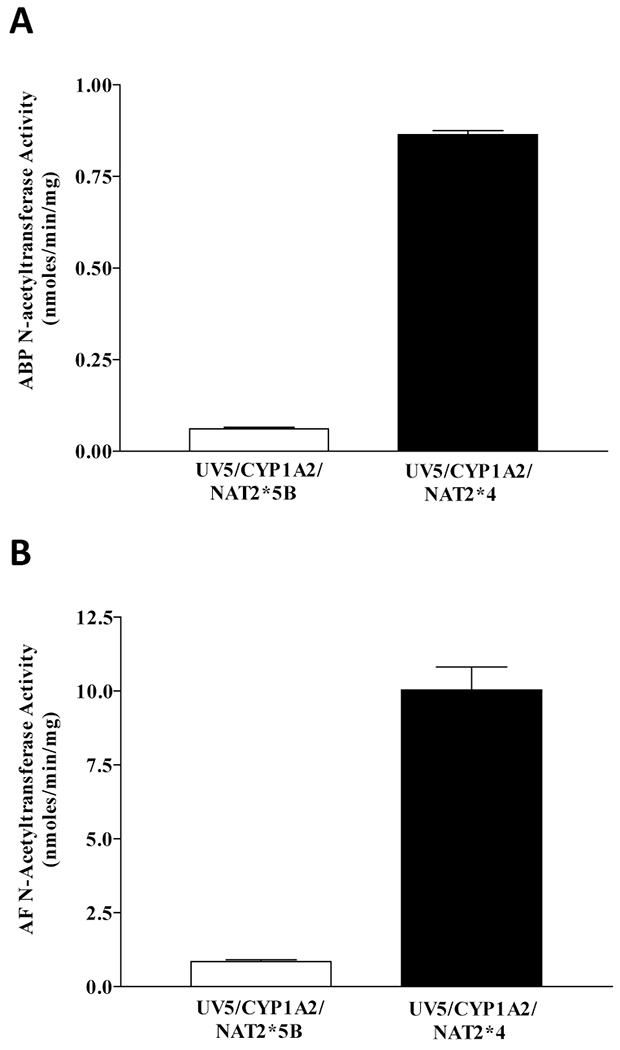
ABP and AF NAT activity in UV5/CYP1A2/NAT2*5B or UV5/CYP1A2/NAT2*4 cells. Each bar represents Mean ± SEM for three independent experiments. A: The difference in ABP NAT activity between the CYP1A2/NAT2*5B and the CYP1A2/NAT2*4 CHO cell lines was significant (p < 0.0001). B: The difference in AF NAT activity between the CYP1A2/NAT2*5B and the CYP1A2/NAT2*4 CHO cell lines was significant (p = 0.0003).
Figure 2.
Figure 2.
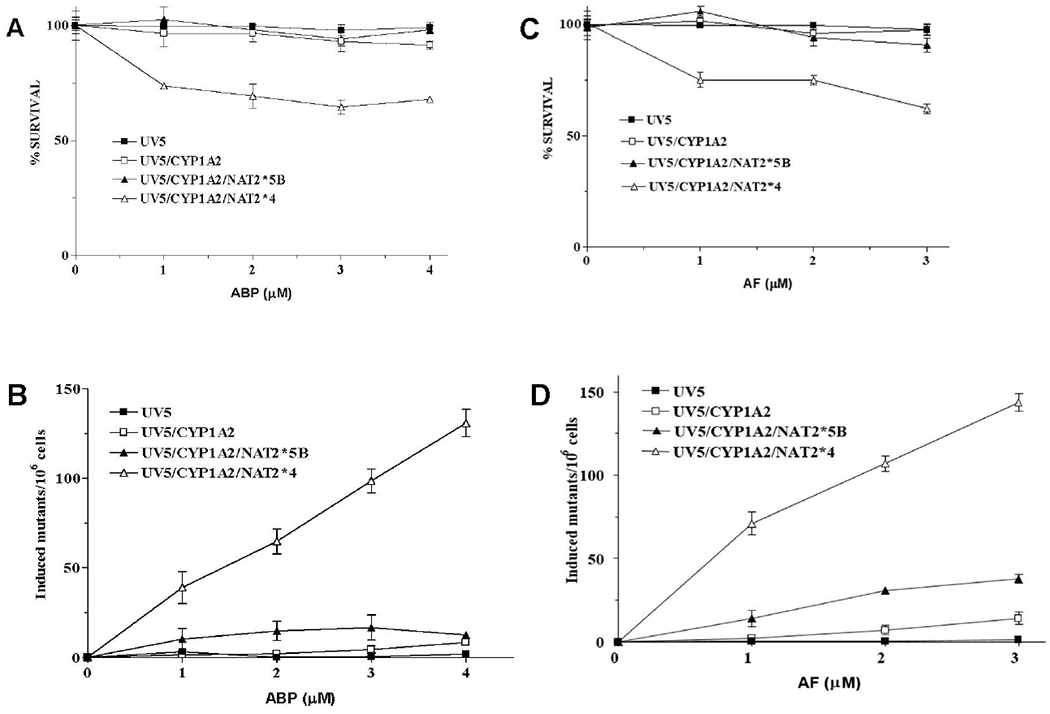
Cytotoxicity and hprt mutants. Percent survival measured by colony forming ability plotted for each of the four UV5 CHO cell lines following treatment with ABP (A) or AF (C). Data represent Mean ± SEM for two independent experiments. hprt mutant fractions following treatment with ABP (B) or AF (D). Data presented as Mean ± SEM for 4 independent experiments. Error bars not shown fall within the symbol. The UV5/CYP1A2/NAT2*4 cells had significantly more (p < 0.001) hprt mutants as compared to all other cell lines following treatment with ABP or AF at each concentration tested. The UV5/CYP1A2/NAT2*5B cells had significantly more hprt mutants than the UV5 and UV5/CYP1A2 cells following treatment with 2.0 μM (p < 0.001) or 3.0 μM (p < 0.01) AF.
Figure 3.
Figure 3.
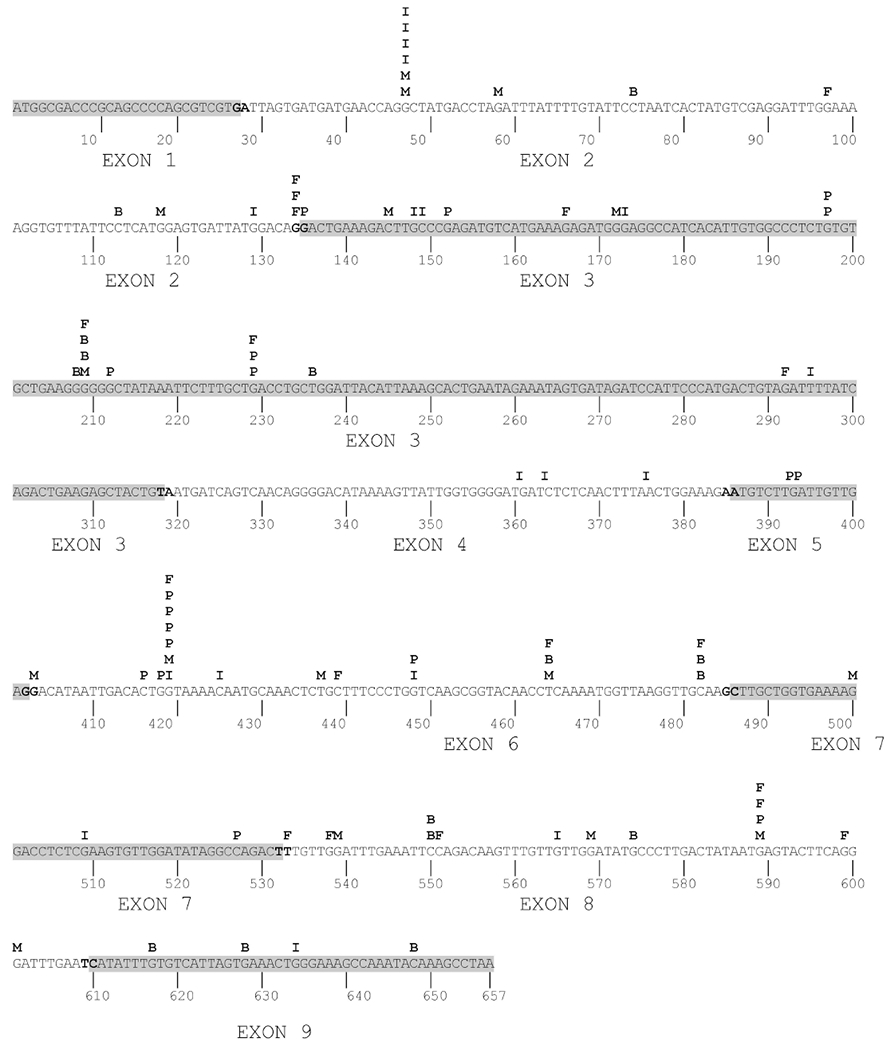
Location of ABP- and AF- induced base substitutions in the mutated hprt cDNAs. Highlighted regions designate deleted exons. Previously identified heterocyclic amine-induced mutations are also shown: B: ABP; F: AF; I: IQ; M: MeIQx; P: PhIP.
Figure 4.
Figure 4.
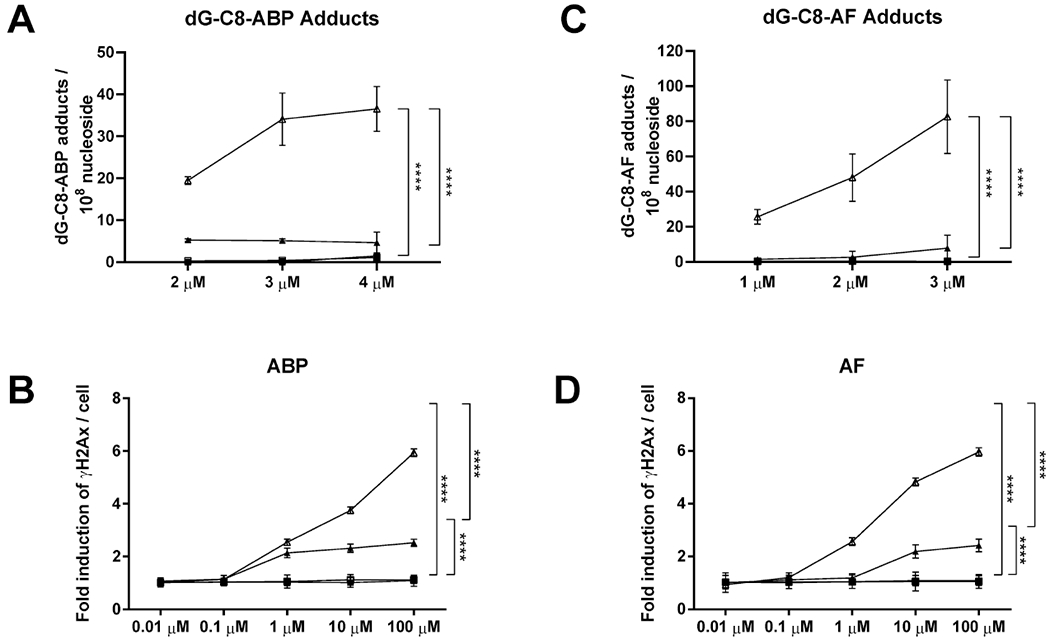
DNA adduct formation and double-strand breaks indicated by gamma-H2AX staining. dG-C8-ABP (A) or dG-C8-AF (B) DNA adduct levels in CHO cells treated with ABP or AF, respectively. Gamma H2AX staining indicating DNA double-strand breaks in CHO cells following incubation with ABP (C) or AF (D), respectively. Data for UV5 cells (closed squares), UV5/CYP1A2 cells (open squares), UV5/CYP1A2/NAT2*5B cells (closed triangles) and UV5/CYP1A2/NAT2*4 cells (open triangles) represent Mean ± SEM for three independent experiments in each of the stably transfected CHO cell lines. dG-C8-ABP (A) and dG-C8-AF (B) DNA adduct levels were significantly greater in the UV5/CYP1A2/NAT2*4 compared to all other cell lines at each concentration tested (p < 0.0001). ****, Differences between the CHO cell lines were significant (p<0.0001) as indicated.
Figure 5.
Figure 5.
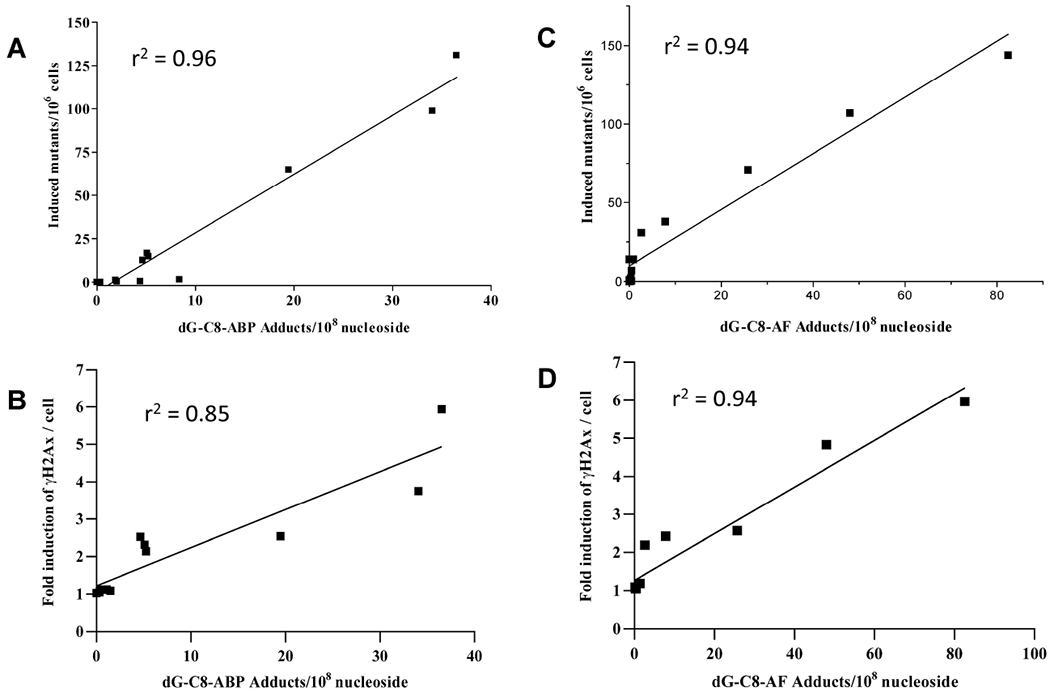
Relationships of hprt mutants and DNA double strand breaks to dG-C8-adduct levels. A. Correlation of ABP-induced hprt mutants to dG-C8-ABP adduct levels in all four cell lines (r2 = 0.96). B. Correlation of ABP-induced DNA double strand breaks to dG-C8-ABP adduct levels in all four cell lines (r2 = 0.85). C. Correlation of ABP-induced hprt mutants to dG-C8- AF adduct levels in all four cell lines (r2 = 0.94). D. Correlation of AF-induced DNA double strand breaks to dG-C8- AF adduct levels in all four cell lines (r2 = 0.94). Data from Figures 2 and 4 have been combined to produce the correlation plots.

References

    1. Ambrosone CB, Abrams SM, Gorlewska-Roberts K, Kadlubar FF. 2007. Hair dye use, meat intake, and tobacco exposure and presence of carcinogen-DNA adducts in exfoliated breast ductal epithelial cells. Arch Biochem Biophys 464(2):169–75 - PubMed
    1. Audebert M, Riu A, Jacques C, et al. 2010. Use of the gammaH2AX assay for assessing the genotoxicity of polycyclic aromatic hydrocarbons in human cell lines. Toxicol Lett 199(2):182–92 - PubMed
    1. Bartsch H, Caporaso N, Coda M, et al. 1990. Carcinogen hemoglobin adducts, urinary mutagenicity, and metabolic phenotype in active and passive cigarette smokers. J Natl Cancer Inst 82(23):1826–31 - PubMed
    1. Bellamri M, Yao L, Bonala R, Johnson F, Von Weymarn LB, Turesky RJ 2019. Bioactivation of the tobacco carcinogens 4-aminobiphenyl (4-ABP) and 2-amino-9H-pyrido[2,3-b]indole (AαC) in human bladder RT4 cells. Arch Toxicol 93(7):1893–1902. - PMC - PubMed
    1. Bendaly J, Doll MA, Millner LM, et al. 2009. Differences between human slow N-acetyltransferase 2 alleles in levels of 4-aminobiphenyl-induced DNA adducts and mutations. Mutat Res 671(1-2):13–9. - PMC - PubMed

Publication types