


Cerebral changes improved by physical activity during cognitive decline: A systematic review on MRI studies
- PMID: 31491837
- PMCID: PMC6699421
- DOI: 10.1016/j.nicl.2019.101933
Cerebral changes improved by physical activity during cognitive decline: A systematic review on MRI studies
Abstract
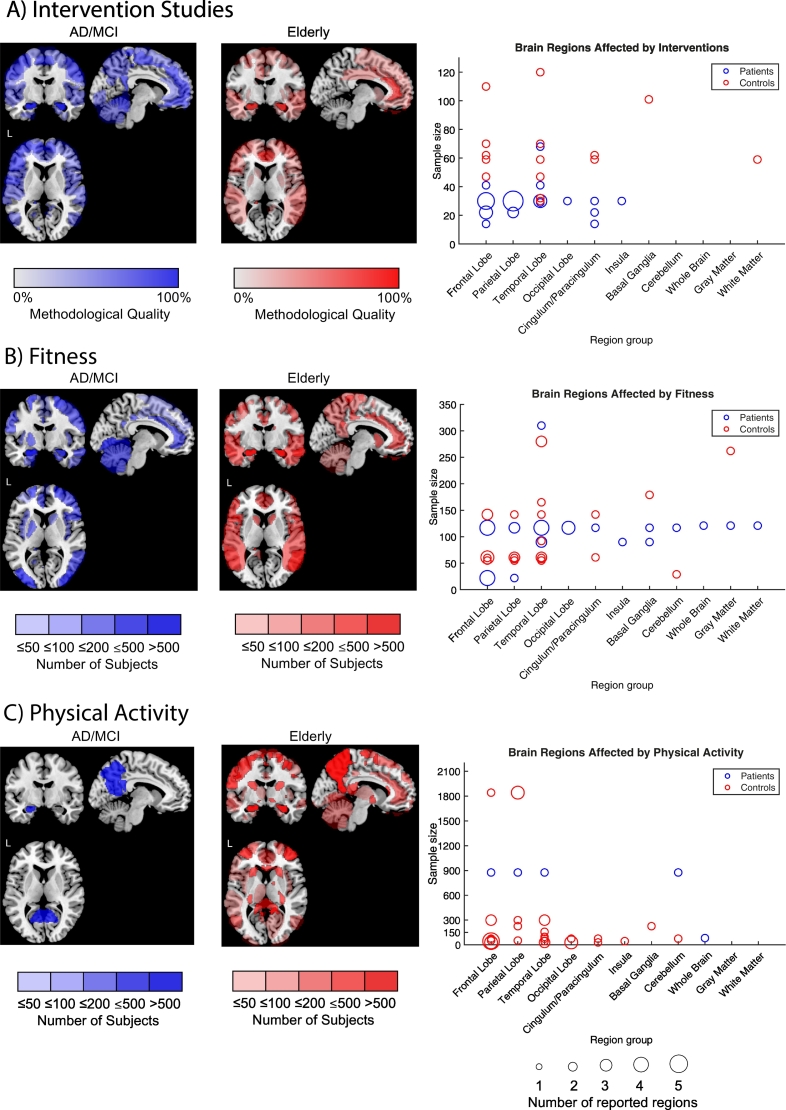
Current treatment in late-life cognitive impairment and dementia is still limited, and there is no cure for brain tissue degeneration or reversal of cognitive decline. Physical activity represents a promising non-pharmacological interventional approach in many diseases causing cognitive impairment, but its effect on brain integrity is still largely unknown. Especially research of cerebral alterations in disease state that goes beyond observations of clinical improvement is crucial to understand disease processes and possible effective treatments. In this systematic review, we address the question how physical activity and fitness in mild cognitive impairment (MCI) and Alzheimer's disease (AD) influences brain architecture compared to cognitively healthy elderly. We review both interventional studies comprising aerobic, coordinative and resistance exercises and observational studies on fitness and physical activity combined with Magnetic Resonance imaging (MRI). Different MRI approaches were included such as volumetric and structural analyses, Diffusion Tensor Imaging (DTI), functional MRI and Cerebral Blood Flow (CBF). We evaluate MRI results for different exercise modalities and performed a methodological evaluation of interventional studies in cognitive decline compared to normal aging. According to our results, among 12 interventions in AD/MCI, aerobic exercise is most frequently applied (9 studies). Interventions in AD/MCI altogether reveal a higher methodological quality compared to interventions in healthy elderly (8.33 ± 2.19 vs. 6.25 ± 2.36 out of 13 points), with most frequent missing aspects related to descriptions of complications, lack of intention-to-treat and statistical power analyses. Effects of aerobic exercise and fitness seem to mainly impact brain structures sensitive to neurodegeneration, which especially comprise frontal, temporal and parietal regions, such as the hippocampal/parahippocampal region, precuneus, anterior cingulate and prefrontal cortex, which are reported by several studies. General fitness measured via an objective fitness assessment and questionnaires seems to have a more global cerebral effect, probably due to its long-term application, whereas distinct intervention effects of durations between 3 and 6 months seem to concentrate on more local brain regions as the hippocampus, which can also be influenced by region of interest analyses. There is still a lack of evidence on other or combined types of intervention modalities, such as resistance, coordinative as well as multicomponent exercise during cognitive decline, and complex interventions as dancing. Future research should examine their beneficial effect on brain integrity, since several non-MRI studies already point to their advantageous impact. As a further future prospect, combination and application of newly developed imaging methods such as metabolic imaging should be envisaged to understand physical activity and its cerebral influence under its many-sided facets.
Keywords: Dementia; Exercise; Fitness; MRI; Neuroimaging; Physical activity.
Copyright © 2019. Published by Elsevier Inc.
Conflict of interest statement
The authors wish to confirm that there are no known conflicts of interest associated with this publication and there has been no significant financial support for this work that could have influenced its outcome.
Figures
References
-
- Abe O., Aoki S., Hayashi N., Yamada H., Kunimatsu A., Mori H.…Ohtomo K. Normal aging in the central nervous system: quantitative MR diffusion-tensor analysis. Neurobiol. Aging. 2002;23(3):433–441. - PubMed
-
- Anderson-Hanley C., Barcelos N.M., Zimmerman E.A., Gillen R.W., Dunnam M., Cohen B.D.…Kramer A.F. The aerobic and cognitive exercise study (ACES) for community-dwelling older adults with or at-risk for mild cognitive impairment (MCI): neuropsychological, neurobiological and neuroimaging outcomes of a randomized clinical trial. Front. Aging Neurosci. 2018;10(May) - PMC - PubMed
-
- Barnes L.L., Mendes de Leon C.F., Wilson R.S., Bienias J.L., Evans D.A. Social resources and cognitive decline in a population of older African Americans and whites. Neurology. 2004;63(12):2322–2326. http://www.ncbi.nlm.nih.gov/pubmed/15623694 Retrieved from. - PubMed
Publication types
MeSH terms
LinkOut - more resources
Full Text Sources
Medical
Research Materials
