


Antibiotic Prescribing by Informal Healthcare Providers for Common Illnesses: A Repeated Cross-Sectional Study in Rural India
- PMID: 31491900
- PMCID: PMC6783982
- DOI: 10.3390/antibiotics8030139
Antibiotic Prescribing by Informal Healthcare Providers for Common Illnesses: A Repeated Cross-Sectional Study in Rural India
Abstract
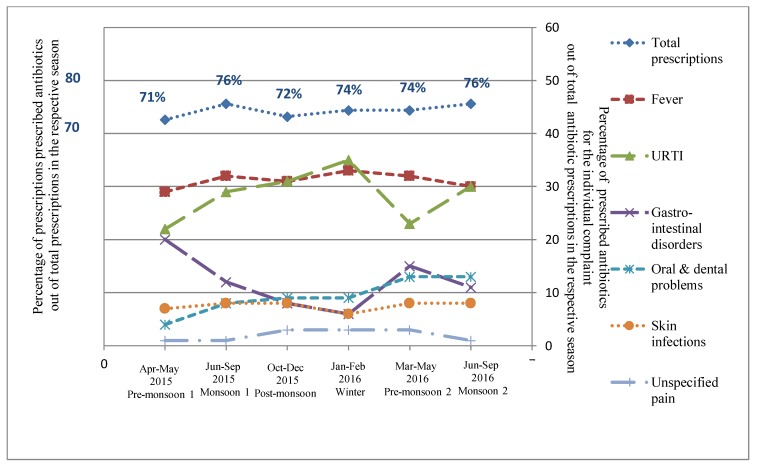
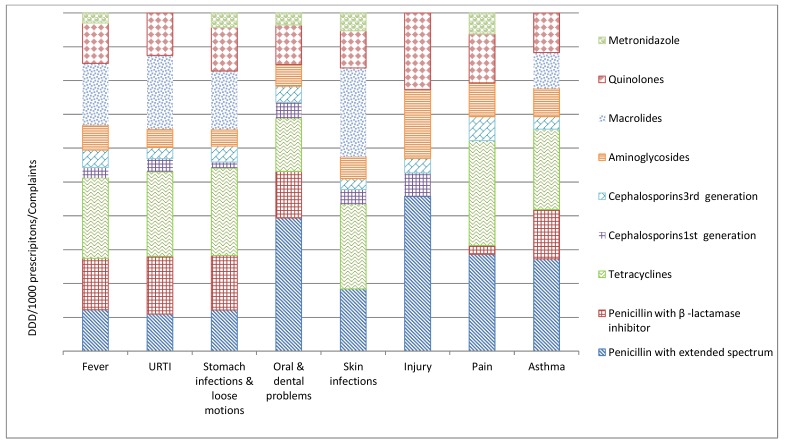
Informal healthcare providers (IHCPs) are predominant healthcare providers in rural India, who prescribe without formal training. Antibiotic prescription by IHCPs could provide crucial information for controlling antibiotic resistance. The aim of this study is to determine the practices and seasonal changes in antibiotic prescribing for common illnesses by IHCPs. A repeated cross-sectional study was conducted over 18 months, covering different seasons in the rural demographic surveillance site, at Ujjain, India. Prescriptions given to outpatients by 12 IHCPs were collected. In total, 15,322 prescriptions for 323 different complaint combinations were analyzed, of which 11,336 (74%) included antibiotics. The results showed that 14,620 (95%) of antibiotics prescribed were broad spectrum and the most commonly prescribed were fluoroquinolones (4771,31%), followed by penicillin with an extended spectrum (4119,27%) and third-generation cephalosporin (3069,20%). Antibiotics were prescribed more frequently in oral and dental problems (1126,88%), fever (3569,87%), and upper respiratory tract infections (3273, 81%); more during the monsoon season (2350,76%); and more frequently to children (3340,81%) than to adults (7996,71%). The study concludes that antibiotics were the more commonly prescribed drugs compared to other medications for common illnesses, most of which are broad-spectrum antibiotics, a situation that warrants further investigations followed by immediate and coordinated efforts to reduce unnecessary antibiotic prescriptions by IHCPs.
Keywords: Healthcare providers; India; antibiotics; infectious diseases; prescription; rural population.
Conflict of interest statement
The authors declare no conflicts of interest.
Figures
References
-
- WHO Pre-Antibiotic Era Looming Large—The World is Almost Out of Time. [(accessed on 1 July 2019)];2014 Available online: http://www.searo.who.int/mediacentre/features/2014/rd-statement-amr2014/en/
-
- Penicillin A.F. Nobel Lecture Dec 11. [(accessed on 1 July 2019)];1945 Available online: http://www.nobelprize.org/nobel_prizes/medicine/laureates/1945/fleming-l....
-
- WHO Global Action Plan on Antimicrobial Ressitance. [(accessed on 1 July 2019)];2015 Available online: http://apps.who.int/iris/bitstream/handle/10665/193736/9789241509763_eng....
-
- CDC Report on “Antibiotic Resistance Threats in the United States”. [(accessed on 1 July 2019)];2013 Available online: http://www.cdc.gov/drugresistance/threat-report-2013/
-
- Jacob J.T., Muliyil J. Public health is infrastructure for human development. Indian J. Med. Res. 2009;130:9–11. - PubMed
Grants and funding
LinkOut - more resources
Full Text Sources
