


Lack of focus on nutrition and documentation in nursing homes, home care- and home nursing: the self-perceived views of the primary care workforce
- PMID: 31492130
- PMCID: PMC6729022
- DOI: 10.1186/s12913-019-4450-1
Lack of focus on nutrition and documentation in nursing homes, home care- and home nursing: the self-perceived views of the primary care workforce
Abstract
Background: Malnutrition is a comprehensive challenge for the nursing home, home care- and home nursing sector. Nutritional care and the subsequent documentation are a common and multifaceted healthcare practice that requires that the healthcare professionals possess complex combinations of competencies in order to deliver high-quality care and treatment. The purpose of this study was to investigate how a varied group of healthcare professionals' perceive their own competencies within nutrition and documentation and how organizational structures influence their daily work and the quality of care provided.
Methods: Two focus groups consisting of 14 healthcare professionals were conducted. The transcribed focus group interviews was analyzed using the qualitative content analysis approach.
Results: Six categories were identified: 1) Lack of uniform and systematic communication affect nutritional care practices 2) Experience-based knowledge among the primary workforce influences daily clinical decisions, 3) Different attitudes towards nutritional care lead to differences in the quality of care 4) Differences in organizational culture affect quality of care, 5) Lack of clear nutritional care responsibilities affect how daily care is performed and 6) Lack of clinical leadership and priorities makes nutritional care invisible.
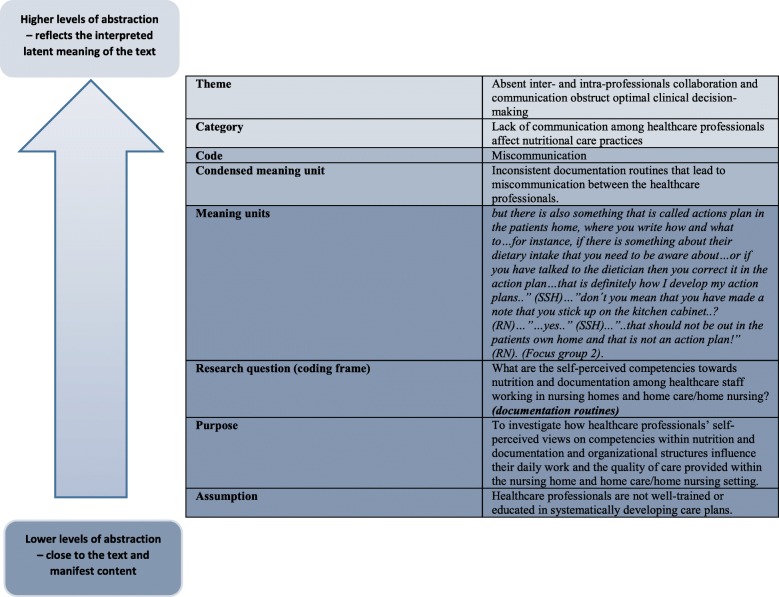
Conclusions: The six categories revealed two explanatory themes: 1) Absent inter- and intra-professional collaboration and communication obstructs optimal clinical decision-making and 2) quality deterioration due to poorly-established nutritional care structure. Overall, the two themes explain that from the healthcare professionals' point of view, a visible organization that allocates resources as well as prioritizing and articulating the need for daily nutritional care and documentation is a prerequisite for high-quality care and treatment. Furthermore, optimal clinical decision making among the healthcare professionals are compromised by imprecise and unclear language and terminology in the patients' healthcare records and also a lack of clinical guidelines and standards for collaboration between different healthcare professionals working in nursing homes, home care or home nursing. The findings of this study are beneficial to support organizations within these settings with strategies focusing on increasing nutritional care and documentation competencies among the healthcare professionals. Furthermore, the results advocate for the daily involvement and support of leaders and managers in articulating and structuring the importance of nutritional care and treatment and the subsequent documentation.
Keywords: Content analysis; Documentation; Focus group; Home care; Home nursing; Nursing home; Nutrition.
Conflict of interest statement
The authors declare that they have no competing interests.
Figures
Similar articles
-
Nursing home leaders' and nurses' experiences of resources, staffing and competence levels and the relation to hospital readmissions - a case study.BMC Health Serv Res. 2018 Dec 12;18(1):955. doi: 10.1186/s12913-018-3769-3. BMC Health Serv Res. 2018. PMID: 30541632 Free PMC article.
-
Healthcare professionals' experiences of providing individualized nutritional care for Older People in hospital and home care: a qualitative study.BMC Geriatr. 2019 Nov 20;19(1):317. doi: 10.1186/s12877-019-1339-0. BMC Geriatr. 2019. PMID: 31747884 Free PMC article.
-
Exploring influencing factors to clinical leadership development: a qualitative study with healthcare professionals in Flemish nursing homes.BMC Health Serv Res. 2024 Oct 3;24(1):1169. doi: 10.1186/s12913-024-11613-9. BMC Health Serv Res. 2024. PMID: 39363365 Free PMC article.
-
[Nursing home placement of people with dementia: a secondary analysis of qualitative data and literature review on perspectives of informal caregivers and healthcare professionals].Pflege. 2018 Jun;31(3):155-166. doi: 10.1024/1012-5302/a000611. Epub 2018 Mar 8. Pflege. 2018. PMID: 29514552 Review. German.
-
Nursing Minimum Data Sets for documenting nutritional care for adults in primary healthcare: a scoping review.JBI Database System Rev Implement Rep. 2018 Jan;16(1):117-139. doi: 10.11124/JBISRIR-2017-003386. JBI Database System Rev Implement Rep. 2018. PMID: 29324561
Cited by
-
Nutritional interventions to prevent and reduce overweight and obesity during postacute stroke rehabilitation: a scoping review protocol.BMJ Open. 2025 Feb 6;15(2):e092156. doi: 10.1136/bmjopen-2024-092156. BMJ Open. 2025. PMID: 39915013 Free PMC article.
-
Beyond motivation: Creating supportive healthcare environments for engaging in therapeutic patient education according to healthcare providers.PEC Innov. 2025 May 25;6:100405. doi: 10.1016/j.pecinn.2025.100405. eCollection 2025 Jun. PEC Innov. 2025. PMID: 40521055 Free PMC article.
-
Acquisition behaviours for nutrition-related information based on a health promotion model for older adults in a long-term care facility.Nurs Open. 2023 Sep;10(9):6416-6427. doi: 10.1002/nop2.1891. Epub 2023 Jun 21. Nurs Open. 2023. PMID: 37344968 Free PMC article.
-
The Longitudinal Effects of Low Body Mass Index on Unfavorable Physical Health Outcomes Among Older Adults Receiving Homecare Nursing: A Prospective Cohort Study.Res Nurs Health. 2025 Aug;48(4):478-486. doi: 10.1002/nur.22471. Epub 2025 May 27. Res Nurs Health. 2025. PMID: 40423666 Free PMC article.
-
Influence of cognitive function and nurse support on malnutrition risk in nursing home residents.Nurs Open. 2021 Jul;8(4):1805-1811. doi: 10.1002/nop2.824. Epub 2021 Feb 26. Nurs Open. 2021. PMID: 33635604 Free PMC article.
References
-
- Sackett DL, Straus S, Richardson SR, Rosenberg W, Haynes RB. London, Churchill Livingstone. 2 2000. Evidence-Based Medicine: How to Practice and Teach EBM.
-
- Sauer AC, Alish CJ, Strausbaugh K, West K, Quatrara B. Nurses needed: identifying malnutrition in hospitalized older adults. NursingPlus Open. 2016;2:21–26. doi: 10.1016/j.npls.2016.05.001. - DOI
Publication types
MeSH terms
LinkOut - more resources
Full Text Sources
Medical
