


Dermal regenerative matrix use in burn patients: A systematic review
- PMID: 31492583
- PMCID: PMC6823152
- DOI: 10.1016/j.bjps.2019.07.021
Dermal regenerative matrix use in burn patients: A systematic review
Abstract
Background: Dermal regenerative matrices (DRMs) have been used for several decades in the treatment of acute and reconstructive burn injury. The objective of this study was to perform a systematic review of the literature to assess clinical outcomes and safety profile of DRMs in full-thickness burn injury.
Methods: Comprehensive searches of MEDLINE, EMBASE, CINAHL, and Cochrane Library were performed from 1988 to 2017. Two independent reviewers completed preliminary and full-text screening of all articles. English-language articles reporting on DRM use in patients with full-thickness burn injury were included.
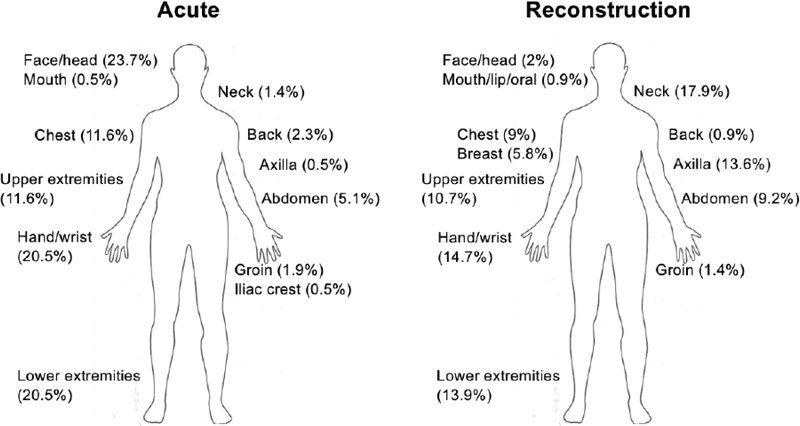
Results: Literature search generated 914 unique articles. Following screening, 203 articles were assessed for eligibility, and 72 met inclusion criteria for analysis. DRM was applied to1084 patients (74% acute burns, 26% burn reconstruction). Of the twelve studies that described changes in ROM, significant improvement was observed in 95% of reconstructive patients. The most frequently treated reconstructive sites were the neck, hand/wrist, lower extremity, and axilla. Vancouver scar scale was used in eight studies and indicated a significant improvement in the scar quality with DRM. The overall complication rate was 13%, most commonly infection, graft loss, hematoma formation, and contracture.
Conclusions: Although variability in functional and cosmetic outcomes was observed, DRM demonstrates improvements in ROM and scar appearance without objective regression. Essential demographic data were lacking in many studies, highlighting the need for future standardization of reporting outcomes in burns following application of dermal substitutes.
Keywords: Artificial skin; Burn; Burn injury; Skin substitute; Thermal injury.
Copyright © 2019 British Association of Plastic, Reconstructive and Aesthetic Surgeons. Published by Elsevier Ltd. All rights reserved.
Conflict of interest statement
CONFLICT OF INTEREST STATEMENT
The authors have no personal, commercial, or financial conflicts of interest to disclose. None of the authors has a financial interest in any of the products, devices, or drugs mentioned in this manuscript. This study was supported by the National Institutes of Health R01-GM087285–01. CFI Leader’s Opportunity Fund: Project #25407 and Canadian Institutes of Health Research (CIHR) grant #123336. Government of Canada Summer Jobs Grant: ROMEO# 20180041. The aforementioned sponsors had no involvement in this study. Some of the Canadian guidelines for Integra usage arose from an Integra-Sponsored Symposium, the Canadian Burn Symposium (Winnipeg, September 2017). Integra Life Sciences had no influence on the outcome of the study.
Figures

References
-
- “Burns.” World Health Organization, World Health Organization, 6 March 2018, www.who.int/en/news-room/fact-sheets/detail/burns.
-
- Lagus H, Sarlomo-Rikala M, Bohling T, Vuola J. Prospective study on burns treated with Integra®, a cellulose sponge and split thickness skin graft: comparative clinical and histological study – randomized controlled trial. Burns. 2013. December;39(8):1577–87. - PubMed
-
- Tompkins RG, Hilton JF, Burke JF, et al. Increased survival after massive thermal injuries in adults: preliminary report using artificial skin. Crit Care Med. 1989. August;17(8):734–40. - PubMed
-
- Cuadra A, Correa G, Roa R, et al. Functional results of burned hands treated with Integra®. J Plast Reconstr Aesthet Surg. 2012. February;65(2):228–34. - PubMed
-
- Peck MD, Kessler M, Meyer AA, Bonham Morris PA. A Trial of the Effectiveness of Artificial Dermis in the Treatment of Patients with Burns Greater Than 45% Total Body Surface Area. J Trauma. 2002;52(5):971–8. - PubMed
Publication types
MeSH terms
Grants and funding
LinkOut - more resources
Full Text Sources
Medical
Miscellaneous
