Review
. 2019 Sep 6;19(10):97.
doi: 10.1007/s11892-019-1216-4.

Novel Preparations of Glucagon for the Prevention and Treatment of Hypoglycemia

Affiliations
Review

Novel Preparations of Glucagon for the Prevention and Treatment of Hypoglycemia

Colin P Hawkes et al. Curr Diab Rep. .

Abstract

Purpose of review: New more stable formulations of glucagon have recently become available, and these provide an opportunity to expand the clinical roles of this hormone in the prevention and management of insulin-induced hypoglycemia. This is applicable in type 1 diabetes, hyperinsulinism, and alimentary hypoglycemia. The aim of this review is to describe these new formulations of glucagon and to provide an overview of current and future therapeutic opportunities that these may provide.

Recent findings: Four main categories of glucagon formulation have been studied: intranasal glucagon, biochaperone glucagon, dasiglucagon, and non-aqueous soluble glucagon. All four have demonstrated similar glycemic responses to standard glucagon formulations when administered during hypoglycemia. In addition, potential roles of these formulations in the management of congenital hyperinsulinism, alimentary hypoglycemia, and exercise-induced hypoglycemia in type 1 diabetes have been described. As our experience with newer glucagon preparations increases, the role of glucagon is likely to expand beyond the emergency use that this medication has been limited to in the past. The innovations described in this review likely represent early examples of a pending large repertoire of indications for stable glucagon.

Keywords: Alimentary; Diabetes; Formulation; Glucagon; Hyperinsulinism; Hypoglycemia.


Conflict of interest statement

Conflict of Interest Colin P. Hawkes declares that he has no conflict of interest.

Figures

Fig. 1
Fig. 1
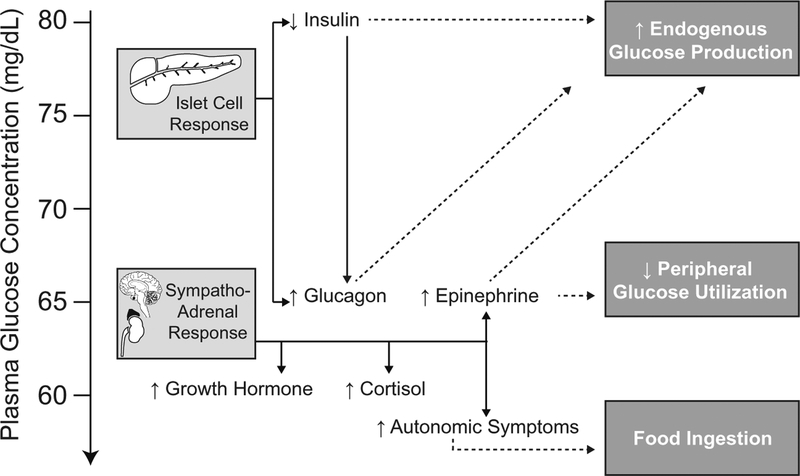
The islet cell and sympathoadrenal response to falling glucose concentrations in normal physiology
Fig. 2
Fig. 2
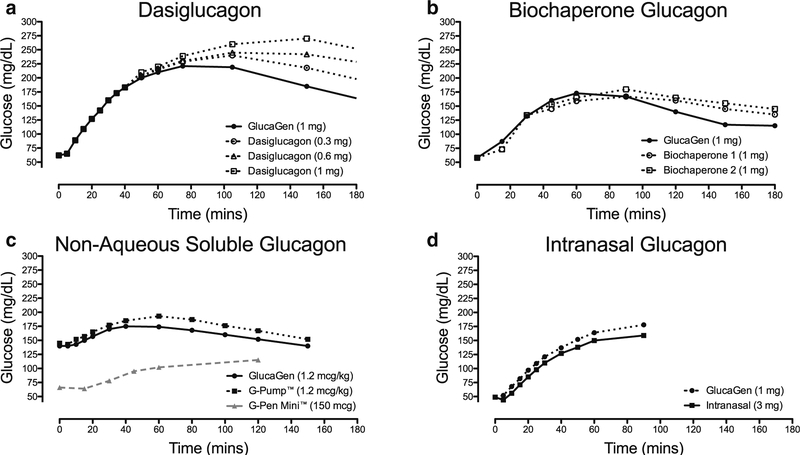
Comparison of the glycemic effect of a dasiglucagon, b biochaperone glucagon, c NAS glucagon, and d intranasal glucagon when compared with standard formulations of glucagon (GlucaGen Hypokit). Mean glucose concentrations at each time-point are represented following administration at t = 0. a Includes 58 patients aged 18 to 50 years with T1D. Hypoglycemia (55 mg/dL ± 10%) was induced by insulin prior to glucagon administration. (adapted from Hovelman et al. [52], with permission from American Diabetes Association). b Includes 27 patients with T1D who received 1 mg of two different biochaperone glucagon formulations when plasma glucose was less than 60 mg/dL. Hypoglycemia was induced by intravenous insulin infusion. (adapted from Glezer et al. [53], with permission from American Diabetes Association). c Black points include 19 adult patients aged 18 to 65 years with T1D. Hypoglycemia was not routinely induced prior to glucagon administration in this study (adapted from Castle et al. [54], with permission from SAGE Publications). Gray points show 62 events of hypoglycemia in 16 adult patients with T1D. In this study, mini-dose (150 mcg) glucagon was used to treat mild hypoglycemia (50 to 69 mg/dL) detected by continuous glucose monitor. (adapted from Haymond et al. [55], with permission from Oxford University Press). d Includes 75 adults with T1D. Hypoglycemia (48 ± 8 mg/dL) was induced by insulin prior to glucagon administration. (adapted from Rickels et al. [56], with permission from American Diabetes Association)

Similar articles

Cited by

References

    1. Schwartz NS, Clutter WE, Shah SD, Cryer PE. Glycemic thresholds for activation of glucose counterregulatory systems are higher than the threshold for symptoms. J Clin Invest. 1987;79(3):777–81. 10.1172/JCI112884. - DOI - PMC - PubMed
    1. Abraham MB, Jones TW, Naranjo D, Karges B, Oduwole A, Tauschmann M, et al. ISPAD clinical practice consensus guidelines 2018: assessment and management of hypoglycemia in children and adolescents with diabetes. Pediatr Diabetes. 2018;19(Suppl27):178–92. 10.1111/pedi.12698. - DOI - PubMed
    1. Hawkes CP, Lado JJ, Givler S, De Leon DD. The effect of continuous intravenous glucagon on glucose requirements in infants with congenital hyperinsulinism. JIMD rep. 2019;45:45–50. 10.1007/8904_2018_140. - DOI - PMC - PubMed
    2. • This study demonstrates the effect of a continuous intravenous glucagon infusion on glucose requirement on infants with congenital hyperinsulinism.

    1. Salehi M, Vella A, McLaughlin T, Patti ME. Hypoglycemia after gastric bypass surgery: current concepts and controversies. J Clin Endocrinol Metab. 2018;103(8):2815–26. 10.1210/jc.2018-00528. - DOI - PMC - PubMed
    1. Kedia N Treatment of severe diabetic hypoglycemia with glucagon: an underutilized therapeutic approach. Diabetes Metab Syndr Obes. 2011;4:337–46. 10.2147/DMSO.S20633. - DOI - PMC - PubMed

Publication types

MeSH terms