Review
. 2020 Mar:75:100779.
doi: 10.1016/j.preteyeres.2019.100779. Epub 2019 Sep 5.

Retinal stem cell transplantation: Balancing safety and potential

Affiliations
Review

Retinal stem cell transplantation: Balancing safety and potential

Mandeep S Singh et al. Prog Retin Eye Res. 2020 Mar.

Abstract

Stem cell transplantation holds great promise as a potential treatment for currently incurable retinal degenerative diseases that cause poor vision and blindness. Recently, safety data have emerged from several Phase I/II clinical trials of retinal stem cell transplantation. These clinical trials, usually run in partnership with academic institutions, are based on sound preclinical studies and are focused on patient safety. However, reports of serious adverse events arising from cell therapy in other poorly regulated centers have now emerged in the lay and scientific press. While progress in stem cell research for blindness has been greeted with great enthusiasm by patients, scientists, doctors and industry alike, these adverse events have raised concerns about the safety of retinal stem cell transplantation and whether patients are truly protected from undue harm. The aim of this review is to summarize and appraise the safety of human retinal stem cell transplantation in the context of its potential to be developed into an effective treatment for retinal degenerative diseases.


Conflict of interest statement

Declarations of interest:

  1. MSS: Patents on retinal cell delivery technology (Johns Hopkins University)

  2. SSP: None

  3. TAA: Consulting for Janssen Biotech, Inc.

  4. MVCS: None

  5. HK: Has an equity interest in jCyte, a company that may potentially benefit from his research results, and also serves on the company's Board. The terms of this arrangement have been reviewed and approved by the University of California, Irvine in accordance with its conflict of interest policies.

  6. REM: Grant funding from Oxstem Ocular Ltd and Astellas Inc.

  7. MT: None

  8. AN: None

  9. SDS: Grant support from Astellas, Nikon, Nidek and Verily

  10. KB: None

Figures

Figure 1.
Figure 1.
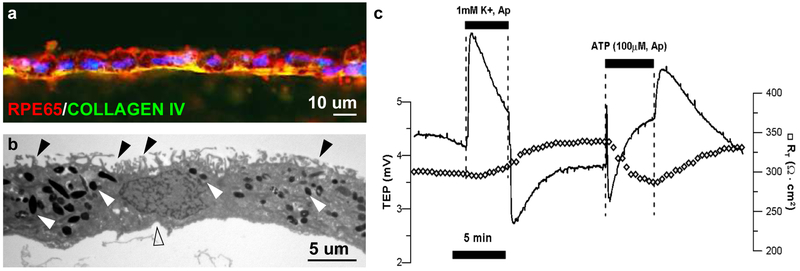
Characteristics of retinal pigment epithelium (RPE) cells differentiated from human induced pluripotent stem cells (iPSC). (a) iPSC-RPE matured on a PLGA scaffold express maturity marker RPE65 and Bruch’s membrane protein COLLAGEN IV. (b) Transmission electron microscope confirms the presence of dense apical processes (black arrowheads), pigment granules (white arrowheads), and basal infoldings (clear arrowhead). (c) iPSC-RPE monolayer electrical response are similar to native RPE cells. Cells have transepithelial resistance of over 300 Ohms.cm2 and a transepithelial potential of 4.5 mV. The cultured RPE monolayer hyperpolarizes in response to low potassium and depolarizes in response to apical ATP application.
Figure 2.
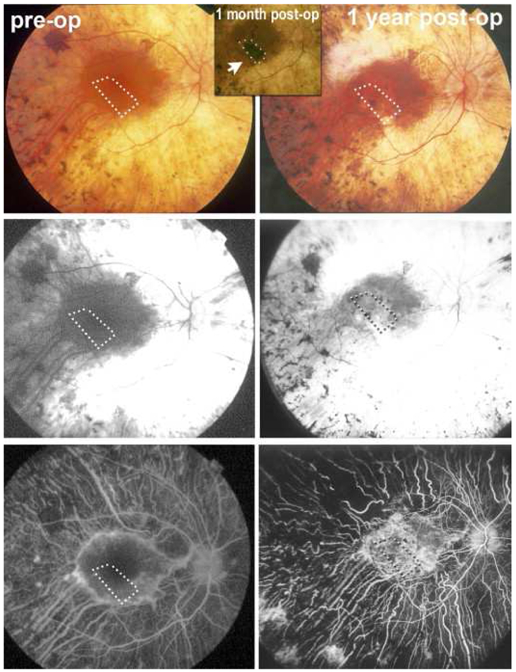
Figure 2.. Allogeneic fetal retina and retinal pigment epithelium (RPE) transplantation.
Images from a study subject with retinitis pigmentosa (RP) who was treated in a clinical trial of allogeneic retina and RPE transplantation (reprinted from Radtke ND, Aramant RB, Petry HM, Green PT, Pidwell DJ, Seiler MJ. Vision improvement in retinal degeneration patients by implantation of retina together with retinal pigment epithelium. Am J Ophthalmol 2008; 146(2): 172-82, with permission from Elsevier)(Radtke et al., 2008). Ten subjects with RP or age-related macular degeneration were included in this study. Donor tissue, comprising 2mm2 to 5mm2 sheets neural retina together with the adjacent RPE layer, was obtained from human fetal eyes of 10–15 weeks’ gestational age. Preoperative retinal images are shown in the left column (top to bottom: color fundus photograph, early-phase fluorescein angiogram, late phase fluorescein angiogram) and corresponding 1-year postoperative images on the right. The absence of fluorescein dye leakage in the region of the transplant (dotted box) was taken to imply evidence of the absence of clinical rejection of the grafts, that were all non-matched, despite the lack of immunosuppression. Four patients showed visual acuity improvements that exceeded that of the non-operated fellow eye, including one subject with 20/800 baseline vision sustained 20/200 vision for more than five years after surgery. No surgical complications occurred.
Figure 3.
Figure 3.
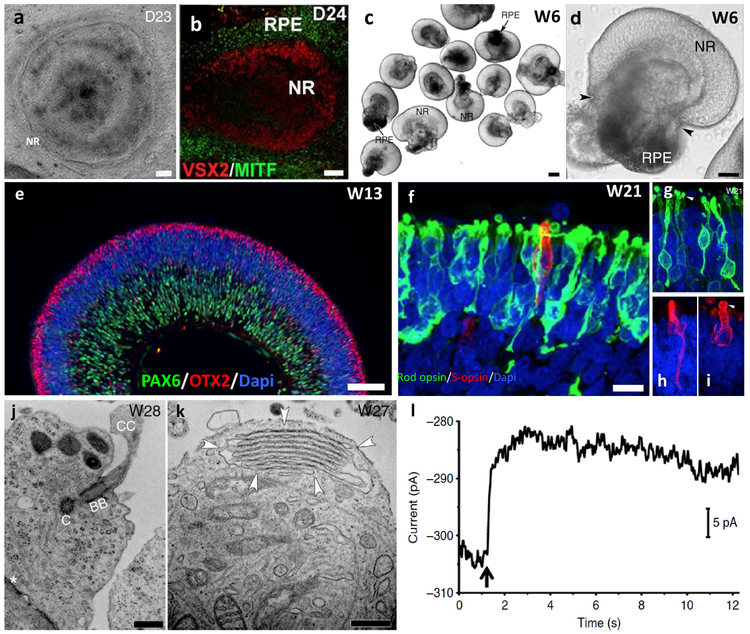
Stem cell-based differentiation of light-sensitive photoreceptor cells in three-dimensional culture. (a-b) Human induced pluripotent stem cells differentiating in adherent conditions formed neural retinal (NR) domains expressing VSX2 that were surrounded by a retinal pigmented epithelium (RPE) domain expressing MITF. (c) These NR domains were isolated and cultured in suspension to yield three-dimensional (3D) retinal cups containing NR and retinal pigment epithelium (RPE) cells. (d) Higher magnification of a retinal cup showing the NR and RPE cells that typically formed adjacent to each other. (d) Over time, 3D retinal cups acquired the characteristic retinal lamination containing the precursors of most of the major neuronal cell types, including ganglion, amacrine and horizontal cells (PAX6), and photoreceptors (OTX2). (f-i) Relatively advanced differentiation of photoreceptors occurred in culture, with morphological and molecular differentiation of rods and cones, including expression of rod opsin (f-g), S-opsin (h), and L/M-opsin (i) in individual cells. (j) As further evidence of relatively advanced differentiation, transmission electron microscopy showed presence of inner segments containing centriole (C), basal bodies (BB) and connecting cilia (CC); an outer limiting membrane (*) was also observed. (k) Laminated outer segments discs (arrowheads) also grew in culture, indicating specific and relatively advanced photoreceptor ultrastructural differentiation. (i) Perforated-patch electrophysiological recordings showed a flash-triggered response from light-sensitive photoreceptors. Scaler bars: 100μm (a-c and e), 50μm (d), 10μm (f), 0.05μm (j-k). (Figure and legend adapted from Zhong XF, Gutierrez C, Xue T, et al. Generation of three-dimensional retinal tissue with functional photoreceptors from human iPSCs. Nature Communications 2014; 5, CC-BY license).(Zhong et al., 2014a)
Figure 4.
Figure 4.
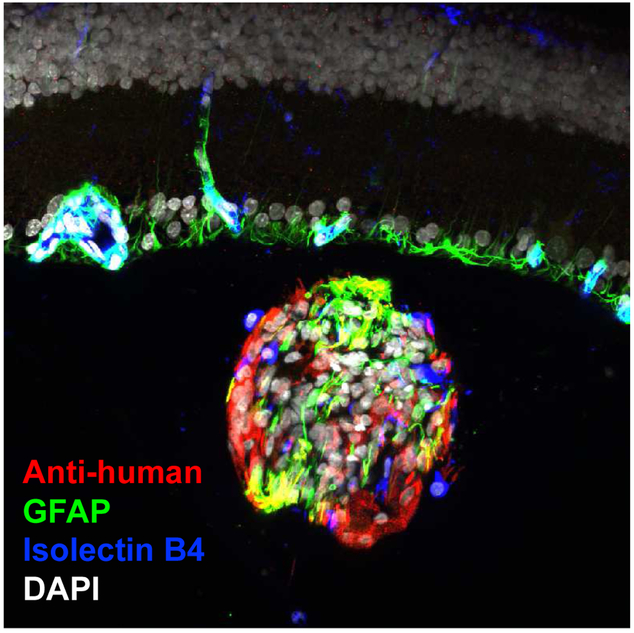
Intravitreal graft of retinal progenitor cells. Cultured human RPCs, labeled with antihuman antibody (red), are seen following injection into the vitreous cavity of a rat eye. The cells are injected as a single cell suspension but subsequently aggregate in vivo to form small clusters, as seen here. These clusters are free-floating and provide neutrotrophic support to the retina (laminar structure above the graft) without the need for integration into the host tissue. The RPCs of the grafts differentiate along either neuronal or glial lineages, with the latter seen here by way of labeling for GFAP (green). Host mononuclear leukocytes investigate the donor cells, illustrated here by positivity for isolectin B4 (blue) within the graft, but do not elicit an immunological rejection response. Nuclei are labeled with DAPI (white). This image was provided by Dr. Geoffrey Lewis, UCSB.
Figure 5.
Figure 5.
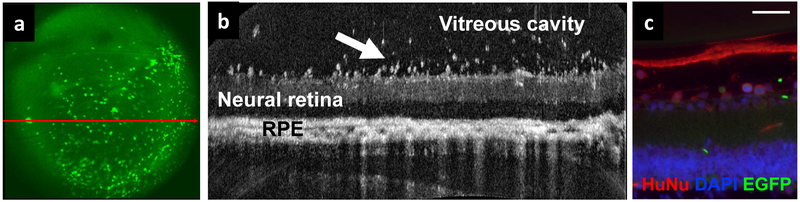
Intravitreal injection of human CD34+ stem cells from bone marrow in rd1 mice with retinal degeneration results in rapid homing and integration of these human cells to the surface layers of the retina (Moisseiev et al., 2016). The mouse was immunosuppressed with tacrolimus and rapamycin to avoid rejection of human cells. (A) Scanning laser ophthalmoscope (SLO) fundus image shows fluorescence from EGFP-labeled human CD34+ cells that have homed to the retina. (B) Simultaneous b-scan optical coherence tomography (OCT) imaging of the retina shows cells integrating into the retinal surface 1 week after intravitreal injection (arrow). RPE: retinal pigment epithelium. (C) Immunohistochemical analysis using anti-human nuclei monoclonal antibody (HuNu, red) shows human cells (identified by ring-shaped staining) within the superficial layers of the retina (scale bar, 50μm). (SLO and OCT images courtesy of Pengfei Zhang, PhD, Robert J. Zawadzki, PhD; immunohistochemical staining and images courtesy of Sharon Olten).
Figure 6.
Figure 6.
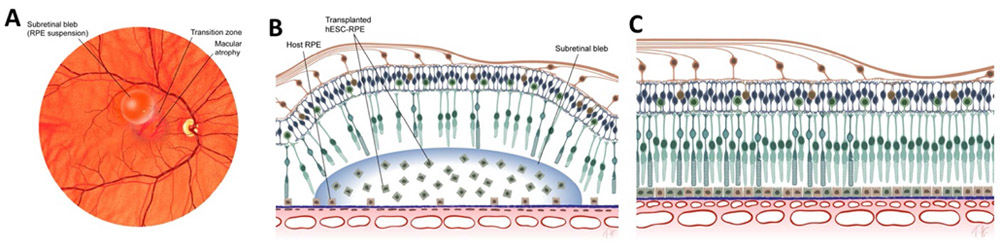
Schematic drawing of hESC-derived RPE transplanted as a suspension for macular degeneration. (A) A fixed volume of transplanted cells is delivered subretinally as a suspension via a 39-gauge injection site, or retinotomy (yellow dot). The transition zone at the border of the atrophic region was treated. (B) Schematic cross-section through the subretinal bleb at the time of delivery to a diseased retina with a suspension of transplanted hESC-derived RPE. (C) Ideally the transplanted cells survive the injection procedure, engraft on Bruch membrane, polarize, and then rescue the surviving photoreceptors. (Illustration by Timothy Hengst)
Figure 7.
Figure 7.
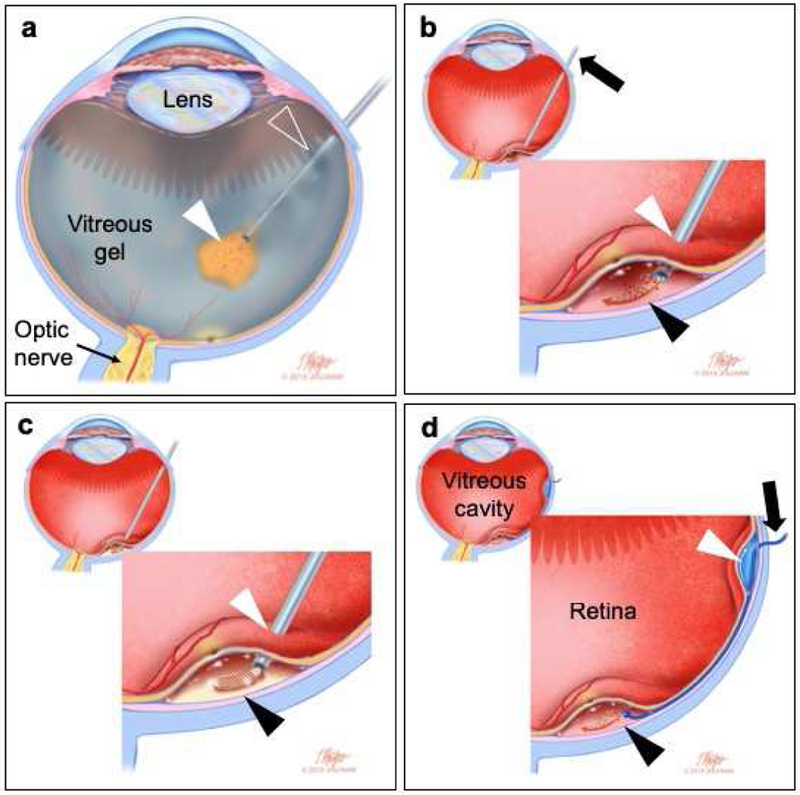
Schematic diagram depicting selected approaches of cell delivery for retinal therapy. (a) Intravitreal injection. The cells are injected as a suspension (white arrowhead) into the vitreous gel via a needle (clear arrowhead) introduced into the eye via the pars plana. The cells do not gain access to the subretinal space and remain in the vitreous. Note that the a vitrectomy procedure has not been performed here because it is not required for intravitreal delivery. (b) Subretinal injection of a cell suspension. After vitrectomy, a small-gauge needle or rigid cannula (arrow) is introduced into the eye via the pars plana. The needle or cannula is passed through a retinotomy at the injection site (white arrowhead) and the cell suspension is placed in the subretinal space near the fovea (black arrowhead). (c) Subretinal injection of a sheet of cells with or without a scaffold. suspension. After vitrectomy, a small-gauge needle or rigid cannula is introduced into the eye via the pars plana and passed through a retinotomy at the injection site (white arrowhead). The sheet construct is placed in the subretinal space near the fovea (black arrowhead). (d) Suprachoroidal cannulation. A flexible catheter (arrow) is inserted into a retinal bleb (white arrowhead) and threaded into the suprachoroidal space to the posterior pole or macula where the cell suspension is injected (black arrowhead) in the subretinal space near the fovea. A vitrectomy procedure is typically required and so the vitreous cavity shown here is devoid of gel. (Illustration by Timothy Phelps, MS, FAMI.)
Figure 8.
Figure 8.
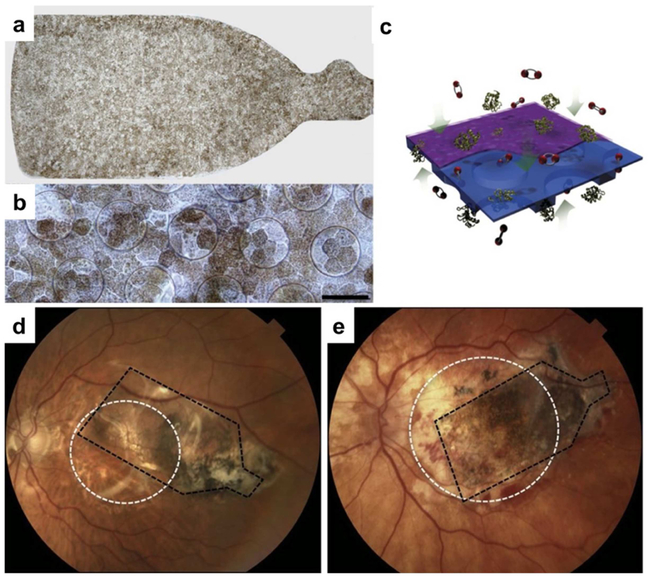
The California Project to Cure Blindness–Retinal Pigment Epithelium 1 (CPCB-RPE1) implant. (a) Low-magnification image of the implant that measured 3.5mm by 6.25mm comprising a synthetic parylene substrate and an overlying monolayer of RPE cells derived from human embryonic stem cells. (b) High-magnification image of the CPCB-RPE1 implant showing several ultrathin circular regions, measuring less than one micron in thickness. These regions facilitated nutrient and growth factor diffusion from the underlying choroid as depicted in the schematic in (c). (d–e) Color fundus photographs of the maculae of two representative study subjects (d, 125 days and e, 120 days post-operatively). The geographic atrophy regions in each subject are demarcated by white dashed lines and the CPCB-RPE1 implants by the black dashed lines respectively. Figure and legend adapted from Kashani AH, Lebkowski JS, Rahhal FM, et al. A bioengineered retinal pigment epithelial monolayer for advanced, dry age-related macular degeneration. Sci Transl Med 2018; 10(435).(Kashani et al., 2018) Reprinted with permission from AAAS.
Figure 9.
Figure 9.
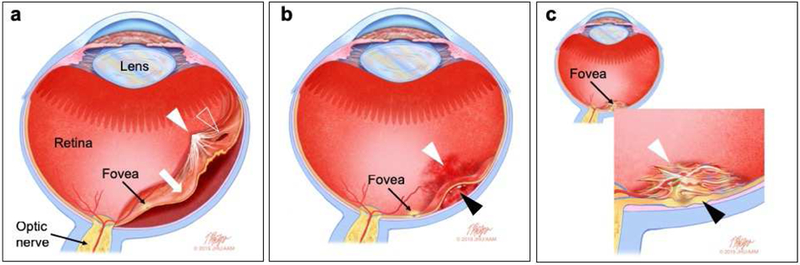
Schematic diagram depicting selected complications of retinal cell therapy. (a) Retinal detachment and proliferative vitreoretinopathy. The retina has detached (white arrow) and the detachment involves the fovea, thus severely reducing visual acuity. The detachment depicted here is associated with a proliferative vitreoretinopathy membrane (white arrowhead) and a retinal break (clear arrowhead). (b) Hemorrhage. Here, blood has collected in the vitreous cavity and on the retinal surface (vitreous cavity hemorrhage, white arrowhead) and beneath the retina (subretinal hemorrhage, black arrowhead) causing a hemorrhagic retinal detachment that threatens the fovea. (c) Epiretinal membrane. A thick epiretinal membrane (white arrowhead) has resulted in foveal thickening and distortion (black arrowhead). Epiretinal membranes can form after cell delivery regardless of whether the exogenous cells have been inadvertently placed in the epiretinal surface. with or without Complications that are not depicted in this diagram include infection (endophthalmitis), cataract, elevation of intraocular pressure and crystalline lens dislocation. (Illustration by Timothy Phelps, MS, FAMI.)
Figure 10.
Figure 10.
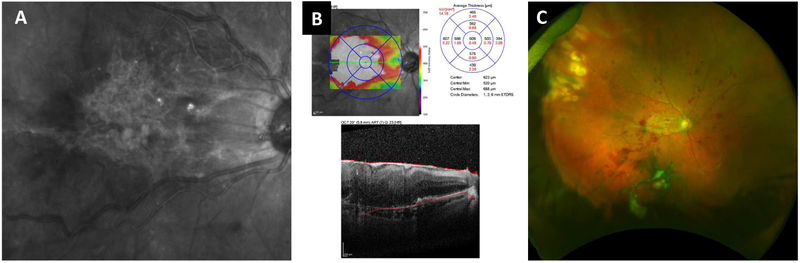
Adverse events outside of clinical trials. (A) Red free retinal image (showing epiretinal membrane, ERM) and (B) OCT of the right eye of a 78-year-old woman having received intravitreal injection of adipose-derived stem cells one week prior to presentation. She suffered profound vision loss immediately following injection from 20/50 to hand motions vision. Seventeen days after injection, she developed a combined traction-rhegmatogenous retinal detachment in this eye (C). After surgical repair, her final visual acuity was counting fingers vision. The OCT and infrared images demonstrate the robust ERM after adipose-derived stem cell injection that was not there prior to injection. The data from this patient have been reported in this reference (Kuriyan et al., 2017), however none of these images were published.

References

    1. Agrawal RN, He S, Spee C, Cui JZ, Ryan SJ, Hinton DR, 2007. In vivo models of proliferative vitreoretinopathy. Nat. Protoc 2, 67–77. - PubMed
    1. American Academy of Ophthalmology, 2016. Intraocular stem cell therapy.
    1. Amezcua L, Nelson F, 2017. Ethical Considerations of Patient-Funded Research for Multiple Sclerosis Therapeutics. Neurotherapeutics : the journal of the American Society for Experimental NeuroTherapeutics 14, 945–951. - PMC - PubMed
    1. Apte RS, 2018. Gene therapy for retinal degeneration. Cell 173, 5. - PubMed
    1. Ardeljan D, Chan CC, 2013. Aging is not a disease: distinguishing age-related macular degeneration from aging. Prog. Retin. Eye Res 37, 68–89. - PMC - PubMed

Publication types

MeSH terms