


Artificial Intelligence in Radiotherapy Treatment Planning: Present and Future
- PMID: 31495281
- PMCID: PMC6732844
- DOI: 10.1177/1533033819873922
Artificial Intelligence in Radiotherapy Treatment Planning: Present and Future
Abstract
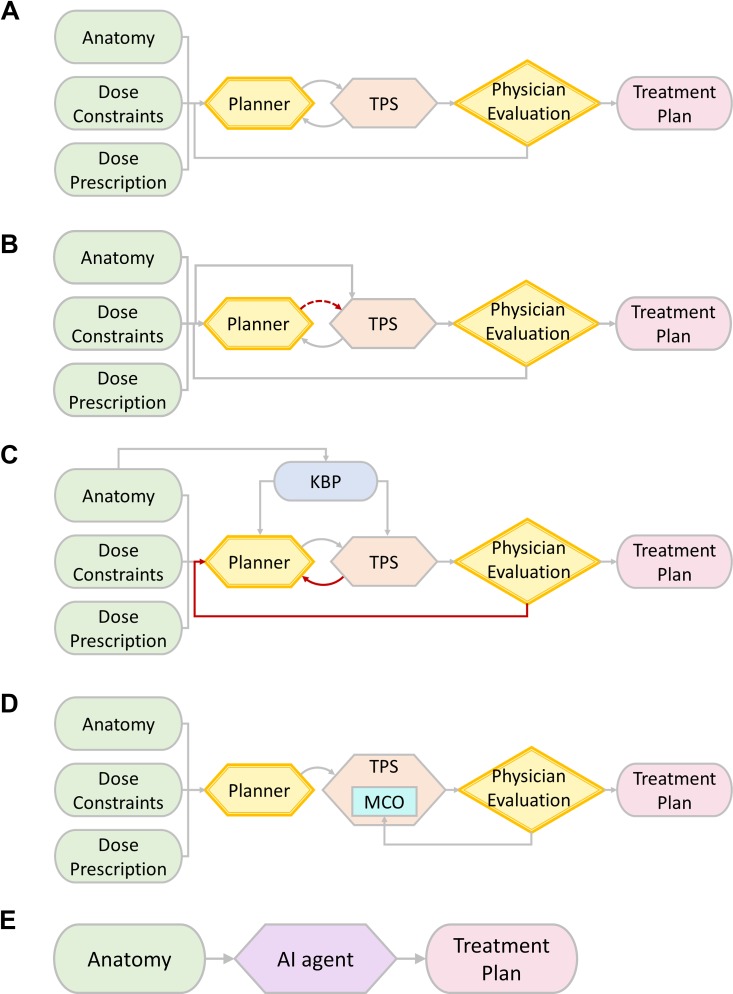
Treatment planning is an essential step of the radiotherapy workflow. It has become more sophisticated over the past couple of decades with the help of computer science, enabling planners to design highly complex radiotherapy plans to minimize the normal tissue damage while persevering sufficient tumor control. As a result, treatment planning has become more labor intensive, requiring hours or even days of planner effort to optimize an individual patient case in a trial-and-error fashion. More recently, artificial intelligence has been utilized to automate and improve various aspects of medical science. For radiotherapy treatment planning, many algorithms have been developed to better support planners. These algorithms focus on automating the planning process and/or optimizing dosimetric trade-offs, and they have already made great impact on improving treatment planning efficiency and plan quality consistency. In this review, the smart planning tools in current clinical use are summarized in 3 main categories: automated rule implementation and reasoning, modeling of prior knowledge in clinical practice, and multicriteria optimization. Novel artificial intelligence-based treatment planning applications, such as deep learning-based algorithms and emerging research directions, are also reviewed. Finally, the challenges of artificial intelligence-based treatment planning are discussed for future works.
Keywords: artificial intelligence machine learning radiotherapy treatment planning automation.
Conflict of interest statement
Figures
References
-
- Russell SJ, Norvig P. Artificial Intelligence: A Modern Approach. Upper Saddle River, New Jersey: Pearson Education Limited; 2016.
-
- Poole DL, Mackworth AK, Goebel R. Computational Intelligence: A Logical Approach. New York, NY: Oxford University Press New York; 1998.
-
- Foy JJ, Marsh R, Ten Haken RK, et al. An analysis of knowledge-based planning for stereotactic body radiation therapy of the spine. Pract Radiat Oncol. 2017;7(5):e355–e60. - PubMed
Publication types
MeSH terms
LinkOut - more resources
Full Text Sources
Miscellaneous
