


The efficacy of app-supported smartphone interventions for mental health problems: a meta-analysis of randomized controlled trials
- PMID: 31496095
- PMCID: PMC6732686
- DOI: 10.1002/wps.20673
The efficacy of app-supported smartphone interventions for mental health problems: a meta-analysis of randomized controlled trials
Abstract
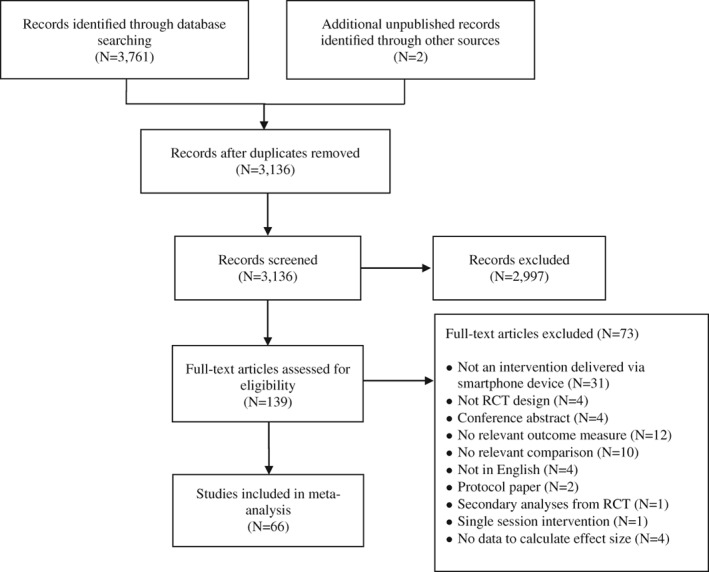
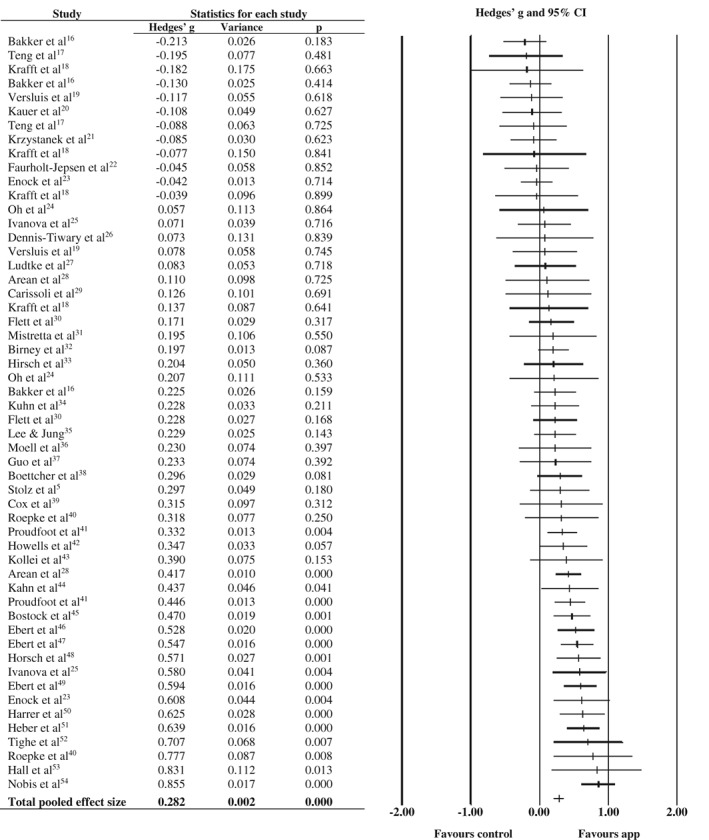
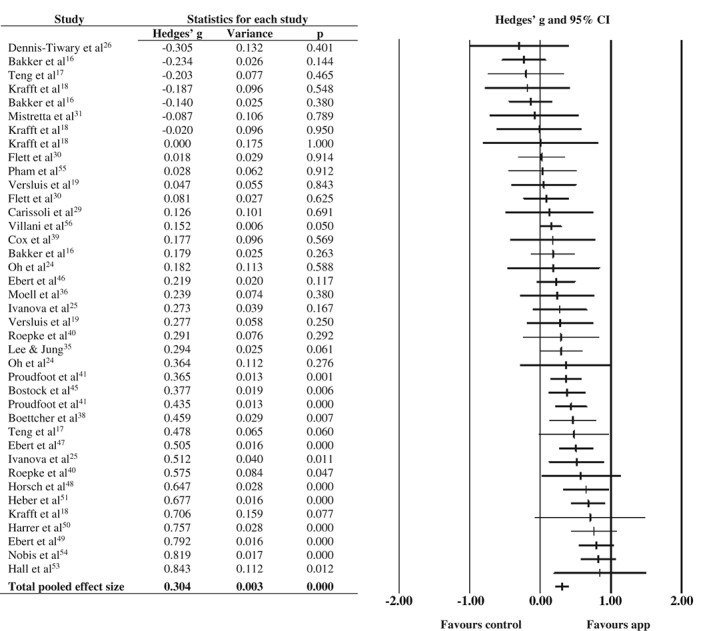
Although impressive progress has been made toward developing empirically-supported psychological treatments, the reality remains that a significant proportion of people with mental health problems do not receive these treatments. Finding ways to reduce this treatment gap is crucial. Since app-supported smartphone interventions are touted as a possible solution, access to up-to-date guidance around the evidence base and clinical utility of these interventions is needed. We conducted a meta-analysis of 66 randomized controlled trials of app-supported smartphone interventions for mental health problems. Smartphone interventions significantly outperformed control conditions in improving depressive (g=0.28, n=54) and generalized anxiety (g=0.30, n=39) symptoms, stress levels (g=0.35, n=27), quality of life (g=0.35, n=43), general psychiatric distress (g=0.40, n=12), social anxiety symptoms (g=0.58, n=6), and positive affect (g=0.44, n=6), with most effects being robust even after adjusting for various possible biasing factors (type of control condition, risk of bias rating). Smartphone interventions conferred no significant benefit over control conditions on panic symptoms (g=-0.05, n=3), post-traumatic stress symptoms (g=0.18, n=4), and negative affect (g=-0.08, n=5). Studies that delivered a cognitive behavior therapy (CBT)-based app and offered professional guidance and reminders to engage produced larger effects on multiple outcomes. Smartphone interventions did not differ significantly from active interventions (face-to-face, computerized treatment), although the number of studies was low (n≤13). The efficacy of app-supported smartphone interventions for common mental health problems was thus confirmed. Although mental health apps are not intended to replace professional clinical services, the present findings highlight the potential of apps to serve as a cost-effective, easily accessible, and low intensity intervention for those who cannot receive standard psychological treatment.
Keywords: App-supported smartphone interventions; anxiety; depression; general psychiatric distress; mental health problems; positive affect; psychological treatments.
© 2019 World Psychiatric Association.
Figures
References
-
- Kazdin AE. Addressing the treatment gap: a key challenge for extending evidence‐based psychosocial interventions. Behav Res Ther 2017;88:7‐18. - PubMed
-
- Kazdin AE. Expanding mental health services through novel models of intervention delivery. J Child Psychol Psychiatry 2019;60:455‐72. - PubMed
-
- Stolz T, Schulz A, Krieger T et al. A mobile app for social anxiety disorder: a three‐arm randomized controlled trial comparing mobile and PC‐based guided self‐help interventions. J Consult Clin Psychol 2018;86:493‐504. - PubMed
LinkOut - more resources
Full Text Sources
Medical
Miscellaneous
