


Thermal and mechanical quantitative sensory testing values among healthy African American adults
- PMID: 31496792
- PMCID: PMC6693422
- DOI: 10.2147/JPR.S211855
Thermal and mechanical quantitative sensory testing values among healthy African American adults
Abstract
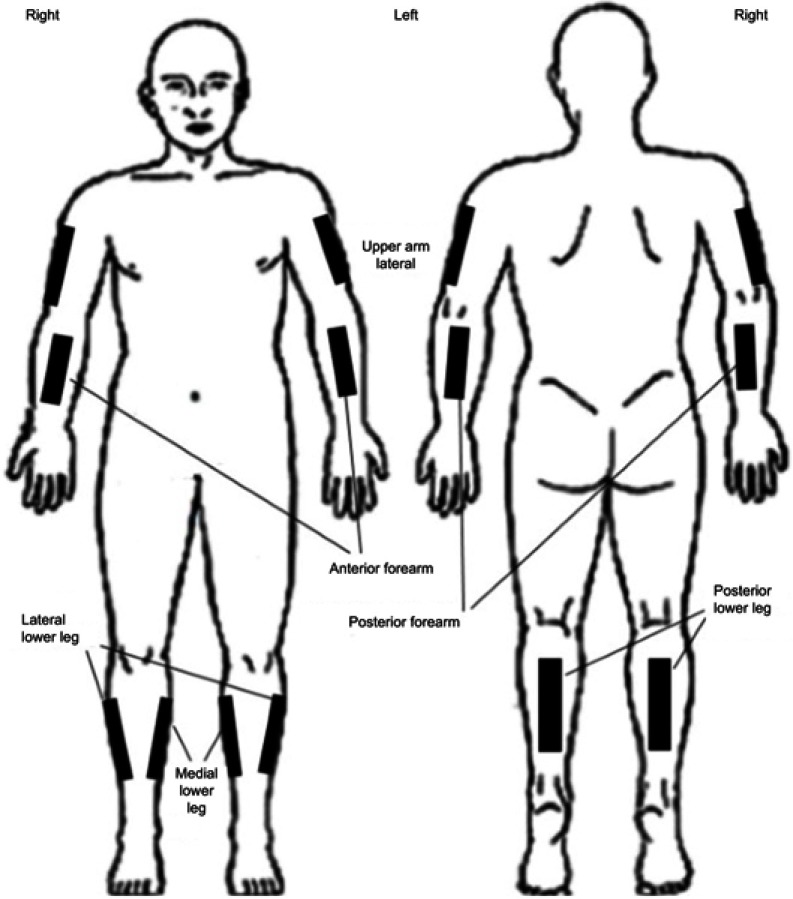
Purpose: Only a few studies have reported quantitative sensory testing (QST) reference values for healthy African Americans, and those studies are limited in sample size and age of participants. The study purpose was to characterize QST values in healthy, pain-free African American adults and older adults whose prior pain experiences and psychological status were also measured. We examined the QST values for differences by sex, age, and body test site.
Patients and methods: A cross-sectional sample of 124 pain-free African American adults (age 18-69 years, 49% female) completed demographic and self-reported pain, fatigue and psychosocial measures. QST was performed to obtain thermal and mechanical responses and associated pain intensity levels.
Results: We found thermal detection values at the anterior forearm were (29.2 °C±1.6) for cool detection (CD) and (34.5 °C±1.2) for warm detection (WD). At that site the sample had cold pain threshold (CPTh) (26.3 °C±5.0), heat pain threshold (HPTh) (37.8 °C±3.6), and mechanical pain thresholds (MPTH) (16.7±22.2 grams of force, gF). There was a significant between sex difference for WD, with women being more sensitive (q=0.027). Lower body sites were less sensitive than upper body sites across all thermal modalities (q<0.003), but not for the mechanical modality.
Conclusion: The QST values from this protocol at the anterior forearm indicate that the healthy African American adults had average thermal pain thresholds close to the temperature of adaptation and average MPTh under 20 gF. Differences in responses to thermal and mechanical stimuli for upper verses lower body were consistent with prior research.
Keywords: African Americans; PROMIS; QST; healthy; pain; quantitative sensory testing.
Conflict of interest statement
Molokie, Wang, Yao and Schlaeger reports grants from NIH, during the conduct of the study. Powell-Roach reports grants from NHLBI and Robert Wood Johnson Foundation, during the conduct of the study. Fillingim owns stock in Algynomics, a company which does not own any tools used for this research. Wilkie reports grants from NIH, during the conduct of the study and is co-founder and chair of eNursing llc, a company which does not own any tools used for this research. The authors report no other conflicts of interest in this work.
Figures


References
-
- Edwards RR, Fillingim RB. Ethnic differences in thermal pain responses. Psychosom Med. 1999;61(3):346–354. - PubMed
Grants and funding
LinkOut - more resources
Full Text Sources
Miscellaneous
