


Complexity of Primary Lifetime Occupation and Cognitive Processing
- PMID: 31496970
- PMCID: PMC6712086
- DOI: 10.3389/fpsyg.2019.01861
Complexity of Primary Lifetime Occupation and Cognitive Processing
Abstract
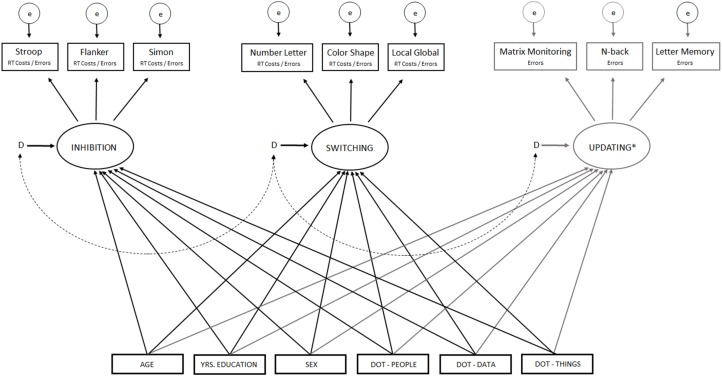
Today, there are a lack of studies focusing on the relationship between occupational complexity and executive functioning. This is noteworthy since executive functions are core aspects of cognitive processing. The present study was aimed to investigate if three occupational complexity factors (with data, people, and things) of main lifetime occupation were related to performance in executive tasks (inhibition, switching, updating). We analyzed cross-sectional data that were available for 225 participants aged 50-75 years. Results from structural equation models showed that higher complexity levels of working with data were related to lower error rates in the updating component of cognitive control. In addition, higher rates of complexity working with people was associated with lower error rates in task-switching, which also persisted after adjustment of fluid intelligence. Complexity with things, however, was not related to performance in the executive tasks. Future studies would benefit from a longitudinal design to investigate if the results from this study also hold in the long term and to further investigate the directionality between factors.
Keywords: DOT; cognition; executive functioning; inhibition; occupational complexity; switching; updating; work complexity.
Figures
References
-
- Andel R., Crowe M., Pedersen N. L., Mortimer J., Crimmins E., Johansson B., et al. (2005). Complexity of work and risk of Alzheimer’s disease: a population-based study of Swedish twins. J. Gerontol. B. Psychol. Sci. Soc. Sci. 60 251–258. - PubMed
-
- Ansiau D., Marquié J. C., Soubelet A., Ramos S. (2005). Relationships between cognitive characteristics of the job, age, and cognitive efficiency. Int. Congr. Ser. 1280 43–48. 10.1016/j.ics.2005.01.020 - DOI
LinkOut - more resources
Full Text Sources
