Review
. 2019 Aug 21:10:1943.
doi: 10.3389/fmicb.2019.01943. eCollection 2019.

Nitrogen Cycling in Soybean Rhizosphere: Sources and Sinks of Nitrous Oxide (N2O)

Affiliations
Review

Nitrogen Cycling in Soybean Rhizosphere: Sources and Sinks of Nitrous Oxide (N2O)

Cristina Sánchez et al. Front Microbiol. .

Abstract

Nitrous oxide (N2O) is the third most important greenhouse gas after carbon dioxide and methane, and a prominent ozone-depleting substance. Agricultural soils are the primary anthropogenic source of N2O because of the constant increase in the use of industrial nitrogen (N) fertilizers. The soybean crop is grown on 6% of the world's arable land, and its production is expected to increase rapidly in the future. In this review, we summarize the current knowledge on N-cycle in the rhizosphere of soybean plants, particularly sources and sinks of N2O. Soybean root nodules are the host of dinitrogen (N2)-fixing bacteria from the genus Bradyrhizobium. Nodule decomposition is the main source of N2O in soybean rhizosphere, where soil organisms mediate the nitrogen transformations that produce N2O. This N2O is either emitted into the atmosphere or further reduced to N2 by the bradyrhizobial N2O reductase (N2OR), encoded by the nos gene cluster. The dominance of nos - indigenous populations of soybean bradyrhizobia results in the emission of N2O into the atmosphere. Hence, inoculation with nos + or nos ++ (mutants with enhanced N2OR activity) bradyrhizobia has proved to be promising strategies to reduce N2O emission in the field. We discussed these strategies, the molecular mechanisms underlying them, and the future perspectives to develop better options for global mitigation of N2O emission from soils.

Keywords: Bradyrhizobium; N2O reductase; denitrification; greenhouse gas; mitigation strategies; nos regulation; rhizosphere; soybean.


Figures
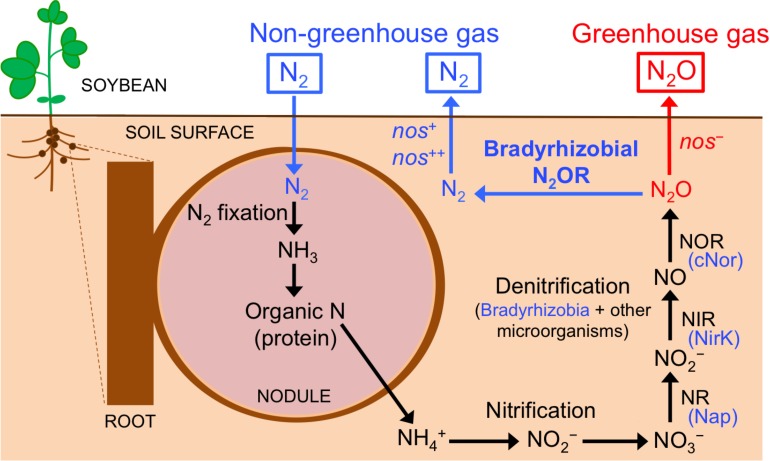
FIGURE 1
FIGURE 1
Nitrogen transformations in soybean rhizosphere. Organic nitrogen in the nodule is mineralized into NH4+ that will be transformed into N2O through nitrification and denitrification processes. Soybean bradyrhizobia (blue) and other microorganisms contribute to the denitrification process. The N2O formed is either emitted into the atmosphere (red) or further reduced to N2 exclusively by soybean bradyrhizobia that produce N2O reductase (N2OR; blue). Nase, nitrogenase; NR, dissimilatory nitrate reductase; Nap, periplasmic nitrate reductase; NIR, dissimilatory nitrite reductase; NirK, Cu-containing nitrite reductase; NOR, nitric oxide reductase; cNor, c-type nitric oxide reductase. See text for more details.
FIGURE 2
FIGURE 2
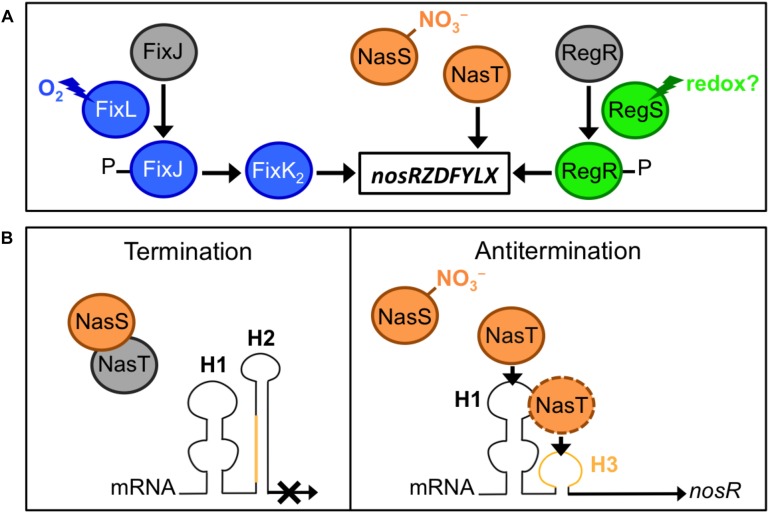
Regulation of N2O reductase genes in bradyrhizobia. (A) Environmental factors and regulatory proteins involved in the control of nos expression. (B) The mechanism for NasT-mediated transcriptional antitermination of the nos genes. In the absence of nitrate (NO3), NasT is sequestered by NasS; thus in the absence of NasT, the native conformation of the nosR-leader mRNA, which contains the H1 and H2 hairpins, is responsible for the termination of the nos transcription. When a certain level of NO3 is sensed by NasS, NasT is dissociated from NasS–NasT complex; the binding of NasT to H1 (and likely to H3 region, in orange) results in a conformational change in the mRNA that allows the read-through transcription of nos genes.

References

    1. Akiyama H., Hoshino Y. T., Itakura M., Shimomura Y., Wang Y., Yamamoto A., et al. (2016). Mitigation of soil N2O emission by inoculation with a mixed culture of indigenous Bradyrhizobium diazoefficiens. Sci. Rep. 6:32869. 10.1038/srep3286910.1038/srep32869 - DOI - PMC - PubMed
    1. Argaw A. (2014). Symbiotic effectiveness of inoculation with Bradyrhizobium isolates on soybean [Glycine max (L.) Merrill] genotypes with different maturities. Springer Plus. 3:753. 10.1186/2193-1801-3-753 - DOI - PMC - PubMed
    1. Badr O., Probert S. D. (1992). Nitrous oxide in the Earth’s atmosphere. Appl. Energ. 41 177–200. 10.1016/0306-2619(92)90002-s - DOI
    1. Bakken L. R., Bergaust L., Liu B., Frostegard Å. (2012). Regulation of denitrification at the cellular level: a clue to the understanding of N2O emissions from soils Phil. Trans. R. Soc. B. 367 1224–1234. 10.1098/rstb.2011.0321 - DOI - PMC - PubMed
    1. Bakker P. A., Berendsen R. L., Doornbos R. F., Wintermans P. C., Pieterse C. M. (2013). The rhizosphere revisited: root microbiomics. Front. Plant Sci. 4:165. 10.3389/fpls.2013.00165 - DOI - PMC - PubMed

LinkOut - more resources