Quick fix for care, productivity, hygiene and inequality: reframing the entrenched problem of antibiotic overuse
- PMID: 31497315
- PMCID: PMC6703303
- DOI: 10.1136/bmjgh-2019-001590
Quick fix for care, productivity, hygiene and inequality: reframing the entrenched problem of antibiotic overuse
Abstract
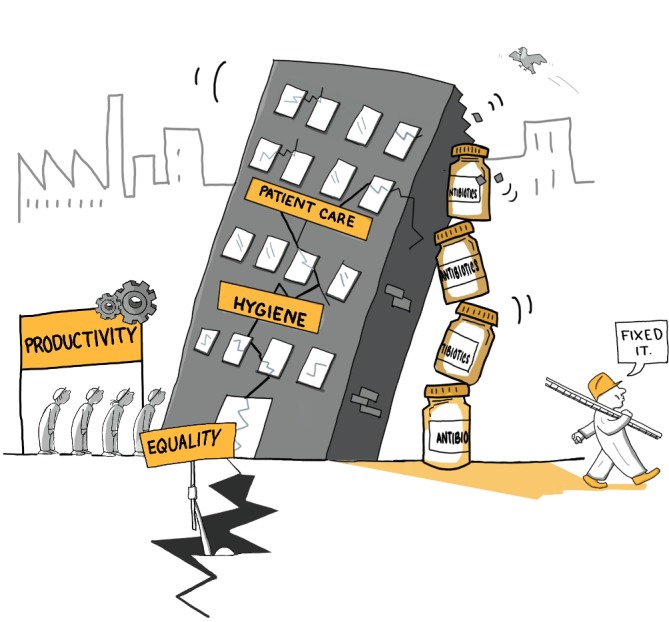
Antimicrobial resistance (AMR) is a major challenge of our time. A key global objective is to reduce antibiotic use (ABU), in order to reduce resistance caused by antimicrobial pressure. This is often set as a 'behaviour change' issue, locating intervention efforts in the knowledge and attitudes of individual prescribers and users of medicines. Such approaches have had limited impact and fall short of addressing wider drivers of antibiotic use. To address the magnitude of antibiotic overuse requires a wider lens to view our relationships with these medicines. This article draws on ethnographic research from East Africa to answer the question of what roles antibiotics play beyond their immediate curative effects. We carried out interviews, participant observation and documentary analysis over a decade in northeast Tanzania and eastern and central Uganda. Our findings suggest that antibiotics have become a 'quick fix' in our modern societies. They are a quick fix for care in fractured health systems; a quick fix for productivity at local and global scales, for humans, animals and crops; a quick fix for hygiene in settings of minimised resources; and a quick fix for inequality in landscapes scarred by political and economic violence. Conceptualising antibiotic use as a 'quick fix' infrastructure shifts attention to the structural dimensions of AMR and antimicrobial use (AMU) and raises our line of sight into the longer term, generating more systemic solutions that have greater chance of achieving equitable impact.
Keywords: antimicrobial resistance; care; hygiene; inequality; productivity.
Conflict of interest statement
Competing interests: None declared.
References
-
- World Health Organisation Global action plan on antimicrobial resistance. Geneva: Available online at, 2015.
-
- OIE The OIE strategy on antimicrobial resistance and the Prudent use of antimicrobials. World Organisation for Animal Health, 2016Online at.
-
- Food and Agiculture Organisation of the United Nations The Fao action plan on antimicrobial resistance 2016-2020. Rome. Available online at 2016http://www.fao.org/3/a-i5996e.pdf
Publication types
LinkOut - more resources
Full Text Sources