


Neonatal Cardiac ECMO in 2019 and Beyond
- PMID: 31497583
- PMCID: PMC6712998
- DOI: 10.3389/fped.2019.00327
Neonatal Cardiac ECMO in 2019 and Beyond
Abstract
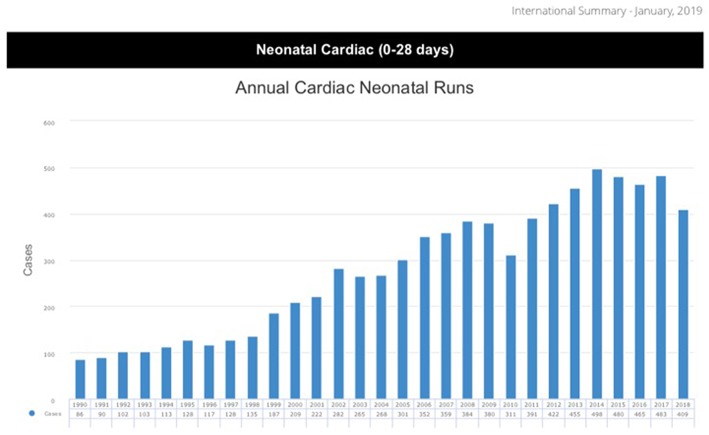
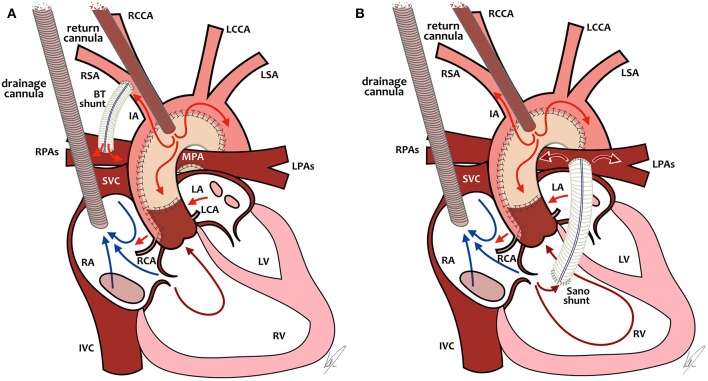
Worldwide, the use of Extracorporeal Membrane Oxygenation (ECMO) for cardiac failure has been steadily increasing in the neonatal population and has become a widely accepted modality. Especially in centers caring for children with (congenital) heart disease, ECMO is now an essential part of care available for those with severe heart failure as a bridge to recovery, long term mechanical support, or transplantation. Short-term outcomes depend very much on indication. Hospital survival is ~40% for all neonatal cardiac ECMO patients combined. ECMO is being used for pre- and/or post-operative stabilization in neonates with congenital heart disease and in neonates with medical heart disease such as myocarditis, cardiomyopathy or refractory arrhythmias. ECMO use during resuscitation (ECPR) or for sepsis is summarized elsewhere in this special edition of Frontiers in Pediatrics. In this review article, we will discuss the indications for neonatal cardiac ECMO, the difficult process of patients' selection and identifying the right timing to initiate ECMO, as well as outline pros and cons for peripheral vs. central cannulation. We will present predictors of mortality and, very importantly, predictors of survival: what can be done to improve the outcomes for your patients. Furthermore, an overview of current insights regarding supportive care in neonatal cardiac ECMO is given. Additionally, we will address issues specific to neonates with single ventricle physiology on ECMO, for example cannulation strategies and the influence of shunt type (Blalock-Taussig shunt vs. "right ventricle to pulmonary artery" shunt). We will not only focus on short term outcomes, such as hospital survival, but also on the importance of long-term neuro-developmental outcomes, and we will end this review with suggestions for future research.
Keywords: ECMO; cardiac; heart failure; neonate; post-cardiotomy; selection criteria; single ventricle.
Figures
Similar articles
-
Post-cardiotomy extracorporeal cardiopulmonary resuscitation in neonates with complex single ventricle: analysis of outcomes.Eur J Cardiothorac Surg. 2011 Dec;40(6):1396-405; discussion 1405. doi: 10.1016/j.ejcts.2011.01.087. Epub 2011 Apr 20. Eur J Cardiothorac Surg. 2011. PMID: 21507672
-
Does single ventricle physiology affect survival of children requiring extracorporeal membrane oxygenation support following cardiac surgery?World J Pediatr Congenit Heart Surg. 2014 Jan 1;5(1):7-15. doi: 10.1177/2150135113507292. World J Pediatr Congenit Heart Surg. 2014. PMID: 24403349
-
Improved Outcome of Cardiac Extracorporeal Membrane Oxygenation in Infants and Children Using Magnetic Levitation Centrifugal Pumps.Artif Organs. 2016 Jan;40(1):27-33. doi: 10.1111/aor.12647. Epub 2015 Nov 26. Artif Organs. 2016. PMID: 26608937
-
Cardiac extracorporeal life support: state of the art in 2007.Cardiol Young. 2007 Sep;17 Suppl 2:104-15. doi: 10.1017/S1047951107001217. Cardiol Young. 2007. PMID: 18039404 Review.
-
Review of ECMO (extra corporeal membrane oxygenation) support in critically ill adult patients.Heart Lung Circ. 2008;17 Suppl 4:S41-7. doi: 10.1016/j.hlc.2008.08.009. Epub 2008 Oct 29. Heart Lung Circ. 2008. PMID: 18964254 Review.
Cited by
-
Extracorporeal Membrane Oxygenation in Congenital Heart Disease.Children (Basel). 2022 Mar 9;9(3):380. doi: 10.3390/children9030380. Children (Basel). 2022. PMID: 35327752 Free PMC article. Review.
-
ECMO in neonates: The association between cerebral hemodynamics with neurological function.Front Pediatr. 2022 Sep 6;10:908861. doi: 10.3389/fped.2022.908861. eCollection 2022. Front Pediatr. 2022. PMID: 36147805 Free PMC article. Review.
-
Risk factors, incidence, and outcomes of neonatal respiratory extracorporeal membrane oxygenation including association with therapeutic hypothermia in California during 2013-2020.J Perinatol. 2024 Oct;44(10):1442-1447. doi: 10.1038/s41372-024-02067-2. Epub 2024 Aug 4. J Perinatol. 2024. PMID: 39098921
-
Assessment of Brain Development in Children With Congenital Diaphragmatic Hernia - an Automated Brain Segmentation Approach.In Vivo. 2025 Jan-Feb;39(1):302-310. doi: 10.21873/invivo.13828. In Vivo. 2025. PMID: 39740909 Free PMC article.
-
Perioperative extracorporeal membrane oxygenation in neonates with transposition of the great arteries: 15 years of experience.Eur J Cardiothorac Surg. 2025 Feb 4;67(2):ezae442. doi: 10.1093/ejcts/ezae442. Eur J Cardiothorac Surg. 2025. PMID: 39842855 Free PMC article.
References
-
- ECMO, Registry of the Extracorporeal Life Support Organization (ELSO) ,. Ann Arbor, MI: Extracorporeal Life Support Organization; Available online at: https://www.elso.org/Registry/Overview.aspx (accessed April 29, 2019).
-
- Mascio CE, Austin EH, Jacobs JP, Jacobs ML, Wallace AS, He X, et al. . Perioperative mechanical circulatory support in children: an analysis of the Society of Thoracic Surgeons Congenital Heart Surgery Database. J Thorac Cardiovasc Surg. (2014) 147:658–64. 10.1016/j.jtcvs.2013.09.075 - DOI - PMC - PubMed
Publication types
LinkOut - more resources
Full Text Sources
Miscellaneous
