


Obesity, Echocardiographic Changes and Framingham Risk Score in the Spectrum of Gout: A Cross-Sectional Study
- PMID: 31497764
- PMCID: PMC6719573
- DOI: 10.5606/ArchRheumatol.2019.7062
Obesity, Echocardiographic Changes and Framingham Risk Score in the Spectrum of Gout: A Cross-Sectional Study
Abstract
Objectives: This study aims to establish cardiovascular risk in obese and non-obese patients in stages of gout by using Framingham risk score (FRS) and transthoracic echocardiography.
Patients and methods: This single-center cross-sectional study encompassed 201 patients (160 males, 41 females; mean age 56.9±13 years; range 20 to 89 years) including 52 asymptomatic hyperuricemia, 86 gouty arthritis without tophi, and 63 gouty tophi patients. Body Mass Index (BMI) and FRS were calculated. Left atrium (LA), interventricular septum, posterior wall (PW) of the left ventricle, fractional shortening (FS), mitral annular systolic velocity (S'), mitral annular early diastolic velocity (E') and transmitral to mitral annular early diastolic velocity ratio (E/E') were measured. Data were analyzed by Kolmogorov-Smirnov test, Shapiro-Wilk test, t-test, Mann-Whitney U test, analysis of variance test and multiple linear regression models.
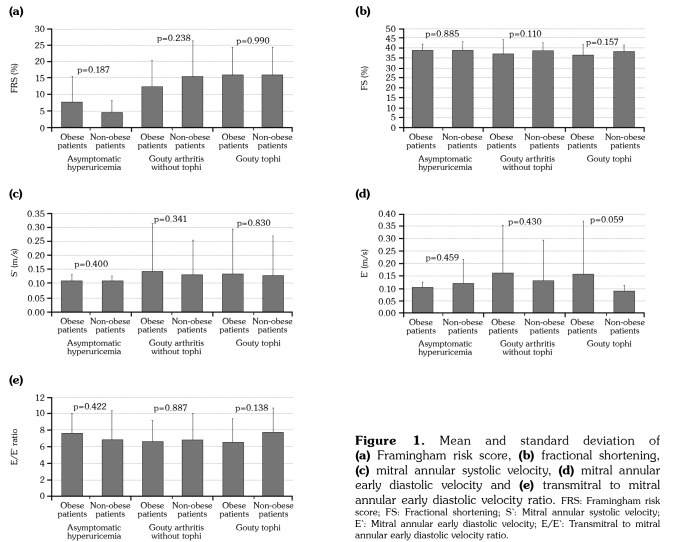
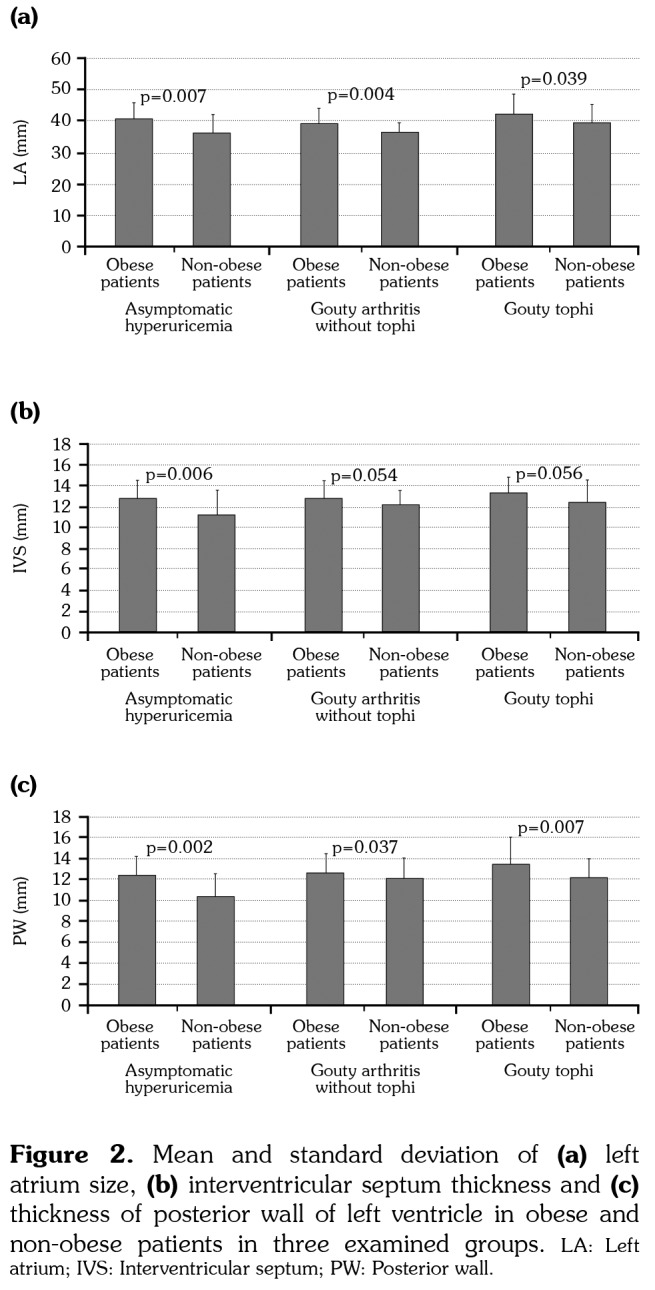
Results: There was no significant difference in FRS, FS, S', E' and E/E' between obese and non-obese patients with asymptomatic hyperuricemia, gouty arthritis without tophi or gouty tophi. Obese patients in the three disease gradations had larger LA (p=0.007, p=0.004, p=0.039) and thicker PW (p=0.002, p=0.037, p=0.007). Increased BMI independently predicted the thickening of the PW in asymptomatic hyperuricemia (R2=0.319), gouty arthritis without tophi (R2=0.093) and gouty tophi (R2=0.068).
Conclusion: Despite the lack of difference in FRS and functional systolic and diastolic parameters between obese and non-obese patients in the spectrum of gout, morphological heart changes were more pronounced in obese patients. In gouty tophi, it is possible that higher urate load together with chronic inflammation contribute for the alterations, as obesity worsens them.
Keywords: Cardiovascular risk; gout stages; obesity.
Conflict of interest statement
Conflict of Interest: The authors declared no conflicts of interest with respect to the authorship and/or publication of this article.
Figures
References
-
- Kopelman PG, Caterson ID, Stock MJ, Dietz WH. Clinical Obesity in Adults and Children in Adults and Children. Massachusetts: Blackwell Publishing; 2005.
-
- Poirier P, Giles TD, Bray GA, Hong Y, Stern JS, Pi-Sunyer FX, et al. Obesity and cardiovascular disease: pathophysiology, evaluation, and effect of weight loss: an update of the 1997 American Heart Association Scientific Statement on Obesity and Heart Disease from the Obesity Committee of the Council on Nutrition, Physical Activity, and Metabolism. Circulation. 2006;113:898–918. - PubMed
-
- Choi HK, Atkinson K, Karlson EW, Curhan G. Obesity, weight change, hypertension, diuretic use, and risk of gout in men: the health professionals follow-up study. Arch Intern Med. 2005;165:742–748. - PubMed
-
- Enomoto A, Kimura H, Chairoungdua A, Shigeta Y, Jutabha P, Cha SH, et al. Molecular identification of a renal urate anion exchanger that regulates blood urate levels. Nature. 2002;417:447–452. - PubMed
LinkOut - more resources
Full Text Sources