


GhFAD2-3 is required for anther development in Gossypium hirsutum
- PMID: 31500565
- PMCID: PMC6734329
- DOI: 10.1186/s12870-019-2010-9
GhFAD2-3 is required for anther development in Gossypium hirsutum
Abstract
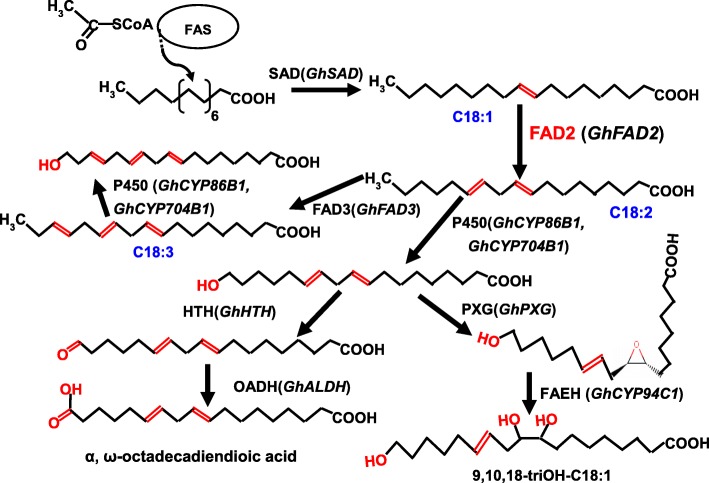
Background: In higher plants, the FAD2 gene encodes the microsomal oleate Δ12-desaturase, one of the key enzymes essential for the biosynthesis of the polyunsaturated lipids that serve many important functions in plant development and stress responses. FAD2 catalyzes the first step, in the biosynthesis of the polyunsaturated fatty acids (PUFAs) found in the cell membrane and cell wall, and it is thus of great importance to investigate the regulatory role of FAD2 in anther development.
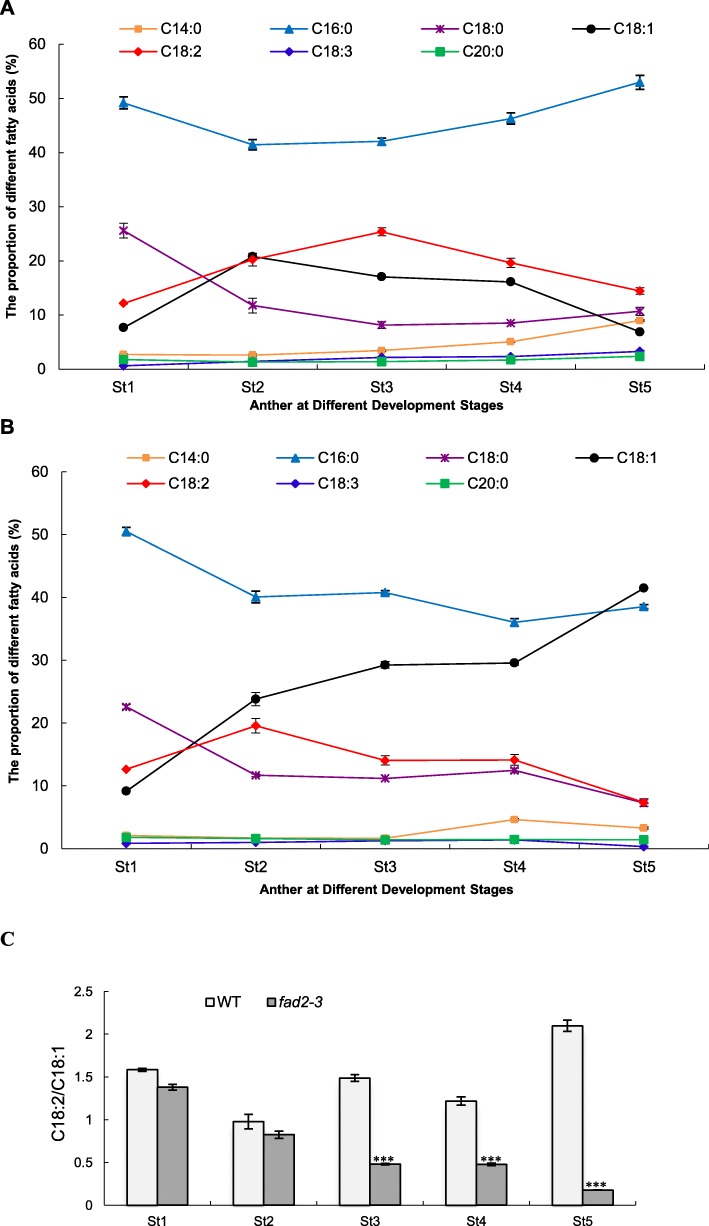
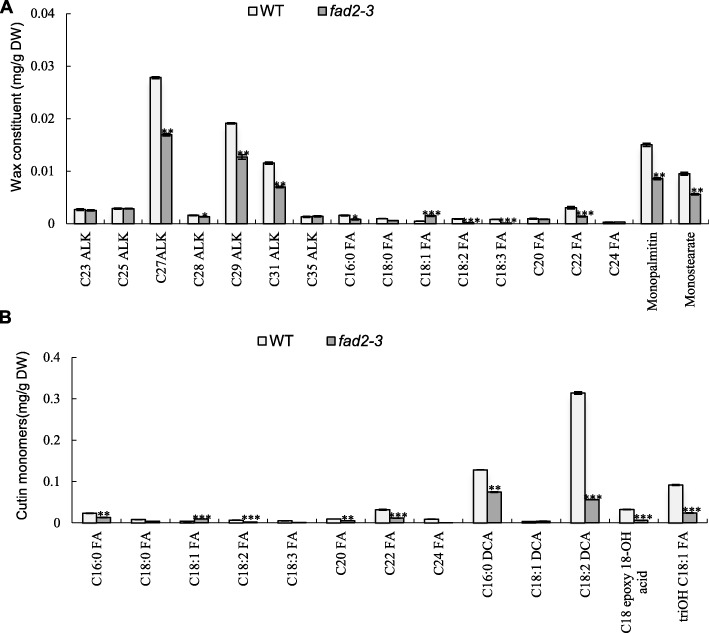
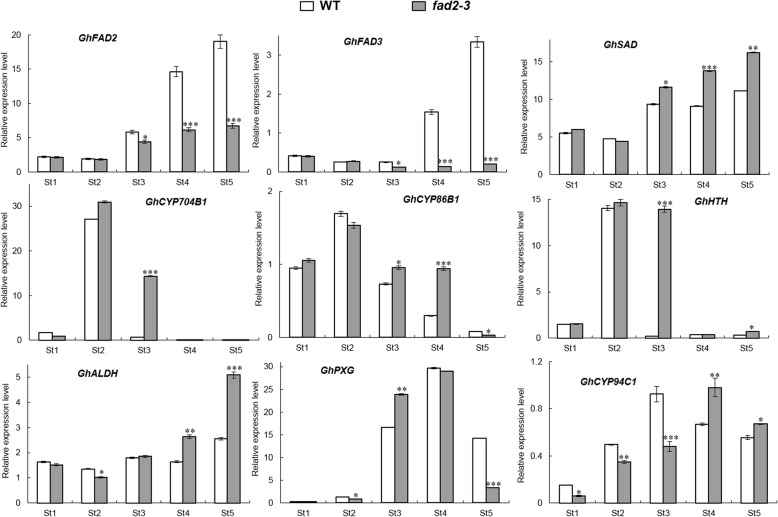
Results: We reported the molecular characterization of the cotton (Gossypium hirsutum) GhFAD2 gene family and the essential role of GhFAD2-3 in cotton anther development. G. hirsutum contains four pairs of homoeologous FAD2 genes (GhFAD2-1 to GhFAD2-4). GhFAD2-3 is ubiquitously and relatively highly expressed in all analyzed tissues, particularly in anthers. Specific inhibition of GhFAD2-3 using the RNA interference approach resulted in male sterility due to impaired anther development at the stages from meiosis to maturation. The cellular phenotypic abnormality observed at the meiosis stage of the GhFAD2-3 silenced plant (fad2-3) coincides with the significant reduction of C18:2 in anthers at the same stage. Compared with that of the wild type (WT), the content of C18:1 was 41.48%, which increased by 5 fold in the fad2-3 anther at the pollen maturation stage. Moreover, the ratio of monounsaturated to polyunsaturated fatty acid was 5.43 in fad2-3 anther, which was much higher than that of the WT (only 0.39). Through compositional analysis of anthers cuticle and transcriptome data, we demonstrated it was unfavorable to the development of anther by regulating GhFAD2-3 expression level to increase the oleic acid content.
Conclusions: Our work demonstrated the importance of C18:2 and/or C18:3 in the development of the pollen exine and anther cuticle in cotton and provided clue for further investigation of the physiological significance of the fatty acid composition for plant growth and development.
Keywords: Fatty acid composition; GhFAD2; Gossypium hirsutum; Linoleic acid; Male sterile; Oleic acid.
Conflict of interest statement
The authors declare that they have no competing interests.
Figures

References
-
- Shanklin John, Cahoon Edgar B. DESATURATION AND RELATED MODIFICATIONS OF FATTY ACIDS. Annual Review of Plant Physiology and Plant Molecular Biology. 1998;49(1):611–641. - PubMed
-
- Jin Un-Ho, Lee Jin-Woo, Chung Young-Soo, Lee Jai-Heon, Yi Young-Byung, Kim Young-Kil, Hyung Nam-In, Pyee Jae-Ho, Chung Chung-Han. Characterization and temporal expression of a ω-6 fatty acid desaturase cDNA from sesame (Sesamum indicum L.) seeds. Plant Science. 2001;161(5):935–941.
-
- Jung Jin Hee, Kim Hyojin, Go Young Sam, Lee Saet Buyl, Hur Cheol-Goo, Kim Hyun Uk, Suh Mi Chung. Identification of functional BrFAD2-1 gene encoding microsomal delta-12 fatty acid desaturase from Brassica rapa and development of Brassica napus containing high oleic acid contents. Plant Cell Reports. 2011;30(10):1881–1892. - PubMed
-
- Li Lingyong, Wang Xiaolin, Gai Junyi, Yu Deyue. Molecular cloning and characterization of a novel microsomal oleate desaturase gene from soybean. Journal of Plant Physiology. 2007;164(11):1516–1526. - PubMed
MeSH terms
Substances
Grants and funding
LinkOut - more resources
Full Text Sources
Other Literature Sources
