


Gout, Hyperuricaemia and Crystal-Associated Disease Network (G-CAN) consensus statement regarding labels and definitions of disease states of gout
- PMID: 31501138
- PMCID: PMC7288724
- DOI: 10.1136/annrheumdis-2019-215933
Gout, Hyperuricaemia and Crystal-Associated Disease Network (G-CAN) consensus statement regarding labels and definitions of disease states of gout
Abstract
Objective: There is a lack of standardisation in the terminology used to describe gout. The aim of this project was to develop a consensus statement describing the recommended nomenclature for disease states of gout.
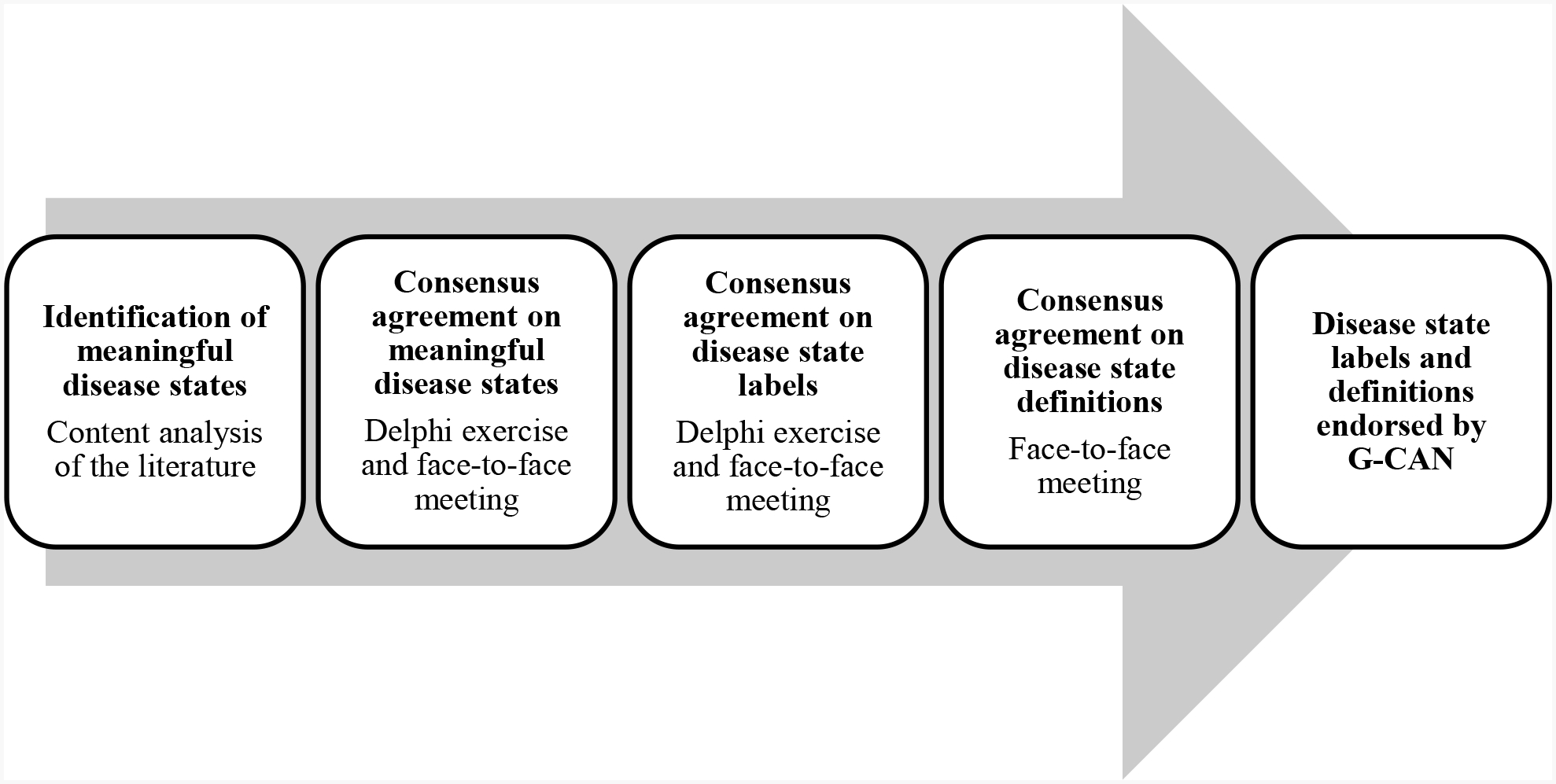
Methods: A content analysis of gout-related articles from rheumatology and general internal medicine journals published over a 5-year period identified potential disease states and the labels commonly assigned to them. Based on these findings, experts in gout were invited to participate in a Delphi exercise and face-to-face consensus meeting to reach agreement on disease state labels and definitions.
Results: The content analysis identified 13 unique disease states and a total of 63 unique labels. The Delphi exercise (n=76 respondents) and face-to-face meeting (n=35 attendees) established consensus agreement for eight disease state labels and definitions. The agreed labels were as follows: 'asymptomatic hyperuricaemia', 'asymptomatic monosodium urate crystal deposition', 'asymptomatic hyperuricaemia with monosodium urate crystal deposition', 'gout', 'tophaceous gout', 'erosive gout', 'first gout flare' and 'recurrent gout flares'. There was consensus agreement that the label 'gout' should be restricted to current or prior clinically evident disease caused by monosodium urate crystal deposition (gout flare, chronic gouty arthritis or subcutaneous tophus).
Conclusion: Consensus agreement has been established for the labels and definitions of eight gout disease states, including 'gout' itself. The Gout, Hyperuricaemia and Crystal-Associated Disease Network recommends the use of these labels when describing disease states of gout in research and clinical practice.
Keywords: gout; hyperuricemia; language; monosodium urate crystals; nomenclature; terminology; urate.
© Author(s) (or their employer(s)) 2019. No commercial re-use. See rights and permissions. Published by BMJ.
Conflict of interest statement
Competing interests: AKT has received speaking fees and honoraria for advisory boards from Berlin Chemie Menarini, Novartis, Grünenthal and AstraZeneca. JAS has received consultant fees from Crealta/Horizon, Medisys, Fidia, UBM LLC, Medscape, WebMD, the National Institutes of Health and the American College of Rheumatology. JAS owns stock options in Amarin pharmaceuticals and Viking therapeutics. JAS is a member of the executive of OMERACT, an organisation that develops outcome measures in rheumatology and receives arms-length funding from 36 companies. JAS is a member of the Veterans Affairs Rheumatology Field Advisory Committee. JAS is the editor and the Director of the UAB Cochrane Musculoskeletal Group Satellite Center on Network Meta-analysis. JAS previously served as a member of the following committees: member, the American College of Rheumatology's (ACR) Annual Meeting Planning Committee (AMPC) and Quality of Care Committees, the Chair of the ACR Meet-the-Professor, Workshop and Study Group Subcommittee and the co-chair of the ACR Criteria and Response Criteria subcommittee. ND has received speaking fees from Pfizer, Horizon, Janssen, and AbbVie, consulting fees from Horizon, AstraZeneca, Dyve Biosciences, Hengrui, and Kowa, and research funding from Amgen and AstraZeneca.
Figures
Comment in
-
Improving how we talk about gout.Nat Rev Rheumatol. 2019 Nov;15(11):635. doi: 10.1038/s41584-019-0319-2. Nat Rev Rheumatol. 2019. PMID: 31570830 No abstract available.
References
-
- Vaccher S, Kannangara DR, Baysari MT, et al. Barriers to Care in Gout: From Prescriber to Patient. J Rheumatol 2016; 43(1): 144–9. - PubMed
