Associations of Subjective Memory Complaints and Simple Memory Task Scores With Future Dementia in the Primary Care Setting
- PMID: 31501202
- PMCID: PMC7032907
- DOI: 10.1370/afm.2443
Associations of Subjective Memory Complaints and Simple Memory Task Scores With Future Dementia in the Primary Care Setting
Abstract
Purpose: Family physicians need simple yet comprehensive algorithms to discriminate between community-dwelling older persons who are at increased risk of dementia and those who are not. We aimed to investigate associations between incident dementia and responses to a single question regarding subjective memory complaints (SMC) combined with scores on 2 simple memory tests that are easy to use in the primary care setting.
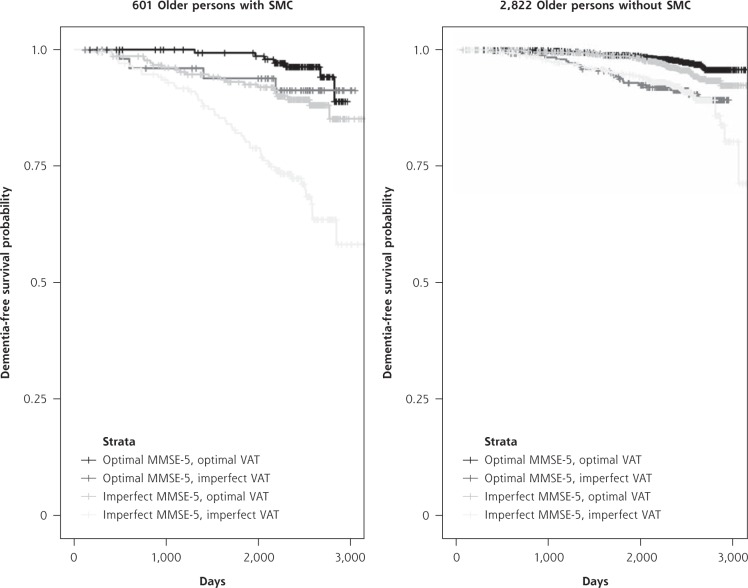
Methods: Analyses were based on data from 3,454 community-dwelling older persons who participated in the 6- to 8-year Prevention of Dementia by Intensive Vascular Care (preDIVA) trial, yielding 21,341 person-years of observation. Participants were considered a single cohort. We used Cox models to assess separate and combined associations of SMC, an imperfect score on the Mini-Mental State Examination delayed recall item (MMSE-5), and an imperfect score on the Visual Association Test (VAT) with future dementia.
Results: Subjective memory complaints alone were associated with future dementia (hazard ratio [HR] = 3.01; 95% CI, 2.31-3.94; P <.001), as were the MMSE-5 (HR = 2.14; 95% CI, 1.59-2.87; P <.001) and VAT (HR = 3.19; 95% CI, 2.46-4.13; P <.001) scores. After a median follow-up of 6.7 years, the occurrence of dementia ranged from 4% to 30% among persons with SMC, depending on the MMSE-5 and VAT scores. These test scores did not substantially alter the association with future dementia for persons without SMC.
Conclusions: In persons with SMC, the strength of the association between future dementia and an imperfect MMSE-5 score depends substantially on the VAT score.
Keywords: association learning; cognition; dementia; geriatric assessment; memory; neuropsychological tests; primary health care; risk assessment; self report.
© 2019 Annals of Family Medicine, Inc.
Figures

References
-
- de Vugt ME, Verhey FR. The impact of early dementia diagnosis and intervention on informal caregivers. Prog Neurobiol. 2013; 110: 54-62. - PubMed
-
- Mitchell AJ, Beaumont H, Ferguson D, Yadegarfar M, Stubbs B. Risk of dementia and mild cognitive impairment in older people with subjective memory complaints: meta-analysis. Acta Psychiatr Scand. 2014; 130(6): 439-451. - PubMed
-
- Galasko D, Klauber MR, Hofstetter CR, Salmon DP, Lasker B, Thal LJ. The Mini-Mental State Examination in the early diagnosis of Alzheimer’s disease. Arch Neurol. 1990; 47(1): 49-52. - PubMed
-
- Small BJ, Viitanen M, Backman L. Mini-Mental State Examination item scores as predictors of Alzheimer’s disease: incidence data from the Kungsholmen Project, Stockholm. J Gerontol A. 1997; 52(5): M299-M304. - PubMed
-
- Ashford JW, Kolm P, Colliver JA, Bekian C, Hsu LN. Alzheimer patient evaluation and the mini-mental state: item characteristic curve analysis. J Gerontol. 1989; 44(5): P139-P146. - PubMed
Publication types
MeSH terms
Associated data
LinkOut - more resources
Full Text Sources
Medical