. 2019 Sep 9;10(1):4087.
doi: 10.1038/s41467-019-12044-5.

Multi-stimuli-responsive programmable biomimetic actuator

Affiliations

Multi-stimuli-responsive programmable biomimetic actuator

Yue Dong et al. Nat Commun. .

Abstract

Untethered small actuators have various applications in multiple fields. However, existing small-scale actuators are very limited in their intractability with their surroundings, respond to only a single type of stimulus and are unable to achieve programmable structural changes under different stimuli. Here, we present a multiresponsive patternable actuator that can respond to humidity, temperature and light, via programmable structural changes. This capability is uniquely achieved by a fast and facile method that was used to fabricate a smart actuator with precise patterning on a graphene oxide film by hydrogel microstamping. The programmable actuator can mimic the claw of a hawk to grab a block, crawl like an inchworm, and twine around and grab the rachis of a flower based on their geometry. Similar to the large- and small-scale robots that are used to study locomotion mechanics, these small-scale actuators can be employed to study movement and biological and living organisms.


Conflict of interest statement

The authors declare no competing interests.

Figures
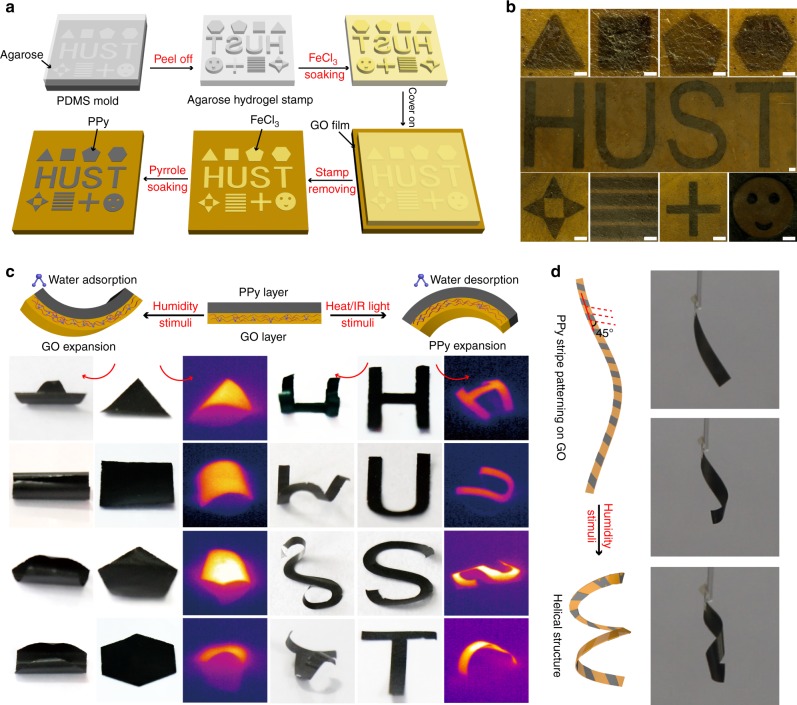
Fig. 1
Fig. 1
Fabrication and programmable structure changes of actuator. a Schematic diagram of precise PPy patterning on a GO film for the fabrication of a programmed GO/PPy actuator; b optical image of precise PPy patterning on a GO film (Scale bar: 100 μm); c working mechanism of GO/PPy bilayer actuator and the structural changes of actuators with regular triangle, square, regular pentagon, regular hexagon, and H-, U-, S-, and T-shape patterns under the stimuli of humidity and IR light; d schematic diagram of a programmable GO/PPy actuator
Fig. 2
Fig. 2
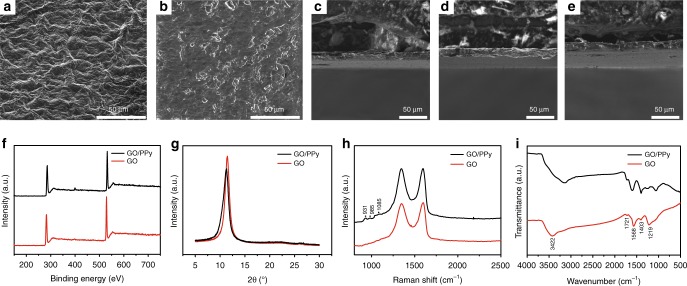
Structural characterization of GO/PPy actuator. SEM image of a the GO film side and b the PPy side; cross-sectional SEM image of GO/PPy actuators fabricated on the basis of GO films with different thicknesses of c 12.8 μm, d 25.2 μm and e 37.1 μm; f XPS spectra of GO and GO/PPy; g XRD pattern of GO and GO/PPy; h Raman spectra of GO and GO/PPy; i FT-IR spectra of pure GO and GO/PPy
Fig. 3
Fig. 3
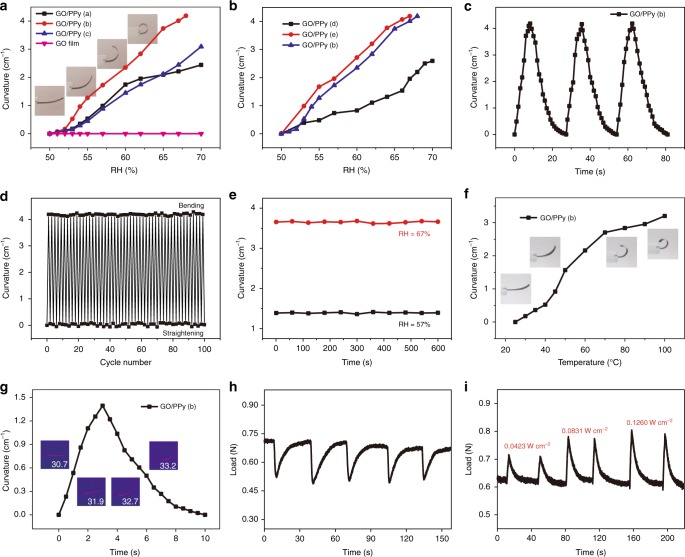
Actuating performance of GO/PPy actuator. a Actuating performance of GO/PPy actuators under the stimulus of humidity, (GO/PPy (a), GO/PPy (b) and GO/PPy (c) represent GO/PPy actuators with different GO thicknesses of 12.8, 25.2 and 37.1 μm, respectively) (the insets are photographs of the bending GO/PPy ribbon under different RH values); b Actuating performance of GO/PPy actuators under the stimulus of humidity, (GO/PPy (d), GO/PPy (e) and GO/PPy (b) represent GO/PPy actuators with increasing PPy thicknesses and same GO thickness of 25.2 μm; c switching from the bent to the straight state of GO/PPy (b) by changing the corresponding RH from 50 to 68%, and vice versa; d cyclic stability of the curvature of a GO/PPy actuator over 100 cycles (50–68% RH); e durable behavior of GO/PPy (b) after exposure to 57% or 67% RH for 600 s; f actuating performance of GO/PPy (b) under the stimulus of temperature (the insets are photographs of the bending GO/PPy ribbon at temperatures of 25, 50 and 100 °C); g actuating performance of GO/PPy (b) under the stimulus of IR light (the insets are photographs of the bending GO/PPy (b) at different times); h the bending force of GO/PPy (b) actuator recorded during the process of turning on/off the humidifier; i the contractile force of GO/PPy (b) actuator recorded during the process of turning on/off IR light with power densities of 0.0423, 0.0831 and 0.126 W cm−2 (from left to right)
Fig. 4
Fig. 4
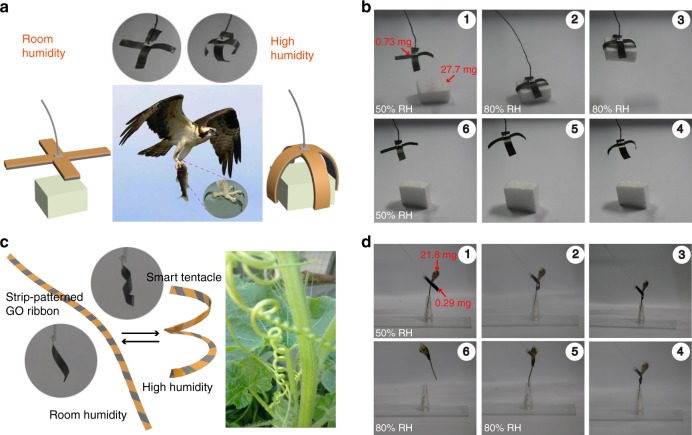
Biomimetic gripper with cross and helical structure. a Schematic illustration of a smart GO/PPy gripper with a cross structure inspired by the claw of a hawk (middle image). It exhibits a straight state at room humidity (≈50% RH, left images) and a bent state at high humidity (≈80% RH, right images). b The process of a foam being picked up and released by a smart GO/PPy gripper; c schematic illustration of a smart GO/PPy tendril-inspired by a tendril climber plant (right images). The tendril curves at room humidity (≈50% RH, left images) and curls to a helical structure under high humidity (≈80% RH, middle images); d a flower can be removed from a homemade vase by the helical GO/PPy gripper
Fig. 5
Fig. 5
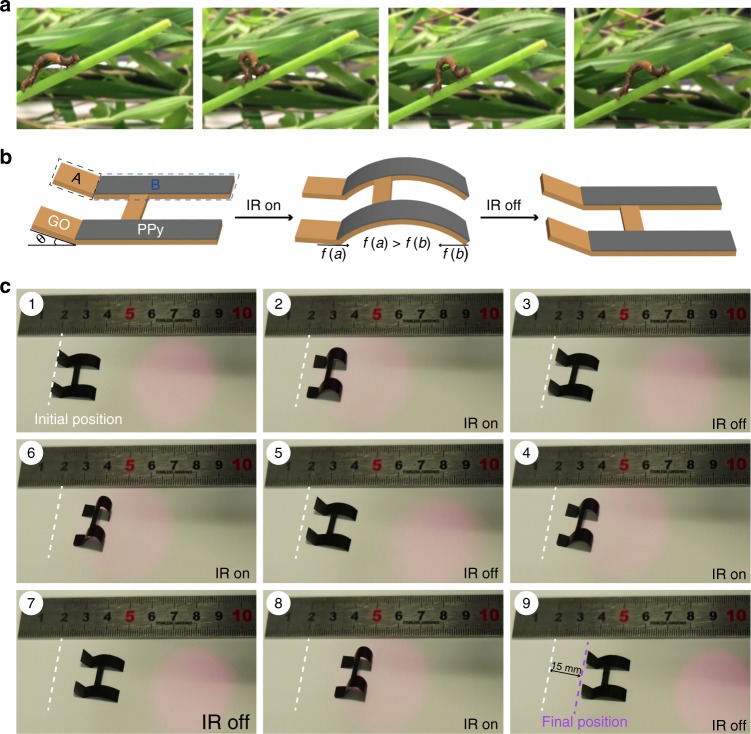
Biomimetic soft walking robot. a the movement process of the inchworm; b the schematic diagram of soft walking robot and its movement; c the movement process of the soft walking robot under the interval stimulus of IR light

References

    1. Gladman AS, Matsumoto EA, Nuzzo RG, Mahadevan L, Lewis JA. Biomimetic 4D printing. Nat. Mater. 2016;15:413–418. doi: 10.1038/nmat4544. - DOI - PubMed
    1. Iamsaard S, et al. Conversion of light into macroscopic helical motion. Nat. Chem. 2014;6:229. doi: 10.1038/nchem.1859. - DOI - PubMed
    1. Arazoe H, et al. An autonomous actuator driven by fluctuations in ambient humidity. Nat. Mater. 2016;15:1084. doi: 10.1038/nmat4693. - DOI - PubMed
    1. Zhang L, Liang H, Jacob J, Naumov P. Photogated humidity-driven motility. Nat. Commun. 2015;6:7429. doi: 10.1038/ncomms8429. - DOI - PMC - PubMed
    1. Hines L, Petersen K, Lum GZ, Sitti M. Soft actuators for small-scale robotics. Adv. Mater. 2017;29:1603483. doi: 10.1002/adma.201603483. - DOI - PubMed

Publication types