Benefit of Reducing Body Weight Loss with A Nutritional Support Pathway in Patients Undergoing Allogeneic Hematopoietic Stem Cell Transplantation
- PMID: 31503241
- PMCID: PMC6754707
- DOI: 10.12659/MSMBR.917329
Benefit of Reducing Body Weight Loss with A Nutritional Support Pathway in Patients Undergoing Allogeneic Hematopoietic Stem Cell Transplantation
Abstract
Background: This retrospective, historically controlled investigative study examined the benefit of a nutritional support pathway that included nutritional education before the start of conditioning and emphasized oral nutrition in response to nutrition-related adverse events in patients undergoing hematopoietic stem cell transplantation (HSCT).
Material and methods: Participants were patients undergoing allogeneic HSCT; 46 were in the control group (i.e., did not follow our nutritional pathway) and 36 were in the group that underwent nutritional intervention (enhanced nutrition group). We compared the following parameters between groups from the day before the start of conditioning to the day after completion of parenteral nutrition (PN): percent loss of body weight (%LBW), percent loss of skeletal muscle mass (%LSMM), and estimated basal energy expenditure (EBEE) sufficiency rate. The relationship between each parameter and %LBW was also examined. We also compared nutritional indices, gastrointestinal graft versus host disease (GvHD) grade, oral energy intake, and %LBW between groups.
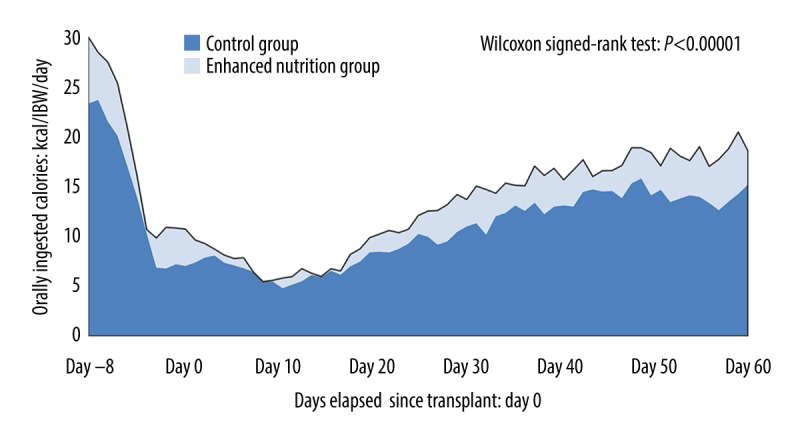
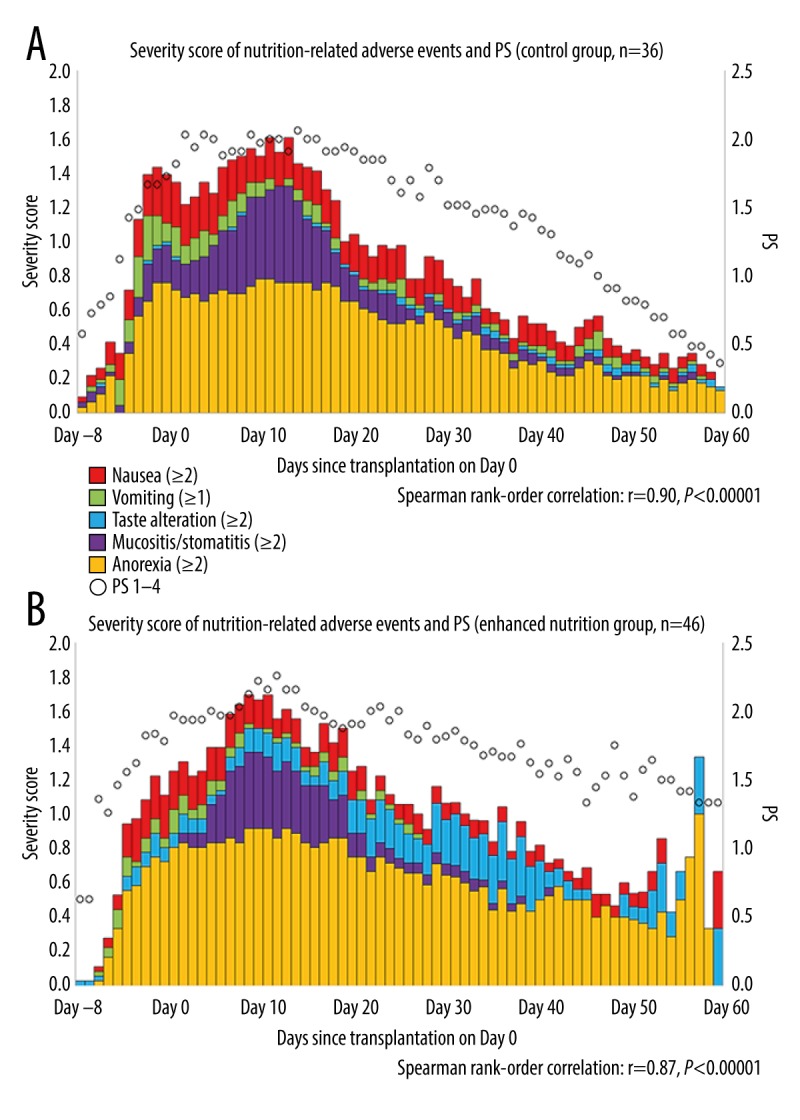
Results: There was a relationship between %LBW, %LSMM, and EBEE sufficiency rate in both groups. Compared with the control group, the enhanced nutrition group had significantly improved energy intake amount, EBEE sufficiency rate, PN duration, and oral energy intake over time. The enhanced nutrition group also had increased oral energy intake, no difference in gastrointestinal GvHD grade, and improved %LBW compared with the control group.
Conclusions: Use of our nutritional support pathway in patients undergoing HSCT may be beneficial for %LBW and gastrointestinal GvHD grade, enabling early enhanced nutritional intervention after HSCT.
Figures



References
-
- Deeg HJ, Seidel K, Bruemmer B, et al. Impact of patient weight on non-relapse mortality after marrow transplantation. Bone Marrow Transplant. 1995;15:461–68. - PubMed
-
- Dickson TM, Kusnierz-Glaz CR, Blume KG, et al. Impact of admission body weight and chemotherapy dose adjustment on the outcome of autologous bone marrow transplantation. Biol Blood Marrow Transplant. 1995;5:299–305. - PubMed
-
- Aoyama T, Imataki O, Mori K, et al. Nutritional risk in allogeneic stem cell transplantation: Rationale for a tailored nutritional pathway. Ann Hematol. 2017;96:617–25. - PubMed
-
- Aoyama T, Arai H, Imataki O, et al. Factors influencing loss of body weight in cord blood transplantation with nutritional support for hematopoietic stem cell transplantation. Asian Journal of Clinical Nutrition. 2017;9:137–46.
-
- Mousavi M, Hayatshahi A, Sarayani A, et al. Impact of clinical pharmacist-based parenteral nutrition service for bone marrow transplantation patients: A randomized clinical trial. Support Care Cancer. 2013;21:3441–48. - PubMed