"Close-to-Release": Spontaneous Bioorthogonal Uncaging Resulting from Ring-Closing Metathesis
- PMID: 31503474
- PMCID: PMC6823642
- DOI: 10.1021/jacs.9b07193
"Close-to-Release": Spontaneous Bioorthogonal Uncaging Resulting from Ring-Closing Metathesis
Abstract
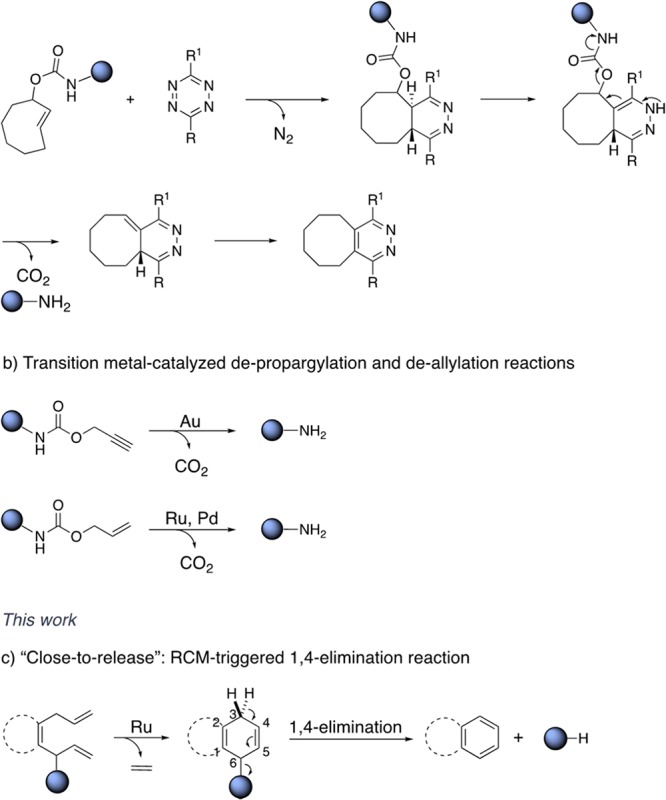
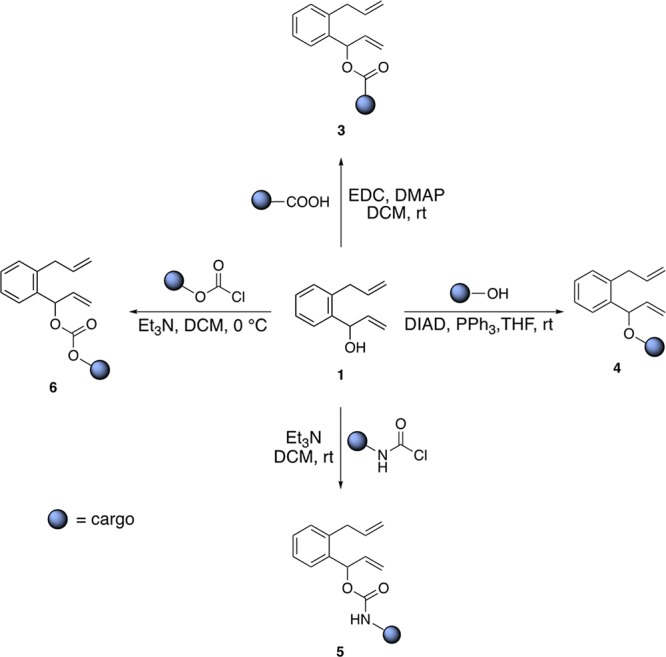
Bioorthogonal uncaging reactions offer versatile tools in chemical biology. In recent years, reactions have been developed to proceed efficiently under physiological conditions. We present herein an uncaging reaction that results from ring-closing metathesis (RCM). A caged molecule, tethered to a diolefinic substrate, is released via spontaneous 1,4-elimination following RCM. Using this strategy, which we term "close-to-release", we show that drugs and fluorescent probes are uncaged with fast rates, including in the presence of mammalian cells or in the periplasm of Escherichia coli. We envision that this tool may find applications in chemical biology, bioengineering and medicine.
Conflict of interest statement
The authors declare no competing financial interest.
Figures
References
-
- Sletten E. M.; Bertozzi C. R. From Mechanism to Mouse: A Tale of Two Bioorthogonal Reactions. Acc. Chem. Res. 2011, 44, 666–676. 10.1021/ar200148z. - DOI - PMC - PubMed
- Lang K.; Chin J. W. Bioorthogonal Reactions for Labeling Proteins. ACS Chem. Biol. 2014, 9, 16–20. 10.1021/cb4009292. - DOI - PubMed
- Kolb H. C.; Finn M. G.; Sharpless K. B. Click Chemistry: Diverse Chemical Function from a Few Good Reactions. Angew. Chem., Int. Ed. 2001, 40, 2004–2021. 10.1002/1521-3773(20010601)40:11<2004::AID-ANIE2004>3.0.CO;2-5. - DOI - PubMed
- Das J. Aliphatic Diazirines as Photoaffinity Probes for Proteins: Recent Developments. Chem. Rev. 2011, 111, 4405–4417. 10.1021/cr1002722. - DOI - PubMed
-
- Tu J.; Xu M.; Franzini R. M. Dissociative Bioorthogonal Reactions. ChemBioChem 2019, 20, 1615–1627. 10.1002/cbic.201800810. - DOI - PubMed
- Mejia Oneto J. M.; Khan I.; Seebald L. M.; Royzen M. In Vivo Bioorthogonal Chemistry Enables Local Hydrogel and Systemic Pro-Drug to Treat Soft Tissue Sarcoma. ACS Cent. Sci. 2016, 2, 476–482. 10.1021/acscentsci.6b00150. - DOI - PMC - PubMed
- Rossin R.; Renart Verkerk P.; van den Bosch S. M.; Vulders R. C. M.; Verel I.; Lub J.; Robillard M. S. In Vivo Chemistry for Pretargeted Tumor Imaging in Live Mice. Angew. Chem., Int. Ed. 2010, 49, 3375–3378. 10.1002/anie.200906294. - DOI - PubMed
- Ji X.; Pan Z.; Yu B.; De La Cruz L. K.; Zheng Y.; Ke B.; Wang B. Click and Release: Bioorthogonal Approaches to “On-Demand” Activation of Prodrugs. Chem. Soc. Rev. 2019, 48, 1077–1094. 10.1039/C8CS00395E. - DOI - PubMed
- Li J.; Chen P. Development and Application of Bond Cleavage Reactions in Bioorthogonal Chemistry. Nat. Chem. Biol. 2016, 12, 129–137. 10.1038/nchembio.2024. - DOI - PubMed
- Neumann K.; Gambardella A.; Lilienkampf A.; Bradley M. Tetrazine-Mediated Bioorthogonal Prodrug-Prodrug Activation. Chem. Sci. 2018, 9, 7198–7203. 10.1039/C8SC02610F. - DOI - PMC - PubMed
- Devaraj N. K. The Future of Bioorthogonal Chemistry. ACS Cent. Sci. 2018, 4, 952–959. 10.1021/acscentsci.8b00251. - DOI - PMC - PubMed
- Azoulay M.; Tuffin G.; Sallem W.; Florent J. C. A New Drug-Release Method Using the Staudinger Ligation. Bioorg. Med. Chem. Lett. 2006, 16, 3147–3149. 10.1016/j.bmcl.2006.03.073. - DOI - PubMed
Publication types
MeSH terms
Substances
LinkOut - more resources
Full Text Sources
Other Literature Sources
Molecular Biology Databases