


Industry Derived Occupational Exposure Limits: A Survey of Professionals on the Dutch System of Exposure Guidelines
- PMID: 31504142
- PMCID: PMC6853705
- DOI: 10.1093/annweh/wxz069
Industry Derived Occupational Exposure Limits: A Survey of Professionals on the Dutch System of Exposure Guidelines
Abstract
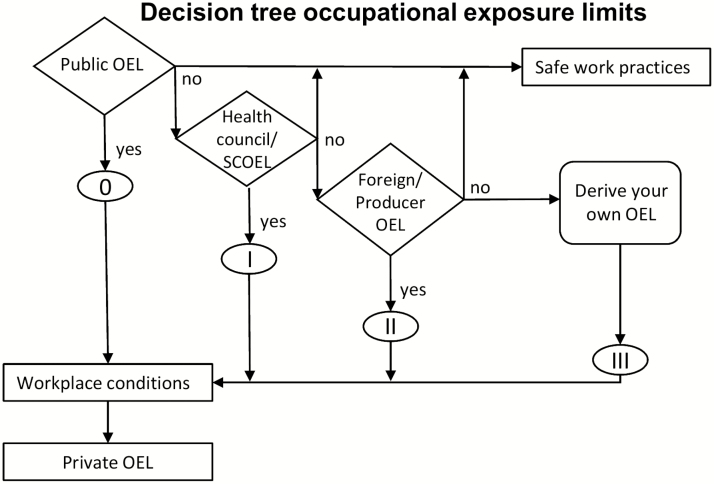
The Netherlands' system for occupational exposure limits (OELs) encompasses two kinds of OELs: public and private. Public OELs are set by the government. Private OELs are derived by industry and cover all substances without a public OEL. In parallel, the regulation concerning the Registration, Evaluation, Authorisation and Restriction of Chemicals (REACH) has introduced an exposure guidance value similar to the OEL, namely the Derived No-Effect Level (DNEL) for workers' inhalation exposure. This study aimed to investigate issues encountered by occupational health professionals regarding private OELs, and how they perceive the DNELs for workers in relation to private OELs. Towards this aim, we sent out a web-based questionnaire to the members of the Dutch professional organization for occupational hygienists (Nederlandse Vereniging voor Arbeidshygiëne [NVVA], n = 513) and to members of the Dutch professional organization for safety engineers (NVVK, n = 2916). Response rates were 27% (n = 139) and 7% (n = 198), respectively. More occupational hygienists (59%) than safety engineers (17%) reported to derive private OELs themselves. Our respondents reported several challenges with the derivation of private OELs. Fifty-one percent of the occupational hygienists and 20% of the safety engineers stated to see a role of REACH Registrants' worker DNELs as private OELs. However, more than half of our respondents were undecided or unfamiliar with worker DNELs. In addition, stated opinions on where worker DNELs fit in the hierarchy of private OELs varied considerably. To conclude, both these professional groups derive private OELs and stated that they need more guidance for this. Furthermore, there is a lack of clarity whether worker DNELs may qualify as private OELs, and where they would fit in the hierarchy of private OELs.
Keywords: chemical risk management; health risk assessment; industrial hygiene; maximum allowable concentration; occupational health.
© The Author(s) 2019. Published by Oxford University Press on behalf of the British Occupational Hygiene Society.
Figures
References
-
- Consortium TNO, Bureau KLB and Royal Haskoning (2008) Beslisschema grenswaarde keuze. Notitie aan de Beleidingscommissie Leidraad. January 8th 2008. Reference: 9S2119.01/N0009D/Nijm, Sociaal-Economische Raad.
-
- ECHA – European Chemicals Agency (2012) Guidance on information requirements and chemical safety assessment Chapter R.8: Characterisation of dose [concentration]-response for human health. November 2012. Version 2.1. Helsinki: ECHA.
-
- Fairhurst S. (1995) The uncertainty factor in the setting of occupational exposure standards. Ann Occup Hyg 39:375–85. doi: 10.1016/0003-4878(95)00007-2. - DOI
Publication types
MeSH terms
LinkOut - more resources
Full Text Sources
Medical