


Blood eosinophil count and airway epithelial transcriptome relationships in COPD versus asthma
- PMID: 31506971
- PMCID: PMC7064968
- DOI: 10.1111/all.14016
Blood eosinophil count and airway epithelial transcriptome relationships in COPD versus asthma
Abstract
Background: Whether the clinical or pathophysiologic significance of the "treatable trait" high blood eosinophil count in COPD is the same as for asthma remains controversial. We sought to determine the relationship between the blood eosinophil count, clinical characteristics and gene expression from bronchial brushings in COPD and asthma.
Methods: Subjects were recruited into a COPD (emphysema versus airway disease [EvA]) or asthma cohort (Unbiased BIOmarkers in PREDiction of respiratory disease outcomes, U-BIOPRED). We determined gene expression using RNAseq in EvA (n = 283) and Affymetrix microarrays in U-BIOPRED (n = 85). We ran linear regression analysis of the bronchial brushings transcriptional signal versus blood eosinophil counts as well as differential expression using a blood eosinophil > 200 cells/μL as a cut-off. The false discovery rate was controlled at 1% (with continuous values) and 5% (with dichotomized values).
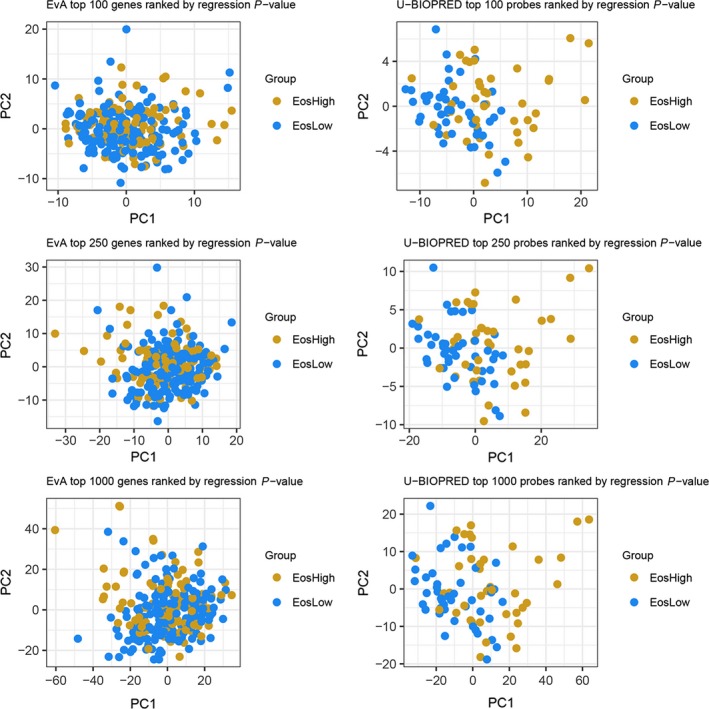
Results: There were no differences in age, gender, lung function, exercise capacity and quantitative computed tomography between eosinophilic versus noneosinophilic COPD cases. Total serum IgE was increased in eosinophilic asthma and COPD. In EvA, there were 12 genes with a statistically significant positive association with the linear blood eosinophil count, whereas in U-BIOPRED, 1197 genes showed significant associations (266 positive and 931 negative). The transcriptome showed little overlap between genes and pathways associated with blood eosinophil counts in asthma versus COPD. Only CST1 was common to eosinophilic asthma and COPD and was replicated in independent cohorts.
Conclusion: Despite shared "treatable traits" between asthma and COPD, the molecular mechanisms underlying these clinical entities are predominately different.
Keywords: T2-immunity; asthma; chronic obstructive pulmonary disease; eosinophil; gene expression.
© 2019 The Authors. Allergy published by John Wiley & Sons Ltd.
Conflict of interest statement
The authors acknowledge the contributions from the wider EvA and UBIOPRED consortia.
Figures
References
-
- http://www.GOLD.org GOLD guidelines. Accessed 17th May 2019.
-
- Brightling CE, Greening N. Airway inflammation in COPD‐ progress to precision medicine. Eur Respir J. 2019;54(2):1900651. - PubMed
-
- Hammad H, Lambrecht BN. Barrier epithelial cells and the control of type 2 immunity. Immunity. 2015;21:29‐40. - PubMed
-
- Bafadhel M, McKenna S, Terry S, et al. Acute exacerbations of chronic obstructive pulmonary disease: identification of biologic clusters and their biomarkers. Am J Respir Crit Care Med. 2011;184(6):662‐671. - PubMed
Publication types
MeSH terms
Substances
Grants and funding
LinkOut - more resources
Full Text Sources
Medical
Miscellaneous
