


Efficacy of EGFR-TKIs with or without upfront brain radiotherapy for EGFR-mutant NSCLC patients with central nervous system metastases
- PMID: 31507098
- PMCID: PMC6825912
- DOI: 10.1111/1759-7714.13189
Efficacy of EGFR-TKIs with or without upfront brain radiotherapy for EGFR-mutant NSCLC patients with central nervous system metastases
Abstract
Background: Although the clinical efficacy of epidermal growth factor receptor tyrosine kinase inhibitors (EGFR-TKIs) in EGFR-mutant non-small cell lung cancer (NSCLC) patients has been demonstrated, their efficacy in EGFR-mutant NSCLCs with central nervous system (CNS) metastases and the role of radiotherapy remain unclear. This study aimed to determine if it is preferable to add upfront cranial radiotherapy to EGFR-TKIs in patients with EGFR-mutant NSCLC with newly diagnosed brain metastases.
Methods: We retrospectively analyzed the data of EGFR-mutant NSCLC patients with CNS metastases who received EGFR-TKIs as a first-line therapy.
Results: A total of 104 patients were enrolled and 39 patients received upfront brain radiotherapy, while 65 patients received first and second generation EGFR-TKIs first. The median time to treatment failure (TTF) was 7.8 months (95% confidence interval [CI]: 6.3-9.4). The median survival time (MST) was 24.0 months (95% CI: 20.1-30.1). The overall response rate of the CNS was 37%. The median CNS progression-free survival (PFS) was 13.2 months (95% CI: 10.0-16.2). Brain radiotherapy prior to EGFR-TKI prolonged TTF (11.2 vs. 6.8 months, P = 0.038) and tended to prolong CNS-PFS (15.6 vs. 11.1 months, P = 0.096) but was not significantly associated with overall survival (MST 26.1 vs. 24.0 months, P = 0.525). Univariate and multivariate analyses indicated that poor performance status and the presence of extracranial metastases were poor prognostic factors related to overall survival.
Conclusion: EGFR-TKI showed a favorable effect for EGFR-mutant NSCLC patients with CNS metastases. Prolonged TTF and CNS-PFS were observed with upfront brain radiotherapy.
Keywords: EGFR mutation; Brain metastases; EGFR tyrosine kinase inhibitor; non-small cell lung cancer; radiotherapy.
© 2019 The Authors. Thoracic Cancer published by China Lung Oncology Group and John Wiley & Sons Australia, Ltd.
Figures
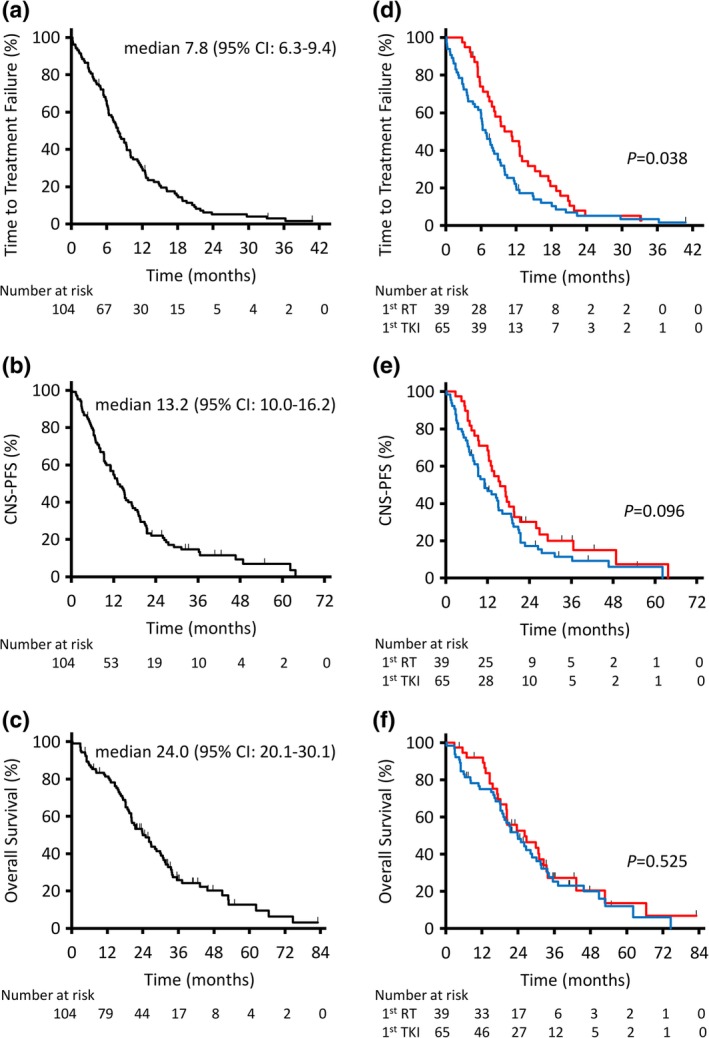
 1st RT and
  1st TKI.
References
-
- Langer CJ, Mehta MP. Current management of brain metastases, with a focus on systemic options. J Clin Oncol 2005; 23: 6207–19. - PubMed
-
- Komaki R, Cox JD, Stark R. Frequency of brain metastasis in adenocarcinoma and large cell carcinoma of the lung: Correlation with survival. Int J Radiat Oncol Biol Phys 1983; 9: 1467–70. - PubMed
-
- Sørensen JB, Hansen HH, Hansen M, Dombernowsky P. Brain metastases in adenocarcinoma of the lung: Frequency, risk groups, and prognosis. J Clin Oncol 1988; 6: 1474–80. - PubMed
-
- Iuchi T, Shingyoji M, Itakura M et al Frequency of brain metastases in non‐small‐cell lung cancer, and their association with epidermal growth factor receptor mutations. Int J Clin Oncol 2015; 20: 674–9. - PubMed
-
- Mitsudomi T, Morita S, Yatabe Y et al Gefitinib versus cisplatin plus docetaxel in patients with non‐small‐cell lung cancer harbouring mutations of the epidermal growth factor receptor (WJTOG3405): An open label, randomised phase 3 trial. Lancet Oncol 2010; 11: 121–8. - PubMed
Publication types
MeSH terms
Substances
LinkOut - more resources
Full Text Sources
Medical
Research Materials
Miscellaneous
