. 2019 Jul 5:18:142-153.
doi: 10.1016/j.jot.2019.06.001. eCollection 2019 Jul.

Muscle injury promotes heterotopic ossification by stimulating local bone morphogenetic protein-7 production

Affiliations

Muscle injury promotes heterotopic ossification by stimulating local bone morphogenetic protein-7 production

La Li et al. J Orthop Translat. .

Abstract

Background: Heterotopic ossification (HO) is a pathological condition of abnormal bone formation in soft tissue, which causes pain and restricted range of motion in patients. There are two broad categories of HO, hereditary and acquired. Although different types of HO do not use identical mechanistic pathways of pathogenesis, muscle injury appears to be a unifying feature for all types of HO. However, little is known about the mechanisms by which muscle injury facilitates HO formation.

Objective and method: This study aimed to explore the cellular and molecular mechanisms linking muscle injury to HO by using cardiotoxin to induce muscle injury in a bone morphogenetic protein-2 (BMP-2)-induced HO mouse model.

Results: We found that muscle injury augmented HO formation and that this effect was correlated with BMP signalling activation and upregulation of BMP-7 expression at the early phase of HO progression. We further demonstrated that inhibition of BMP-7 activity in vitro suppressed the osteogenesis-promoting effect of conditioned medium derived from injured muscle tissue and in vivo reduced the volume of HO formation. We also showed that antiinflammatory drug treatment reduced the volume of HO with concomitant reduction in BMP-7 production.

Conclusion: In summary, our study has identified BMP-7 as a key osteoinductive factor in injured muscle that facilitates HO formation.

The translational potential of this article: Our results provide a candidate mechanistic rationale for the use of antiinflammatory drugs in the prevention of HO.

Keywords: Bone morphogenetic protein; Heterotopic ossification; Inflammation; Macrophages; Muscle injury; Stromal/stem cells.


Figures
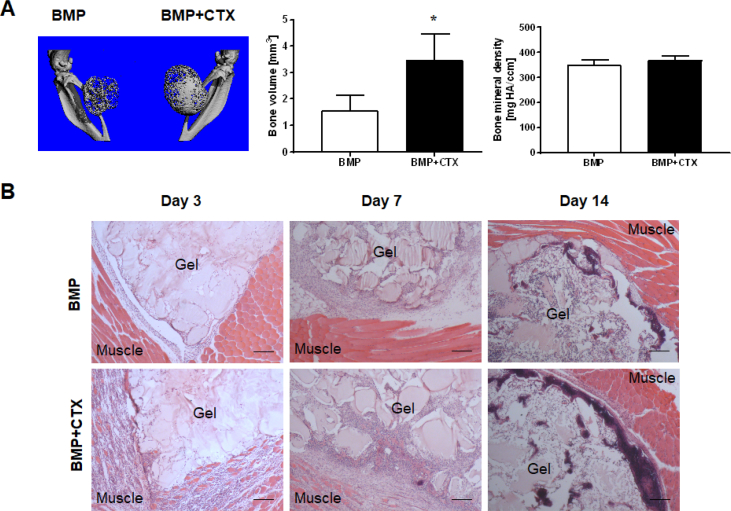
Figure 1
Figure 1
CTX-induced muscle injury significantly increased HO volume. (A) microCT imaging and analysis. Significantly larger HO volume was observed in the BMP-2/CTX coinjection group (right leg) compared with the group receiving BMP-2 injection alone (left leg) (*, p < 0.05; n = 4). No significant difference in bone mineral density was found between the two groups. (B) H&E staining illustrating the time course of HO progression. Severe inflammatory response in muscle tissue was seen at the early time points in the CTX-injured groups. Scale bar = 200 μm.
Figure 2
Figure 2
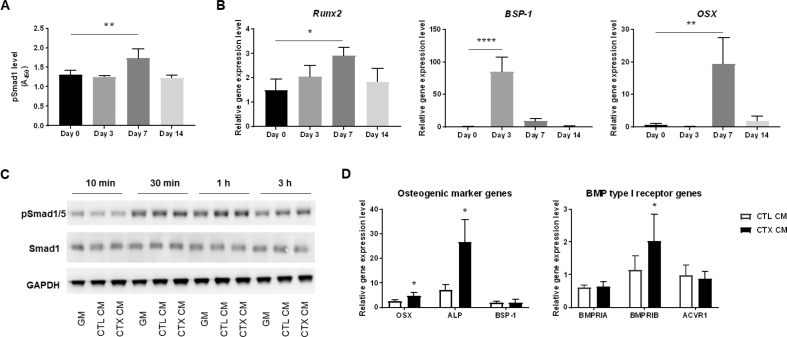
CTX-induced muscle injury generated an osteoinductive environment. (A) Phosphorylated Smad1 level in muscle tissue lysates measured by pSMAD1 ELISA at different time points after CTX injection demonstrated the activation of BMP signalling (**, p < 0.01; n = 3). (B) PCR analysis showed the upregulation of osteogenic marker gene expression in muscle tissue after CTX injection with the expression of different genes peaking at different time points. (*, p < 0.05; **, p < 0.01; ****, p < 0.0001; n = 3). Data are normalized to uninjected Day 0 control mice. (C) Western blot analysis of phosphorylated Smad1/5 protein and total Smad1 levels revealed the time course of BMP signalling activation in MDSCs cultured in GM and muscle tissue–derived CM. (D) PCR analysis of osteogenic marker gene and BMP type I receptor gene expression in MDSCs. Significantly higher OSX, ALP and BMPR1B expression was detected in MDSCs cultured in CTX CM compared with CTL CM (*, p < 0.05; n = 3). Data are normalized to MDSCs cultured in GM.
Figure 3
Figure 3
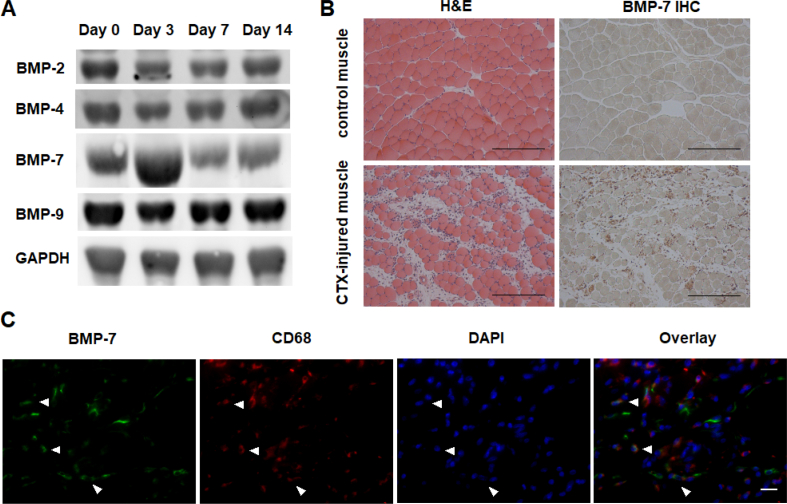
BMP-7 level increased in CTX-injured muscle. (A) Western blot analysis of the expression profile of selected BMP ligands after muscle injury. (B) H&E and IHC images showing the presence and distribution of BMP-7 in CTX-injured muscle tissue at 48 h after CTX injury. Bar = 200 μm. (C) Immunofluorescence staining showing the location of BMP-7 (green) in relation to macrophage marker CD68 (red) in CTX-injured muscle tissue. Arrowheads indicate the double positive cells present in CTX-injured muscle tissue. Bar = 20 μm.
Figure 4
Figure 4
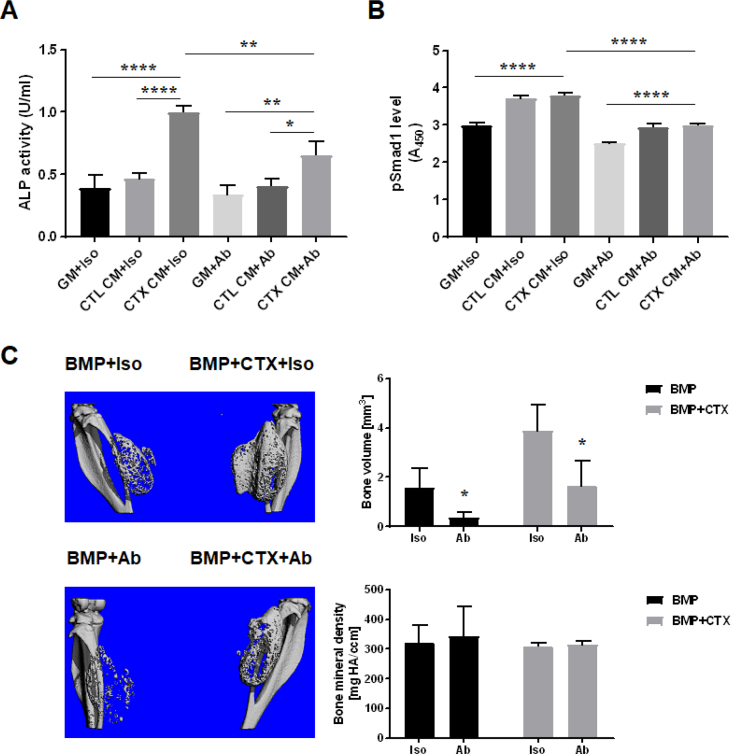
Inhibition of BMP-7 activity suppressed osteogenesis in vitro and reduced HO formation in vivo. (A) Osteogenesis of MDSCs in vitro. ALP activity measured in different groups of cell lysates showed that treatment with BMP-7–neutralizing antibody suppressed the osteogenesis-promoting effect of CTX CM (*, p < 0.05; **, p < 0.01; ****, p < 0.0001; n = 3). Iso: isotype control antibody treatment group; Ab: BMP-7–neutralizing antibody treatment group. (B) BMP signalling in vitro. Phosphorylated Smad1 level in cell lysates measured by pSMAD1 ELISA showed that activation of BMP signalling was inhibited with addition of BMP-7–neutralizing antibody (****, p < 0.0001; n = 3). (C) HO formation in vivo. microCT imaging and analysis showed significant reduction in HO volume upon BMP-7–neutralizing antibody treatment compared with isotype control antibody treatment (*, p < 0.05; n = 4). No significant difference in bone mineral density was found between BMP-7–neutralizing antibody and isotype control antibody treatment groups.
Figure 5
Figure 5
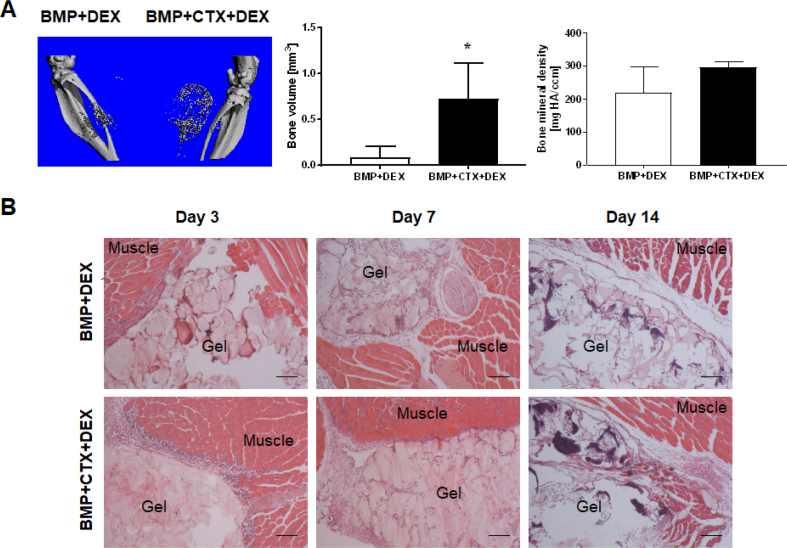
Suppression of inflammation reduced HO volume in vivo. (A) microCT imaging and analysis. Reduction of HO volume and bone mineral density was observed in animals treated with the antiinflammatory drug dexamethasone (DEX) (*, p < 0.05; n = 4). (B) H&E staining illustrating the time course of HO progression in animals treated with antiinflammatory drug. A diminished inflammatory response was found in CTX-injured muscle. Bar = 200 μm.
Figure 6
Figure 6
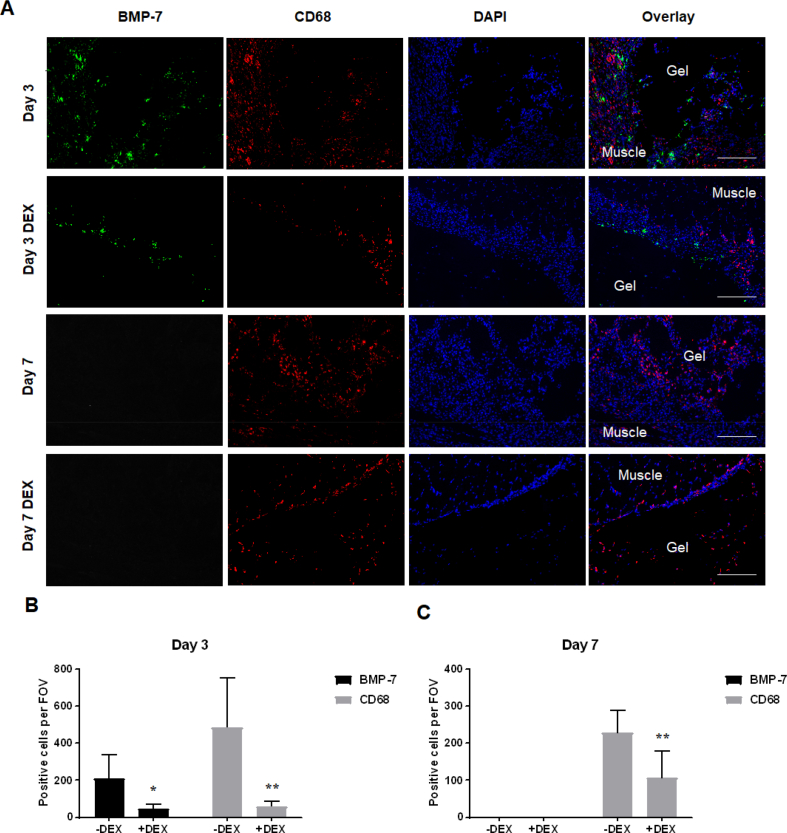
Suppression of inflammation in vivo reduced BMP-7 level in CTX-injured muscle. (A) Immunofluorescence staining showing decreased macrophage number (CD68, red) and reduced BMP-7 level (green) in CTX-injured muscle in animals treated with the antiinflammatory drug dexamethasone (DEX). Bar = 200 μm. (B and C) Quantitative analysis of BMP-7+ and CD68 + cells at the interface of hydrogel scaffold and muscle. BMP-7+ and CD68 + cells were counted on 6 independent fields of view (FOV, 20 × magnification). (B) On Day 3, significant decrease in the number of BMP-7+ and CD68 + cells was observed in dexamethasone-treated animals (*, p < 0.05; **, p < 0.01). (C) On Day 7, significant decrease in the number of CD68 + cells was observed in dexamethasone-treated animals (**, p < 0.01), while BMP-7+ cells were not detected.

References

    1. Shehab D., Elgazzar A.H., Collier B.D. Heterotopic ossification. J Nucl Med. 2002;43(3):346–353. - PubMed
    1. Shore E.M., Xu M., Feldman G.J., Fenstermacher D.A., Cho T.J., Choi I.H. A recurrent mutation in the BMP type I receptor ACVR1 causes inherited and sporadic fibrodysplasia ossificans progressiva. Nat Genet. 2006;38(5):525–527. - PubMed
    1. McCarthy E.F., Sundaram M. Heterotopic ossification: a review. Skeletal Radiol. 2005;34(10):609–619. - PubMed
    1. Pignolo R.J., Shore E.M., Kaplan F.S. Fibrodysplasia ossificans progressiva: clinical and genetic aspects. Orphanet J Rare Dis. 2011;6:80. - PMC - PubMed
    1. van Kuijk A.A., Geurts A.C., van Kuppevelt H.J. Neurogenic heterotopic ossification in spinal cord injury. Spinal Cord. 2002;40(7):313–326. - PubMed