


Sublingual Misoprostol versus Foley catheter for cervical ripening in women with preeclampsia or gestational hypertension: A randomized control trial
- PMID: 31508577
- PMCID: PMC6718879
- DOI: 10.18502/ijrm.v17i7.4863
Sublingual Misoprostol versus Foley catheter for cervical ripening in women with preeclampsia or gestational hypertension: A randomized control trial
Abstract
Background: Delivery is the only definite cure for hypertensive disorders. Therefore, cervical ripening and labor induction are important to achieve favorable outcomes.
Objective: This Randomized Control Trial (RCT) is aimed to compare the effects of sublingual misoprostol and Foley catheter in cervical ripening and labor induction among patients with preeclampsia or gestational hypertension.
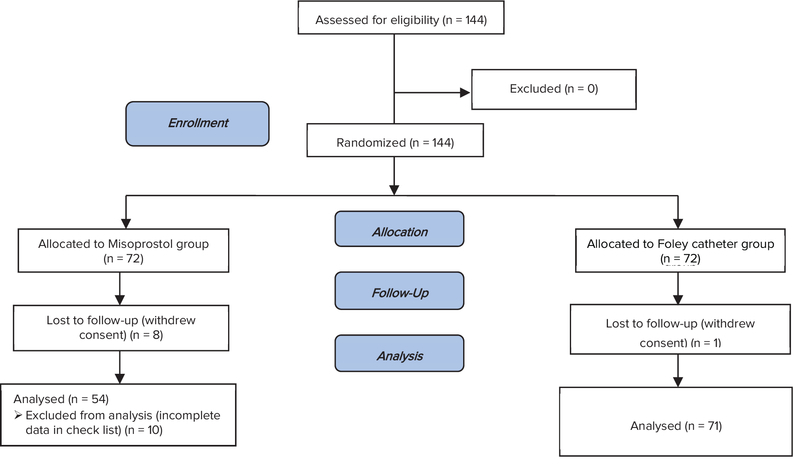
Materials and methods: A total number of 144 women with preeclampsia or gestational hypertention with indication of pregnancy termination, who were referred to academic hospitals of the University of Medical Sciences in Mashhad, Iran, between March 2015 and December 2016, were randomly divided into two groups. In group one (n = 72), 25 µg of misoprostol tablet was administrated sublingually every 4 hr up to six doses. In group two (n = 72), a 16F Foley catheter was placed through the internal cervical os, inflated with 60 cc of sterile saline.
Results: There were no significant differences between groups regarding the demographic characteristics, primary bishop score, and pregnancy termination indication. The cervical ripening time (primary outcome) (8.2 vs 14.2 hr, p 0.00), induction to delivery interval (15.5 vs 19.9 hr, p 0.00), and vaginal delivery before 24 hr (63.9% vs 40%, p = 0.03) were significantly different between the two groups. There was no significant difference between groups in view of oxytocin requirement (p = 0.12), neonatal Apgar score (p = 0.84), or neonatal intensive care unit admission (p = 78).
Conclusion: This trial showed that the application of sublingual misoprostol, compared to the Foley catheter, can reduce cervical ripening period and other parameters related to the duration of vaginal delivery. This misoprostol regimen showed inconsiderable maternal complications.
Keywords: Labor induction; Misoprostol; Pregnancy.; Preeclampsia.
Conflict of interest statement
The authors declare there is no conflict of interests regarding the publication of this manuscript.
Figures
References
-
- Cunningham FG, Leveno KJ, Bloom SL, Spong CY, Dashe JS, Hoffman BL, et al. Williams Obstetrics. 24th Ed. New York: McGraw-Hill Education; 2014.
-
- Chauhan SP, Ananth CV. Induction of labor in the United States: a critical appraisal of appropriateness and reducibility. Semin Perinatol 2012; 36: 336–343. - PubMed
-
- Adeniji AO, Olayemi O, Odukogbe AA. Intravaginal misoprostol versus transcervical Foley catheter in pre-induction cervical ripening. Int J Gynaecol Obstet 2006; 92: 130–132. - PubMed
-
- Adeniji OA, Oladokun A, Olayemi O, Adeniji OI, Odukogbe AA, Ogunbode O, et al. Pre-induction cervical ripening: transcervical foley catheter versus intravaginal misoprostol. J Obstet Gynaecol 2005; 25: 134–139. - PubMed
LinkOut - more resources
Full Text Sources