


The effect of sensation seeking on alcohol use among middle school students: a latent state-trait analysis
- PMID: 31509018
- PMCID: PMC7064400
- DOI: 10.1080/00952990.2019.1660885
The effect of sensation seeking on alcohol use among middle school students: a latent state-trait analysis
Abstract
Background: Sensation seeking has been implicated as a major risk factor for underage alcohol use, however little research into this personality trait has been conducted among children.
Objective: The current study examined if sensation seeking presents as a state or trait in children, and if the state or trait predicted future alcohol use.
Methods: A latent state-trait (LST) analysis was conducted among 552 individuals (54.3% female; age range 8-13; mean age 9.3) to determine the state or trait-based aspects of sensation seeking, and if this state or trait predicted future alcohol use. Sensation seeking behavior and lifetime alcohol use were assessed at four time points using two previously validated measures.
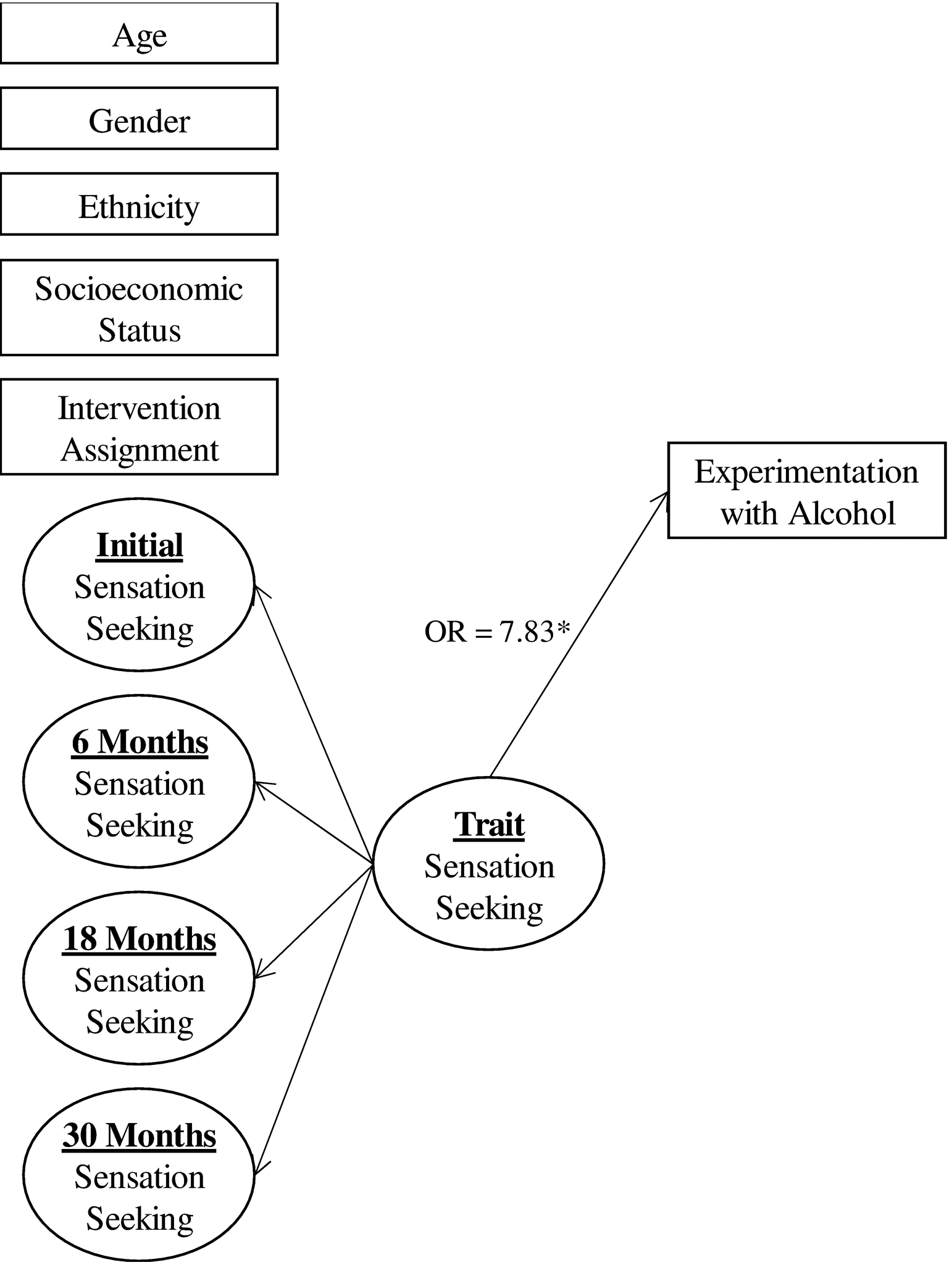
Results: Between 49.4% and 95.3% of individual differences in sensation seeking could be attributed to a stable underlying sensation seeking trait. Further, logistic regression of the stable trait of sensation seeking predicted future alcohol use. A one unit increase in the latent trait increased the odds a student would try alcohol by 7.83 times (95% CI = 1.49-41.11, p = .015). Standardized regression coefficients revealed that an increase of one standard deviation in the latent trait of sensation seeking increased the odds of experimentation with alcohol by 1.29 times (95% CI = 1.11-1.49, p = .001).
Conclusion: Findings suggest sensation seeking presents as a stable trait during childhood, which can cause children to seek out a novel or exciting behaviors such as alcohol use. Future substance use interventions may need to account for the influence of the underlying trait.
Trial registration: ClinicalTrials.gov NCT00787709.
Keywords: Latent state-trait analysis; childhood; early adolescence; sensation seeking; underage alcohol use.
Conflict of interest statement
Disclosure of Interest
The authors report no conflict of interest
Figures
References
-
- Kann L, McManus T, Harris WA, Shanklin SL, Flint KH, Queen B, Lowry R, Chyen D, Whittle L, Thornton J, Lim C, Bradford D, Yamakawa Y, Michelle Leon, Brener N, Ethier KA. Youth Risk Behavior Surveillance — United States, 2017. Atlanta, GA: Centers for Disease Control and Prevention (CDC), 2018;Vol. 76. - PMC - PubMed
-
- McGue M, Iacono WG. The association of early adolescent problem behavior with adult psychopathology. Am J Psychiatry 2005; 162 (6), 1118–1124. - PubMed
-
- Johnston LD, Miech RA, O’Malley PM, Bachman JG, Schulenberg JE, Patrick ME. Monitoring the Future national survey results on drug use, 1975–2017: Overview, key findings on adolescent drug use. 2018.
Publication types
MeSH terms
Associated data
Grants and funding
LinkOut - more resources
Full Text Sources
Medical
