


Antidepressants for Pediatric Patients
Affiliations
- PMID: 31511767
- PMCID: PMC6738970
Item in Clipboard
Antidepressants for Pediatric Patients
Curr Psychiatr.
2019 Sep.
No abstract available
Figures
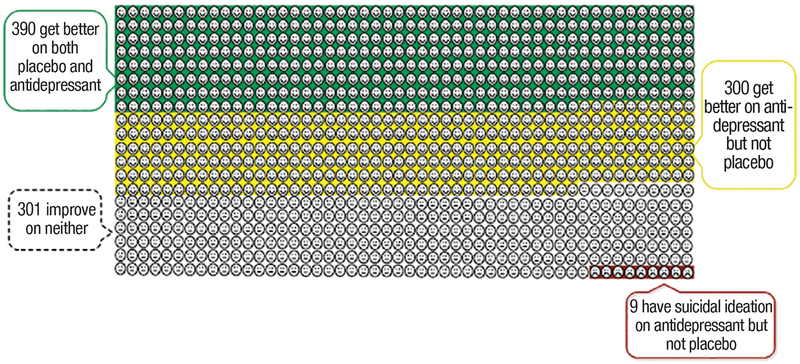
Green faces: Children who will respond to both placebo and
antidepressant Yellow faces: Children who respond to antidepressants but not
placebo White faces: Nonresponders to both medication and placebo Red faces: Children who will experience suicidal ideation on medication
but not placebo Faces covered with an X: Children who will complete suicide on
medication but not placebo Note: There are no faces with Xs because there were no suicides in
randomized controlled trials Source: Based on data from reference
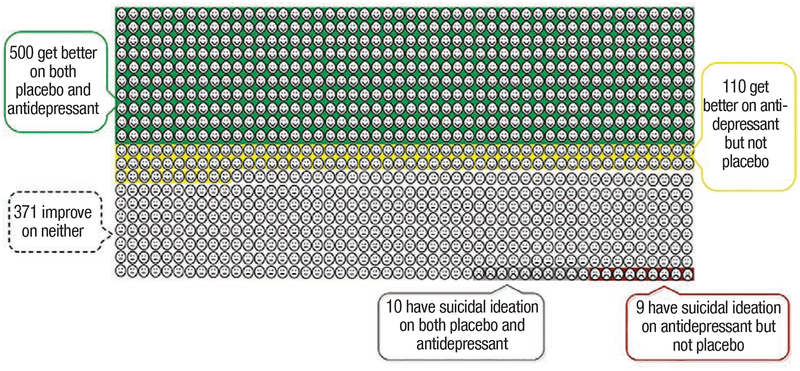
Green faces: Children who will respond to both placebo and
antidepressant Yellow faces: Children who respond to antidepressants but not
placebo White faces: Nonresponders to both medication and placebo Gray faces: Children who will experience suicidal ideation on both
medication and placebo Red faces: Children who will experience suicidal ideation on medication
but not placebo Faces covered with an X: Children who will complete suicide on
medication but not placebo Note: There are no faces with Xs because there were no suicides in
randomized controlled trials Source: Based on data from reference
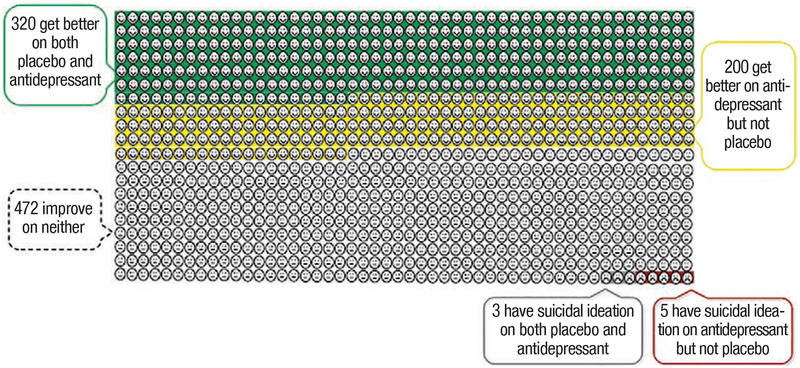
Green faces: Children who will respond to both placebo and
antidepressant Yellow faces: Children who respond to antidepressants but not
placebo White faces: Nonresponders to both medication and placebo Gray faces: Children who will experience suicidal ideation on both
medication and placebo Red faces: Children who will experience suicidal ideation on medication
but not placebo Faces covered with an X: Children who will complete suicide on
medication but not placebo Note: There are no faces with Xs because there were no suicides in
randomized controlled trials Source: Based on data from reference
References
-
- Kessler RC, Avenevoli S, Ries Merikangas K. Mood disorders in children and adolescents: an epidemiologic perspective. Biol Psychiatry. 2001;49(12):1002–1014. - PubMed
-
- Lewinsohn PM, Clarke GN, Seeley JR, et al. Major depression in community adolescents: age at onset, episode duration, and time to recurrence. J Am Acad Child Adolesc Psychiatry. 1994;33(6):809–818. - PubMed
-
- Weissman MM, Wolk S, Goldstein RB, et al. Depressed adolescents grown up. JAMA.1999;281(18):1707–1713. - PubMed
-
- Fergusson DM, Woodward LJ. Mental health, educational, and social role outcomes of adolescents with depression. Arch Gen Psychiatry. 2002;59(3):225–231. - PubMed
Grants and funding
LinkOut - more resources
Full Text Sources