Review
. 2019 Nov;20(11):829-840.
doi: 10.1111/tra.12691. Epub 2019 Sep 12.

Mechanisms of nuclear mRNA export: A structural perspective

Affiliations
Review

Mechanisms of nuclear mRNA export: A structural perspective

Yihu Xie et al. Traffic. 2019 Nov.

Abstract

Export of mRNA from the nucleus to the cytoplasm is a critical process for all eukaryotic gene expression. As mRNA is synthesized, it is packaged with a myriad of RNA-binding proteins to form ribonucleoprotein particles (mRNPs). For each step in the processes of maturation and export, mRNPs must have the correct complement of proteins. Much of the mRNA export pathway revolves around the heterodimeric export receptor yeast Mex67•Mtr2/human NXF1•NXT1, which is recruited to signal the completion of nuclear mRNP assembly, mediates mRNP targeting/translocation through the nuclear pore complex (NPC), and is displaced at the cytoplasmic side of the NPC to release the mRNP into the cytoplasm. Directionality of the transport is governed by at least two DEAD-box ATPases, yeast Sub2/human UAP56 in the nucleus and yeast Dbp5/human DDX19 at the cytoplasmic side of the NPC, which respectively mediate the association and dissociation of Mex67•Mtr2/NXF1•NXT1 onto the mRNP. Here we review recent progress from structural studies of key constituents in different steps of nuclear mRNA export. These findings have laid the foundation for further studies to obtain a comprehensive mechanistic view of the mRNA export pathway.

Keywords: DEAD-box ATPase; export receptor; mRNA export; mRNP remodeling; structural biology.


Conflict of interest statement

Conflicts of interest

The authors have no conflicts of interest to report.

Figures
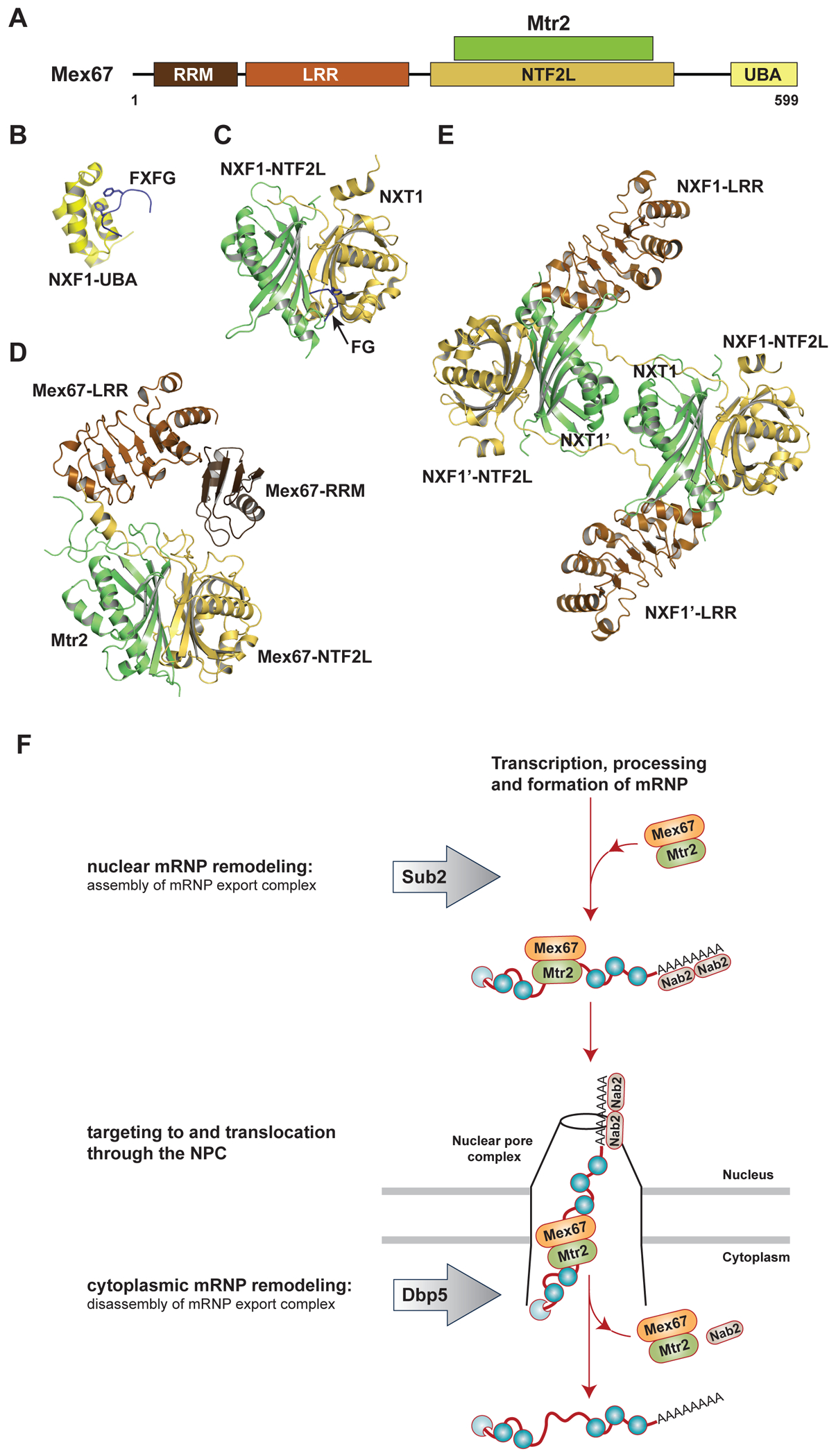
Figure 1.
Figure 1.
Nuclear mRNA export is mediated by the principal export receptor yeast Mex67•Mtr2/ human NXF1•NXT1. (A) Domain schematic of yeast Mex67•Mtr2. (B) Structure of the NXF1-UBA domain bound to a FXFG peptide (PDB ID 1OAI). (C) Structure of the NXF1-NTF2L domain bound to a FG peptide (PDB ID 1JN5). (D) Structure of yeast Mex67 (RRM, LRR, and NTF2L domains) associated with Mtr2 (PDB ID 4WWU). (E) Structure of NXF1 (LRR and NTF2L domains) associated with NXT1 (PDB ID 4WYK). (F) A working model of Mex67•Mtr2 mediated mRNA export. Export is driven by specific alterations of the mRNP protein composition. In the nucleus, Sub2 facilitates the assembly of export-competent mRNPs by recruiting the principal mRNA export receptor Mex67•Mtr2. At the cytoplasmic side of the NPC, Dbp5 mediates disassembly of the export complex by displacing proteins including Mex67•Mtr2 and the poly(A) RNA binding protein Nab2 from the mRNP.
Figure 2.
Figure 2.
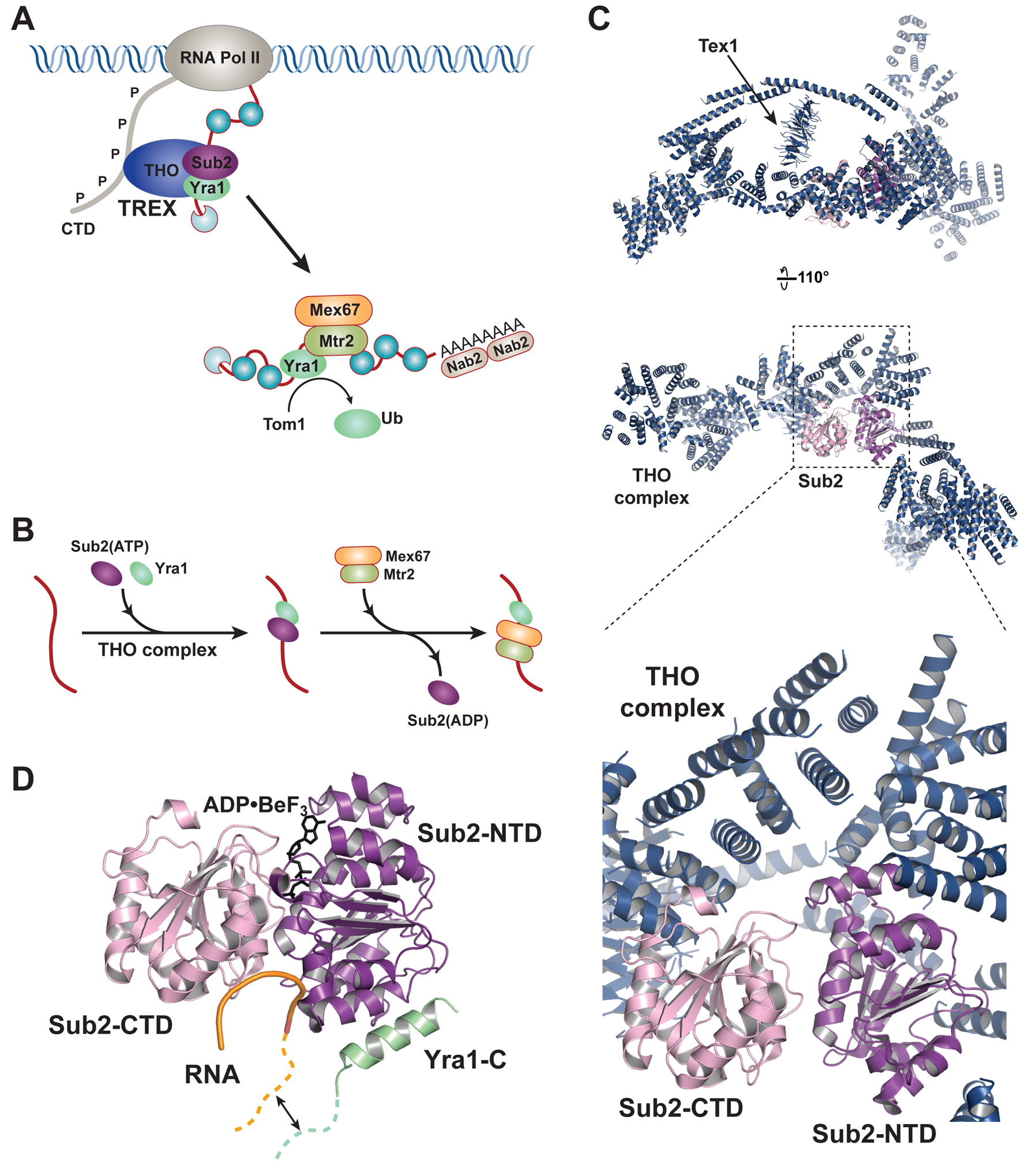
ATPase mediated nuclear mRNP assembly. (A) Yeast TREX complex THO•Sub2•Yra1 travels with RNA Pol II and facilitates loading of the export receptor onto mRNA. (B) A detailed view of the stepwise remodeling reactions driven by the Sub2 ATPase. THO is omitted from the RNA because the dynamics of THO association with mRNA is not known. (C) A 6.0 Å resolution structure of Sub2 bound to a THO core complex which contains S. cerevisiae Tho21–1207, Hpr11–603, Mft11–256, and Thp21–26, as well as S. bayanus Tex11–380 (PDB ID 5SUQ). Top two panels show the overall architecture of the complex. THO is represented by a polyalanine model and only the Tex1 subunit is assigned. The bottom panel highlights the THO-Sub2 binding interface. (D) Structure of Sub2 in association with a truncated Yra1 (Yra1-C, a.a. 208–226) and poly (U) RNA in the presence of ADP•BeF3 (PDB ID 5SUP). The bound RNA is sharply bent, which is characteristic of DEAD-box proteins. The Yra1 region preceding the crystallized fragment is capable of binding RNA (depicted by a green dashed line), and has been proposed to extend the RNA binding site in the Sub2•Yra1 complex.
Figure 3.
Figure 3.
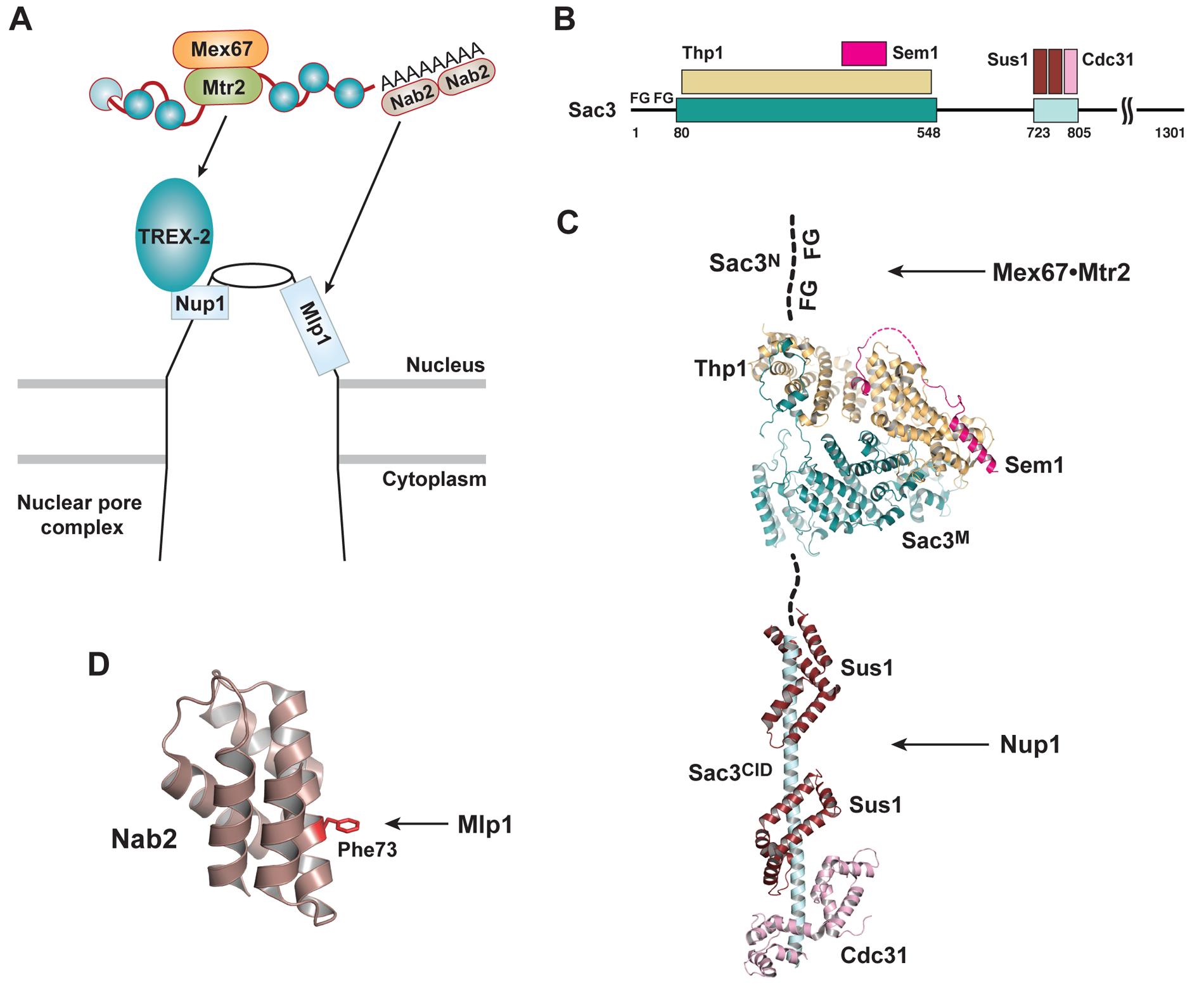
mRNP targeting to the nuclear basket of the NPC in yeast. (A) Schematic of mRNP targeting mediated by the TREX-2 complex and Mlp1 at the nuclear basket of the NPC. (B) Schematic of the TREX-2 complex. (C) Structural basis for the TREX-2 mediated mRNP targeting. TREX-2 complex is built on a scaffold of the Sac3 subunit. The N-terminal region of Sac3 (Sac3N) features FG-repeats that are recognized by the export receptor on mRNP. The middle region of Sac3 (Sac3M) binds to the Thp1 and Sem1 subunits of TREX-2 (PDB ID 5UBP). The C-terminal CID region of Sac3 (Sac3CID) binds to the Sus1 (two copies) and Cdc31 subunits of TREX-2 (PDB ID 3FWC), together mediating NPC association through interaction with the nuclear basket protein Nup1. (D) Structure of the N-terminal Mlp1-binding domain of Nab2 (PDB ID 2V75). The Phe73 residue is critical for the Nab2-Mlp1 interaction.
Figure 4.
Figure 4.
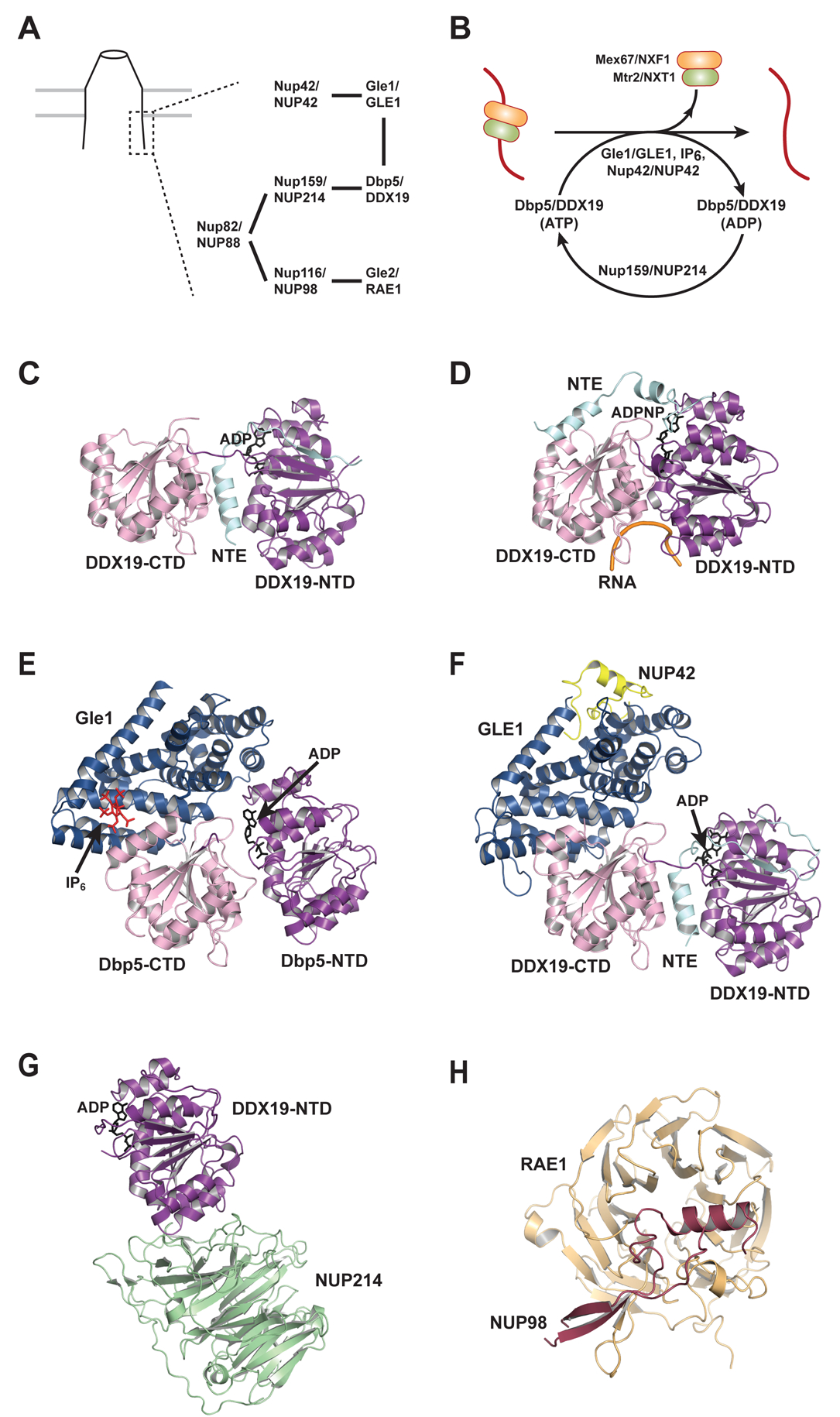
ATPase mediated mRNP remodeling at the cytoplasmic side of the NPC. (A) Schematic diagram of the interaction network of the mRNA export platform at the cytoplasmic side of the NPC. (B) Schematic of Dbp5/DDX19 mediated dissociation of the export receptor from the mRNP, and regulation of the Dbp5/DDX19 catalytic cycle. (C) Structure of DDX19 bound to ADP (PDB ID 3EWS). (D) Structure of DDX19 bound to an ATP-analogue and poly(U) RNA (PDB ID 3G0H). (E) Structure of the Dbp5•Gle1•IP6 complex in the presence of ADP (PDB ID 3RRN). (F) Structure of the DDX19•GLE1•NUP42 complex in the presence of ADP (PDB ID 6B4I). (G) Structure of the DDX19-NTD•NUP214 complex in the presence of ADP (PDB ID 3FMO). (H) Structure of RAE1 in complex with a NUP98 fragment (PDB ID 3MMY).

References

    1. Kohler A, Hurt E. Exporting RNA from the nucleus to the cytoplasm. Nat Rev Mol Cell Biol. 2007;8(10):761–773. - PubMed
    1. Wente SR, Rout MP. The nuclear pore complex and nuclear transport. Cold Spring Harb Perspect Biol. 2010;2(10):a000562. - PMC - PubMed
    1. Terry LJ, Wente SR. Flexible gates: dynamic topologies and functions for FG nucleoporins in nucleocytoplasmic transport. Eukaryot Cell. 2009;8(12):1814–1827. - PMC - PubMed
    1. Smith A, Brownawell A, Macara IG. Nuclear import of Ran is mediated by the transport factor NTF2. Current Biology. 1998;8(25):1403–1406. - PubMed
    1. Stewart M Ran in Nucleocytoplasmic Transport Ras Superfamily Small G Proteins: Biology and Mechanisms 2: Springer, Cham; 2014:109–124.

Publication types